EU digital catch rules: Key notes for seafood exporters
19:05 | 23/03/2025 14:47 | 24/02/2026Trade
The EU rolls out CATCH and revised catch certificates from 2026, adding mandatory digital submission and new control requirements for seafood exports.


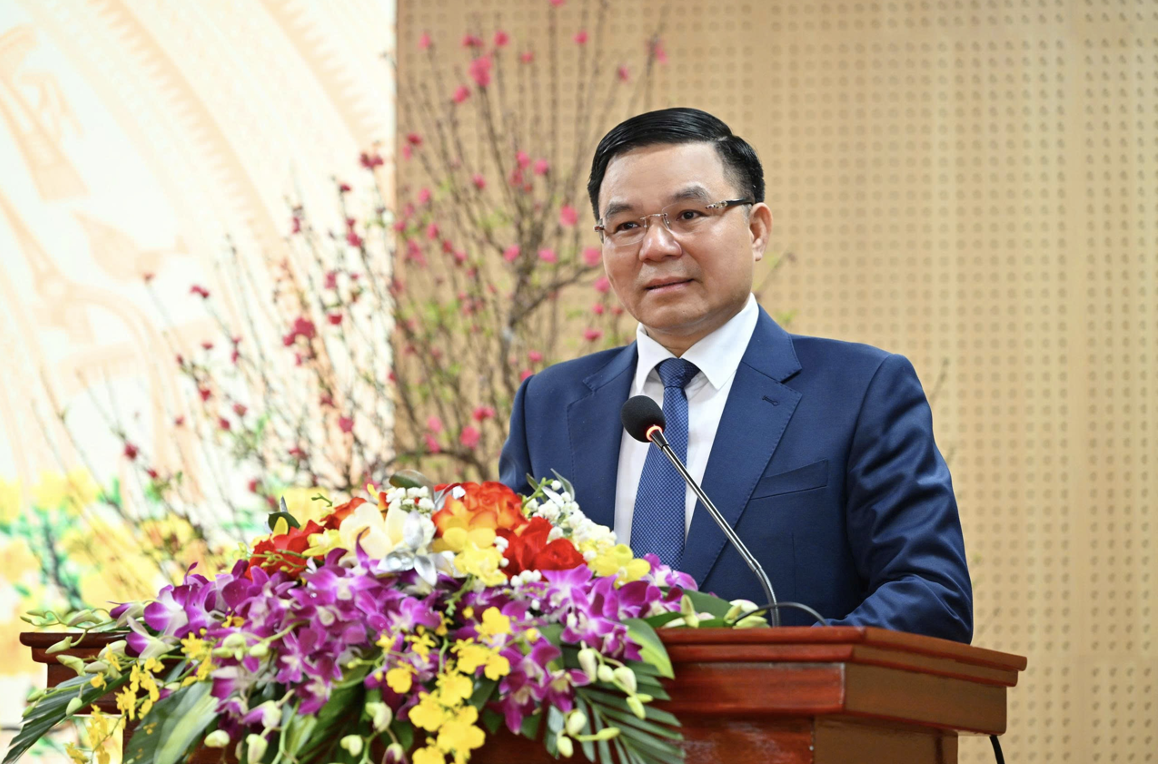
On the afternoon of January 21, on behalf of the Party Committee of the Ministry of Finance, Nguyen Van Thang, Secretary of the Party Committee and Minister of Finance, delivered a presentation at the 14th National Party Congress, expressing strong consensus with the draft documents submitted to the Congress. At the same time, in order to further clarify strategic breakthrough solutions in institutional improvement aimed at unlocking all resources for national development, he presented a thematic paper entitled “Improving institutions and laws on mobilising and using financial resources to meet the requirements of rapid and sustainable national development.”
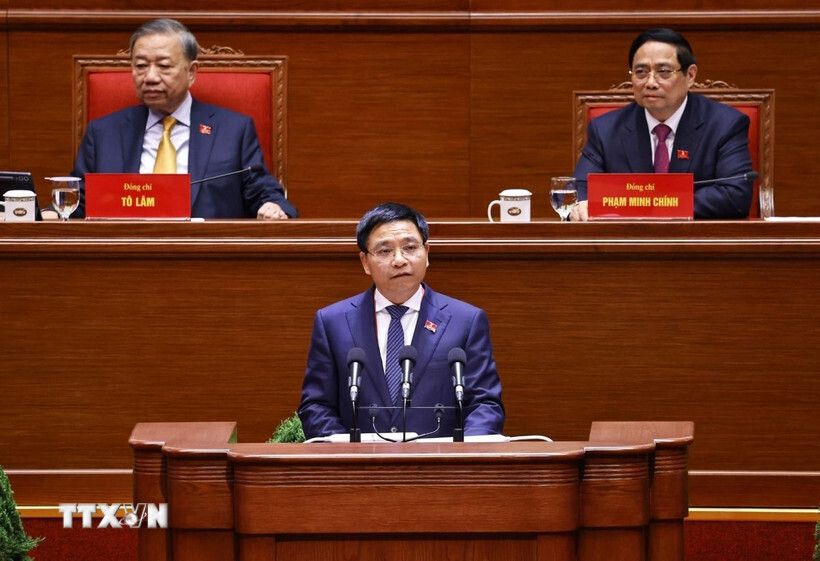
Secretary of the Party Committee and Minister of Finance Nguyen Van Thag deliveres a presentation at the 14th National Party Congress. Photo: VNA.
Major objectives
According to Minister Nguyen Van Thang, the 13th National Party Congress continued to identify institutional reform as one of the three strategic breakthroughs, while emphasising the role of institutional improvement in shaping national development. Specifically, it stressed the need to “continue to strongly renew thinking, build and synchronously improve institutions for sustainable development in economic, political, cultural, social and environmental fields; promptly remove difficulties and bottlenecks; unleash all potential and resources, and create new drivers for the country’s rapid and sustainable development.”
Resolution No. 66-NQ/TW of the Politburo further underscored that law-making and law enforcement constitute the “breakthrough of breakthroughs,” a key task that must move one step ahead to pave the way for national development in the new era.
Thoroughly grasping the Party’s directives, the Party Committee of the Ministry of Finance has led the entire sector in renewing thinking, concentrating the highest level of resources, and creating strong and comprehensive changes in institutional development and improvement. The Ministry of Finance has advised the Government and submitted to the Politburo Resolution No. 68-NQ/TW on private economic development and Resolution No. 79-NQ/TW on state economic development. It has also submitted and issued, within its authority, 929 legal normative documents, including 65 laws and National Assembly resolutions, to remove bottlenecks, meet new development requirements, enhance economic competitiveness, and focus on three key areas, as follows:
First, creating a favourable investment and business environment and unlocking all social resources to improve capital efficiency through fundamental revisions of laws on investment, enterprises, state capital management and planning. This includes maximising the reduction of business conditions, delegating greater autonomy to localities and enterprises, ensuring the principle that enterprises may do anything not prohibited by law, reforming and simplifying administrative procedures, modernising management to enhance state management efficiency, reducing time and costs, and creating maximum convenience for people and businesses. Efforts are also made to resolve long-standing stalled projects and to build legal corridors for new economic models such as free trade zones and new-generation industrial parks.
Second, mobilising, managing and effectively using national financial resources. The Ministry has advised on improving the legal framework on taxation in a simplified and modern direction consistent with international practices, shifting tax administration thinking from “management” to “service,” associated with comprehensive digital transformation and the application of artificial intelligence. Through these measures, the State budget has mobilised the largest volume of resources ever, while maximising tax and fee exemptions, reductions, extensions and deferrals to support businesses in overcoming post-Covid-19 difficulties, nurturing revenue sources, and orienting the development of priority sectors, economic restructuring and growth model renewal, striving to raise the digital economy to at least 30% of GDP by 2030 in line with Politburo Resolution 57.
In expenditure management, the legal framework on the state budget, public investment, bidding and public debt has been revised in connection with state budget restructuring, promoting the guiding role of national financial resources, stimulating social investment, drastically cutting recurrent spending, and increasing resources for development investment and social welfare. Investment is focused on key and breakthrough infrastructure projects, decentralisation and delegation of authority are strengthened, and administrative procedures are minimised to enhance capital efficiency. Economic recovery programmes have been implemented to counter post-pandemic recession.
Third, developing the capital market and creating a framework for new economic models by proactively building a synchronous legal framework aligned with contemporary development trends. New economic models such as international financial centres, stock market development, pilot markets for tokenised assets, free trade zones, new-generation industrial parks and tax investment incentives are promoted to attract high-quality foreign investment while enhancing internal economic capacity for rapid and sustainable development, closely linked with green and digital transitions. Controlled regulatory sandboxes are established to ensure the safe and transparent development of new business models.
Under the Party’s leadership, the engagement of the entire political system from central to local levels, and the support of the people and business community, financial and budgetary institutions have contributed to outstanding economic and fiscal achievements, as reflected in reports submitted to the Congress. Notable results include a 37.6% increase in registered enterprise capital compared to the beginning of the term; total state budget revenue for the period estimated at nearly VND 9.9 quadrillion, exceeding targets and 1.4 times higher than the previous period; total public investment of approximately VND 3.4 quadrillion, up nearly 55%; an upgraded stock market with market capitalisation about 1.9 times higher than at the beginning of 2020; and the establishment and operation of international financial centres and new-generation free trade zones.
Alongside these achievements, with a spirit of self-review and correction, the Party Committee of the Ministry of Finance candidly acknowledged remaining bottlenecks requiring further improvement. These include the need for financial and budgetary laws to better keep pace with the practical demands of the scientific and technological revolution; uneven policy implementation capacity with some issues resolved slowly and capital efficiency still limited; and a capital market whose scale remains inconsistent with its potential and has yet to truly become a medium- and long-term capital mobilisation channel for the economy.
Improving institutions to create space for growth
The 2026 - 2030 period is identified as a phase of acceleration and breakthrough, marking Vietnam’s entry into a new era to realise the aspiration of becoming a high-income developed country by 2045. Minister Nguyen Van Thang affirmed the strong consensus of the Party Committee of the Ministry of Finance with the goals, vision, orientations and key tasks for 2026 - 2030 outlined in the draft resolution, particularly the target of average GDP growth of 10% per year or higher, while ensuring sustainable development, GDP per capita of about USD 8,500 by 2030, and total social investment of around 40% of GDP.
To realise these objectives, the draft resolution identifies the task of “focusing on comprehensively and synchronously improving institutions for rapid and sustainable national development, with economic institutions at the core.” This serves as a mandate for the finance sector to further renew thinking, approaches and actions in institutional development and improvement, and to use financial resources more effectively to meet the requirements of rapid and sustainable development.
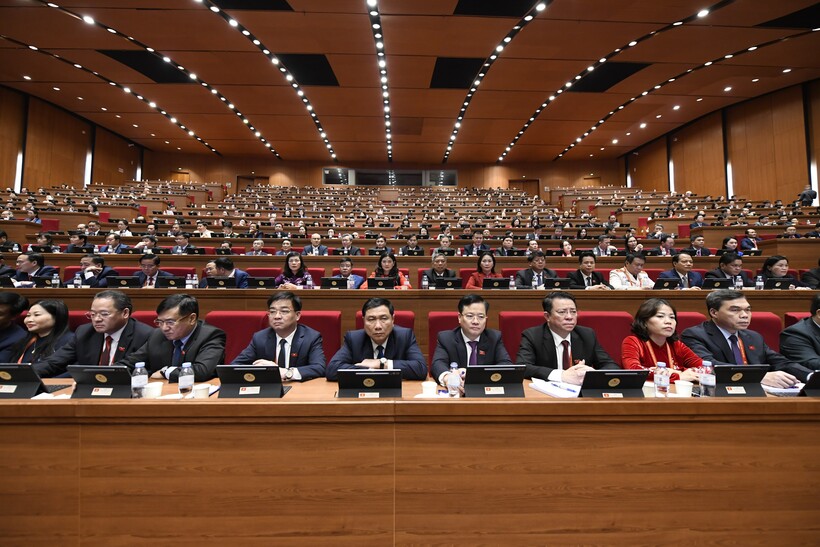
Overview of the 14th National Party Congress. Photo: VNA.
First, promptly advise the issuance of all guiding documents for newly adopted laws and resolutions passed by the National Assembly within the first quarter of 2026, strictly in line with the direction of the Party General Secretary, in order to bring the Party’s breakthrough guidelines and policies into practice as swiftly as possible.
Second, timely advise on the institutionalization and effective implementation of the Party’s resolutions on the development of economic sectors. Translate the aspiration for development into concrete actions and tangible outcomes; accelerate the restructuring of governance and capital at state-owned enterprises; improve operational efficiency, particularly in project investment, to ensure their leading role while safeguarding financial effectiveness.
Affirm and further promote the leading role of the state economy, while developing the private sector to truly become the most important driving force of the economy; adopt policies to support development and market expansion for the collective economy and cooperatives. Attract and effectively utilize foreign investment flows, thereby building and consolidating a resilient development foundation capable of withstanding and adapting more effectively to global and regional fluctuations, enhancing strategic autonomy and the overall strength of the country in the new era.
Third, continue to refine and implement an expansionary fiscal policy with clear focus and priorities; ensure close and harmonious coordination with monetary policy and other policies, with the dual objective of achieving high growth while safeguarding national financial security and safety, maintaining macroeconomic stability, and further restructuring public investment to enhance efficiency.Concentrate resources on breakthrough projects that can shift development trajectories and reverse adverse situations; firmly apply economic cost–benefit accounting in the selection and implementation of each project. Ensure that nationwide there are no more than 3,000 projects funded by the central budget, thereby attracting and leveraging investment resources from other economic sectors.
Fourth, develop a deep, modern and integrated stock market, making it the primary channel for mobilizing medium- and long-term capital for the economy. Establish mechanisms and policies to effectively attract international investment funds. Continue to improve the legal framework to foster new economic models and financial products, such as the knowledge economy, circular economy, carbon markets, green bonds and tokenized assets.
Fifth, regularly review and comprehensively assess the effectiveness of issued policies in order to promptly refine them in line with development requirements; decisively remove bottlenecks; effectively implement planning with a long-term, integrated vision, strengthen regional and sectoral linkages; apply end-to-end digitalization in public financial services, minimize administrative procedures and unreasonable business conditions, and ensure a transparent, fair and competitive environment to create new development momentum. Form key economic regions, growth poles, and a new generation of special economic zones on par with regional and global standards.
Sixth, continue to strengthen policy communication, dissemination and legal enforcement to bring policies into real life, build consensus among the public and the business community, closely link law-making with law enforcement, and reinforce discipline in policy implementation.
According to Secretary of the Party Committee, Minister of Finance Nguyen Van Thang, to successfully realise the strategic goals of the 14th National Party Congress, the Party Committee of the Ministry of Finance commits to the highest level of political determination, continuous efforts, collective wisdom, unity and innovation in institutional development and law enforcement, with the aim of building a stable and coherent financial and budgetary policy system.
19:05 | 23/03/2025 14:47 | 24/02/2026Trade
19:05 | 23/03/2025 14:47 | 24/02/2026Cooperation

19:05 | 23/03/2025 14:45 | 24/02/2026Trade
19:05 | 23/03/2025 14:44 | 24/02/2026News and Events

19:05 | 23/03/2025 20:40 | 23/02/2026Trade