International media have widely praised Vietnam’s economic performance, noting that the country sustained strong growth momentum in 2025 and is increasingly standing out as one of the region’s bright spots.
Vietnam’s Rising economic standing
In January 2026, a range of international outlets published upbeat assessments of Vietnam’s economy, highlighting its 2025 growth results and the underlying drivers behind this performance.
According to the UK-based Reuters, Vietnam recorded GDP growth of 8% in 2025, higher than the previous year, underscoring its notable resilience and expansion capacity. The country continues to be identified as a key link in global supply chains, particularly for electronics, textiles, and footwear.
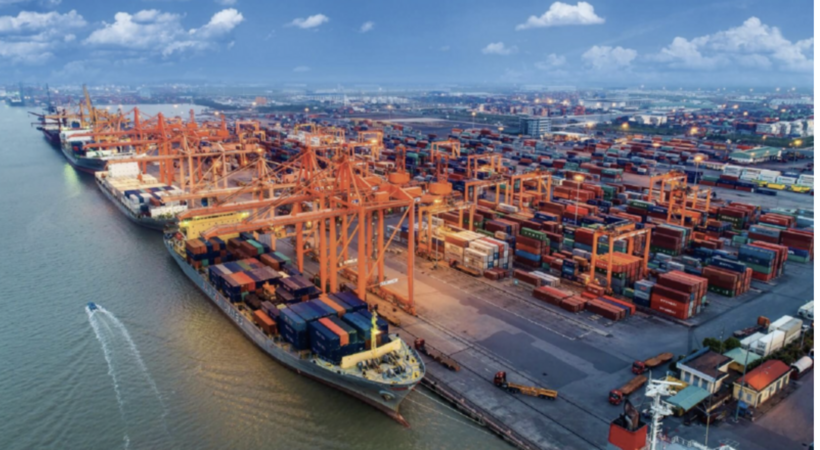
International media outlets issued broadly optimistic assessments of Vietnam’s economy in early 2026. Illustrative image
The presence of multinational corporations such as Samsung, Apple, and Nike, with production and assembly in Vietnam serving major export markets, reflects the country’s increasingly visible role in international manufacturing networks. Reuters also emphasized that 2025 growth was supported by domestic consumption and public infrastructure spending, pointing to efforts to rebalance the growth model toward greater sustainability.
Bloomberg described Vietnam’s economy as outperforming forecasts thanks to simultaneous improvements in manufacturing, investment, and trade. Credit policies, government support, a weaker currency, and a strong recovery in tourism were cited as factors reinforcing Vietnam’s position as one of the world’s fastest-growing economies.
AFP continued to label Vietnam an Asian “success story,” noting that the economy maintained solid growth despite risks stemming from new U.S. tariff measures. According to AFP, this resilience is rooted in domestic consumption, business investment, and public spending, reflecting a strong foundation and a policy orientation supportive of the private sector.
Regional commentary echoed similar views. Singapore’s The Business Times noted that the 8% growth rate in 2025 marked Vietnam’s second-fastest pace in 15 years, while Free Malaysia Today described the result as a useful benchmark for many Asian economies.
These analyses point to four interlinked drivers behind Vietnam’s performance: exports as a core pillar; global production shifts positioning Vietnam as a new manufacturing hub; a marked rise in domestic demand, particularly household consumption and investment; and policy adaptability in the face of external shocks, supporting market and sector diversification.
The McGill International Review (Canada) on January 17 broadened the perspective by placing Vietnam’s growth within its longer development trajectory. The article highlighted the country’s mixed economic model, combining state involvement with a flexible external orientation, which has delivered tangible outcomes: a sharp reduction in poverty since 1990, a near 50% increase in the Human Development Index, and Vietnam’s entry into the group of countries with high human development. Growth rates of 7-10% were compared to those of the Asian Tigers during their industrialization phases, reinforcing the argument that Vietnam is emerging as a strong regional contender.
China’s China Daily on January 19 underscored the watershed nature of Vietnam’s more-than-8% growth in 2025, viewing it as a milestone that positions the country as a standout amid global volatility. Exports, FDI, infrastructure investment, and consumption-stimulus strategies were identified as key foundations. The article also cautioned that the full impact of tariffs on exports may become clearer in 2026, requiring flexible policy adjustments, including market diversification and stronger trade ties with partners such as China.
Strategic advantages and long-term outlook
Another major theme in international coverage is Vietnam’s potential to overtake Thailand in nominal GDP size. Japan’s Nikkei Asia on January 5 reported that Vietnam could approach this threshold in 2026, driven by large-scale public works projects boosting growth.
Forecasts suggest Vietnam’s nominal GDP could reach around USD 500–600 billion in the 2026–2027 period, with per capita GDP surpassing USD 5,000. Thailand Business News described this shift as a historic moment, reflecting Vietnam’s manufacturing surge alongside Thailand’s structural challenges. The Bangkok Post referred to Vietnam as a “rising star,” citing growing foreign investment inflows, including from Thai companies.
Analysts point to several fundamental drivers of rapid growth: the Đổi Mới reforms launched in 1986 that opened the door to private enterprise and global integration; policy stability that builds investor confidence; priorities in industrial upgrading, infrastructure, and human capital; and demographic advantages stemming from a young and abundant workforce. Ambitions to become a hub for high-tech and semiconductor manufacturing, coupled with heavy investment in roads, ports, and airports, are seen as pillars of long-term growth while also supporting a strongly recovering tourism sector.
Fastbull (Hong Kong-China) observed that Vietnam entered 2026 with a dual advantage in global supply chains: serving both as a stable manufacturing base and as an alternative destination in diversification away from China.
FDI continues to flow into electronics, industrial components, and green manufacturing, enhancing technological and managerial capacity. S&P Global reinforced this outlook, reporting Vietnam’s manufacturing PMI at 53.0 at the end of 2025, signaling clear improvements in business conditions and corporate confidence. Despite ongoing challenges related to costs and supply, the 2026 outlook remains positive, with industrial output projected to grow by 6.7%.
Tourism also stands out as a key highlight. The South China Morning Post reported a sharp increase in Chinese visitors to Vietnam in 2025, helping lift total international arrivals to around 21.2 million. Eased visa policies and promotional measures supported growth from multiple markets, pushing tourism revenue above VND 1 quadrillion. The United Nations has ranked Vietnam among the world’s fastest-growing destinations, alongside several major economies.
FDI Intelligence (UK) cited Vietnam as a textbook example of Asia’s FDI “formula,” grounded in consistent governance, transparent regulations, effective infrastructure, and a competitive workforce. Moves by Intel and Google, reported by MENAFN and Nation Thailand, reflect a broader trend of global technology firms expanding or relocating production to Vietnam. Italy’s D’Andrea Partners assessed the 2026 FDI outlook as cautiously optimistic, with high-tech, semiconductors, renewable energy, logistics, and digital services offering clear growth potential.
Taken together, these international assessments suggest Vietnam is entering a decisive phase in shaping its regional economic standing. The achievements of 2025 are widely viewed not as a short-term phenomenon, but as the outcome of a long-term positioning strategy, one that lays the groundwork for Vietnam’s ambition to become an upper-middle-income economy in the coming decade.
Technology innovation, resource and energy efficiency, and emissions reduction are becoming key priorities in many local industrial extension programs. From machinery support to the development of cleaner production models, industrial extension policies are helping bring sustainable production and consumption goals closer to rural industrial establishments.
The Grand Ho Tram has been named “Best Integrated Resort” at the 35th TTG Travel Awards 2026, marking its second consecutive win at the Asia-Pacific travel and hospitality awards.
New cooperation initiatives on grid digitalization, battery energy storage systems (BESS), technical capacity building and applications at power utilities are helping lay the groundwork for modernizing Viet Nam’s power system while strengthening knowledge sharing across Southeast Asia.
Northern localities are strengthening links in supporting industries, energy and logistics to build competitive value chains and create new growth drivers.
As Vietnam attracts growing manufacturing investment, companies are placing greater emphasis on operational readiness to ensure new factories can begin production efficiently.