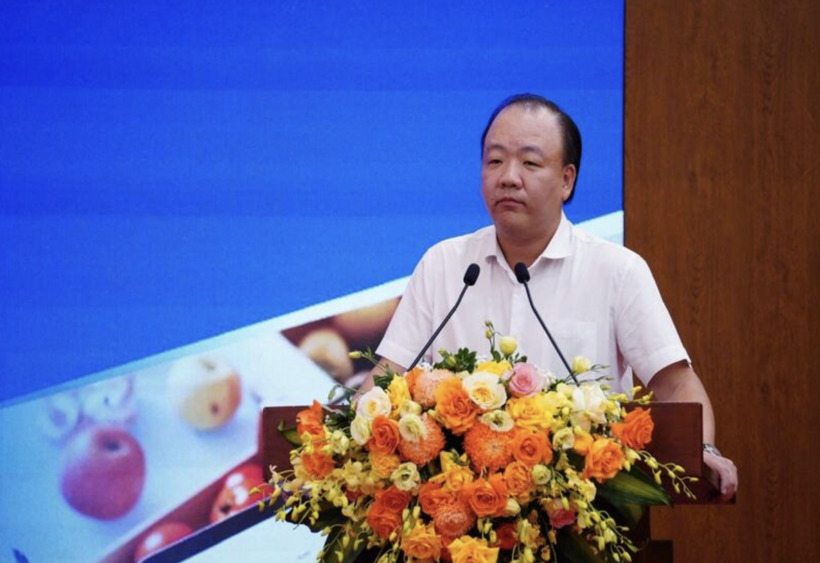
Tran Huu Linh, Director of the Agency for Domestic Market Management and Development, explained the recent shift to more flexible, daily fuel price adjustments.
Flexible management aligned with global price movements
Amid strong volatility in the global energy market, Vietnam’s domestic fuel price management has been carried out in a more flexible manner in order to closely follow developments in international markets while ensuring stable supply and demand at home.
According to Tran Huu Linh, Director of the Agency for Domestic Market Management and Development under the Ministry of Industry and Trade, fuel prices in Vietnam were previously adjusted on a weekly basis, typically on Thursdays. The adjustment was calculated based on the reference price of global petroleum products during the period between two consecutive adjustment cycles.
Tran Huu Linh shares insights on recent fuel price management. Photo: Can Dung
However, as the conflict in the Middle East has caused global oil prices to fluctuate sharply, rising and falling suddenly by the day, or even by the hour the fixed-cycle management mechanism has revealed certain limitations.
In response to this situation, the Ministry of Industry and Trade reported to the Government and received approval from Prime Minister Pham Minh Chinh to adopt a more flexible price management mechanism under Resolution No. 36/NQ-CP dated March 6, 2026, on the Government’s regular meeting for February 2026.
Under the resolution, if global fuel prices experience abnormal fluctuations of more than 7 percent, authorities may consider adjusting domestic prices earlier, even on a daily basis. At the same time, the fuel price stabilization fund may be utilized to mitigate impacts on the market.
In practice, thanks to this flexible management mechanism together with the use of the price stabilization fund around VND 4.000 per liter for gasoline and VND 5.000 per liter for diesel domestic fuel prices have gradually stabilized in recent days.
Specifically, in the latest price adjustment effective from 10p.m. on March 12, the price of E5RON92 gasoline decreased by VND447 per liter to no more than VND 22.504 per liter, while RON95-III gasoline increased by VND 335 per liter to no more than VND 25.575 per liter.
The price of diesel 0.05S rose by VND 555 per liter to no more than VND 27.025 per liter; kerosene increased by VND 2.513 per liter to no more than VND26.932 per liter; and mazut 180CST 3.5S decreased by VND 340 per kilogram to no more than VND 18.661 per kilogram.
These measures not only help keep domestic prices aligned with global market developments but also encourage businesses to proactively import fuel supplies while reducing public concerns and hoarding behavior.
Linh also noted that fuel imports typically involve a certain time lag, usually around three to four days. Therefore, domestic price management must still be based on reference prices from preceding days. This principle is essential to ensure that price management both reflects global market trends and remains consistent with the operational realities of the domestic market.
“In practice, there are times when people see domestic fuel prices remaining high even though global prices on that particular day have declined. The reason is that domestic price adjustments must be based on reference prices from previous days within the calculation cycle. Therefore, if global prices were high during those earlier days, domestic prices at the time of adjustment may still remain elevated. Conversely, when global prices decline, consumers will benefit from that downward trend in subsequent days,” he said.
Flexible price management in line with market developments will allow domestic fuel prices to better reflect fluctuations in global markets. Authorities also hope that businesses and the public will better understand the current price management mechanism, which is considered a timely and necessary solution amid the ongoing volatility in global energy markets.
Notably, before the current disbursement, the fuel price stabilization fund still held more than VND 5.6 trillion. With spending levels of VND 4.000 per liter of gasoline and VND 5.000 per liter of diesel, the fund would only be able to support price stabilization for about 15 days if the current level of disbursement continues.
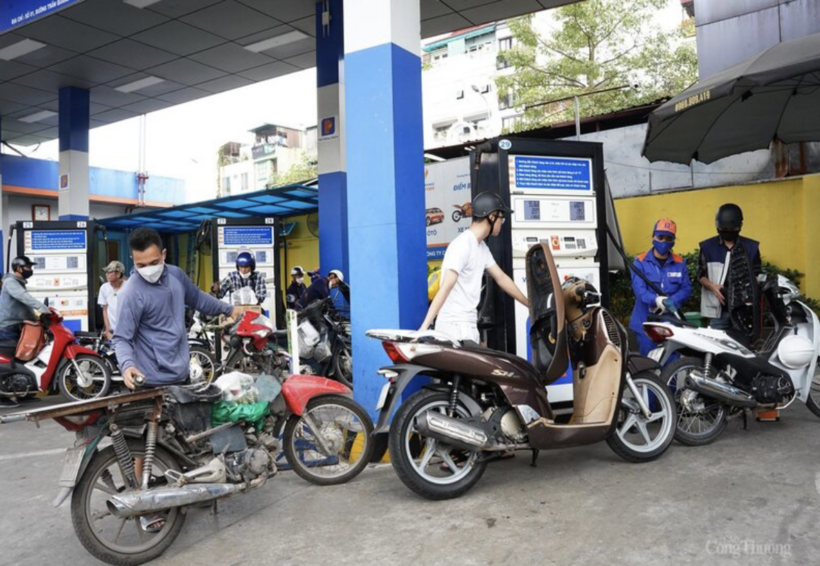
The fuel price stabilization fund is currently being used at VND 4.000 - 5.000 per liter of gasoline and diesel. Photo: Can Dung
Therefore, the Ministry of Industry and Trade is coordinating with the Ministry of Finance to develop proposals for submission to the Prime Minister, including the possibility of advance funding or allocating contingency resources should global oil prices continue to fluctuate unpredictably.
At the same time, the two ministries are studying proposals for the Government to report to the National Assembly Standing Committee on a potential reduction in environmental protection tax on petroleum products, thereby providing an additional fiscal tool to help stabilize the market.
Strengthening fuel reserves to ensure energy security
In addition to price management, improving the country’s fuel reserve capacity is also being considered an urgent requirement to enhance the ability to respond to volatility in the global energy market. This is also seen as an important lesson for developing long-term solutions to strengthen reserves, diversify supply sources, and improve resilience against market shocks.
At a recent meeting of the task force on energy security in response to the complicated developments of the military conflict in the Middle East, Prime Minister Pham Minh Chinh instructed ministries and agencies to urgently develop new plans for petroleum reserves to ensure energy security, particularly in the context of unpredictable global market fluctuations.
The reserve plan is being considered based on several key pillars.
The first is national reserves. Authorities are expected to consider expanding the storage infrastructure while strengthening resources for national reserves, including mobilizing the participation of fuel producers and state-owned petroleum trading enterprises.
The second is commercial reserves. Under current regulations, key petroleum wholesalers must maintain minimum reserves equivalent to 20 days of supply, while distributors are required to maintain reserves sufficient for five days of supply. In the coming period, alongside the completion of new regulations under the decree governing petroleum trading, authorities will intensify inspections and supervision to ensure enterprises strictly comply with commercial reserve requirements.
In addition, authorities are also studying other reserve solutions, including proactively securing supply sources on the international market. The objective is to ensure sufficient crude oil and input materials for domestic fuel production should disruptions or conflicts occur in the global energy market.
These coordinated measures from flexible price management to strengthened reserve capacity are expected to help maintain stability in Vietnam’s domestic fuel market while improving the economy’s ability to respond to unpredictable developments in the global energy market.
On April 24, Prime Minister Le Minh Hung chaired a nationwide conference on accelerating the allocation and disbursement of public investment capital in 2026.
International media highlight Vietnam’s strong growth, rising FDI, market upgrades and tourism appeal, reinforcing its growing role and global standing today.
The Ministry of Industry and Trade (MoIT) held trade promotion activities in Yunnan and Shandong, boosting business links, exports, and investment cooperation between Vietnam and China.
A prestigious international award and a two-million-guest milestone mark a strategic evolution, highlighting the success of the entertainment-led integrated resort model in the regional hospitality market.
On April 24, Prime Minister Le Minh Hung chaired a nationwide conference on accelerating the allocation and disbursement of public investment capital in 2026.
A prestigious international award and a two-million-guest milestone mark a strategic evolution, highlighting the success of the entertainment-led integrated resort model in the regional hospitality market.
Permanent Deputy Prime Minister Pham Gia Tuc urged Hyundai Rotem to expand cooperation, technology transfer, and participation in Vietnam’s railway projects.
Prime Minister Le Minh Hung and President Lee Jae Myung led a Vietnam - the Republic of Korea (RoK) business roundtable in Hanoi, calling for deeper high tech cooperation.