The 2026 - 2030 period is seen as the start of a new era, marking a strategic shift and laying foundations for national development toward the mid-21st century.
On February 7 in Hanoi, within the framework of the National Conference on studying, learning, thoroughly grasping and implementing the Resolution of the 14th National Congress, Politburo member and Director of the Ho Chi Minh National Academy of Politics Doan Minh Huan presented a thematic report entitled: “Outline for the Summary of 100 Years of the Party’s Leadership of the Vietnamese Revolution (1930 - 2030), Orientations for National Development Leadership in the Next 100 Years (2030 - 2130), and the Summary of 40 Years of Implementing the Platform for National Construction in the Transitional Period toward Socialism (1991 - 2031).”
Shaping a development model for the future
At the outset of his presentation, Doan Minh Huan recalled the guiding spirit articulated by General Secretary of the Communist Party of Vietnam To Lam at the closing session of the 14th National Congress. With strategic vision, the Congress assigned the 14th-term Party Central Committee two particularly important review tasks: a summary of 40 years of implementing the Platform for National Construction in the transitional period toward socialism, and a comprehensive review of 100 years of the Communist Party of Vietnam’s leadership of the Vietnamese revolution (1930 - 2030), together with orientations for national development leadership in the subsequent century (2030 - 2130).
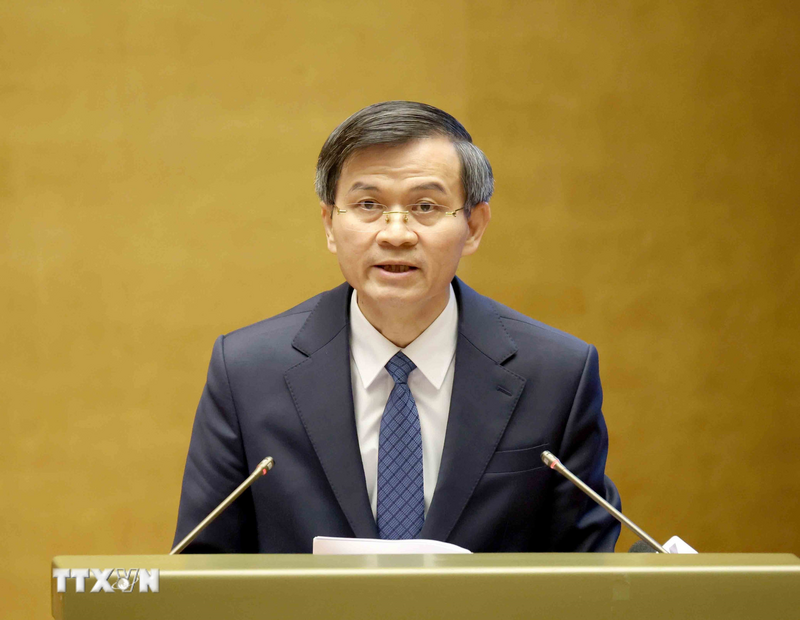
Politburo member and Director of the Ho Chi Minh National Academy of Politics Doan Minh Huan presents the thematic report titled “Outline for the Summary of 100 Years of the Party’s Leadership of the Vietnamese Revolution (1930 - 2030), Orientations for National Development Leadership in the Next 100 Years (2030 - 2130), and the Summary of 40 Years of Implementing the Platform for National Construction in the Transitional Period toward Socialism.” Photo: VNA
Implementing this mandate, the Politburo, the Secretariat and the General Secretary provided close and urgent leadership and direction to ensure the prompt completion of the outline for submission to the conference.
Regarding the summary of 100 years of Party leadership and the orientations for the next century, Doan Minh Huan underscored the necessity of this work. Theoretical and practical reviews are a core component of the Party’s theoretical activity after each leadership cycle, enabling decisions to be made on the basis of rich bodies of knowledge, particularly strategic knowledge.
He noted that a 100-year cycle creates a “historical distance” sufficient to look back on the course of history with depth and reflection. This provides an opportunity to distill law-like patterns that, in specific periods, may not yet have fully emerged through practice.
At this historic turning point, when the first century draws to a close and the second begins conducting a comprehensive “grand review” is an urgent requirement to form strategic knowledge serving the revolutionary cause in a new period. This is considered a unique and unprecedented review, affirming the Party’s leadership and governing role throughout history.
In terms of objectives, the review aims to provide a comprehensive, objective and scientific assessment of the Party’s 100-year leadership across all periods and fields, encompassing both achievements and shortcomings. More importantly, it seeks to refine and elevate accumulated lessons into law-like principles of the Vietnamese revolution over the past century. Knowledge from the first century will serve as the foundation for shaping the vision and development model for the second century. At the same time, the process will help orient and systematize a rich body of digitized data on Party history, supporting education in revolutionary traditions and safeguarding the Party’s ideological foundation.
In terms of content, the review project is expected to focus on three major parts. The summary of the Party’s 100-year leadership of the revolution (1930 - 2030) will be divided into four eras:(i) the era of national independence (1930 - 1945); (ii) the era of safeguarding independence, resisting foreign aggression, national reunification, and initial steps toward socialism (1945 - 1985); (iii) the era of renovation, integration and development (1986 - 2025) and (iv) the era of striving toward a strong, prosperous and thriving nation, beginning in 2026. Within this framework, the 2026 - 2030 period is identified as the starting point of the new era.
The review will be conducted according to the logic linking the Party’s objectives, guidelines and leadership methods with the outcomes achieved in practice. On that basis, the report will distill major achievements and overarching lessons of a law-like nature, as well as recurring issues across different eras and moments of strategic transition.
With regard to orientations for national development to 2045 and the broader vision for the second century (2030 - 2130), the outline identifies the task of forecasting development trends, potential trajectories and evolutionary forms of future development models. It will then define national development goals toward the mid-21st century and propose mechanisms, approaches and models to realize development objectives through 2130.
Turning to the second major component the summary of 40 years of implementing the Platform for National Construction in the transitional period toward socialism (1991 - 2031), Doan Minh Huan affirmed the role and function of the Platform in designing the national development model. The Platform not only sets development objectives but also serves as the basis for maintaining socialist orientation and preventing deviation.
Quoting Party General Secretary To Lam, Doan Minh Huan emphasized that the Party’s first Platform, designed in 1930, has retained guiding value for the nation for nearly a century. However, given the characteristics of the transitional period, marked by the coexistence of incomplete new elements and lingering old ones, along with practical developments beyond predictive capacity a comprehensive review is essential. Such a review is needed to reaffirm values that have been realized and remain valid, while identifying those suited to the late 20th and early 21st centuries that now require supplementation and development to align with the new era.
The summary of 40 years of implementing the Platform is expected to comprise five main parts. First, it will focus on theoretical and practical issues of the transition to socialism, assessing the global context, trends, major contradictions of the era, and the specific characteristics of Vietnam’s transitional period, while defining the model, core values and development pillars of Vietnamese socialism.
Second, it will delve into theoretical and practical issues in implementing major national development orientations, clarifying the evolution of theoretical understanding and results across key sectors, and identifying achievements, limitations and underlying causes over 40 years.
Third, it will summarize theoretical and practical issues in Party building and political system construction, with emphasis on the development of theory on the ruling Party, building a socialist rule-of-law state, the Vietnam Fatherland Front, and promoting socialist democracy.
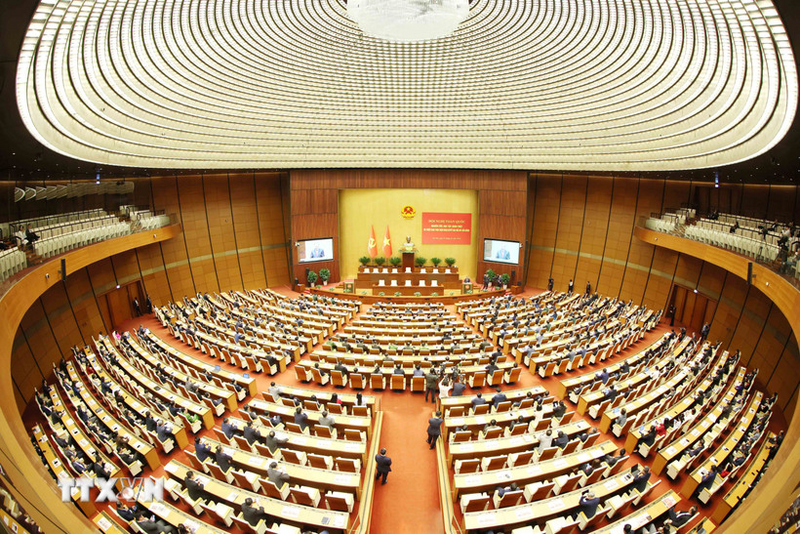
Conference overview. Photo: VNA
Fourth, it will provide an overall assessment, draw major lessons, and identify issues requiring theoretical clarification, closely aligned with the nature of the Platform as the foundational political document of the ruling Party.Fifth, it will analyze the context of the new era and put forward proposals and recommendations, including strategic forecasts to 2045 and a vision toward the end of the 21st century, contributing to the refinement of theory on socialism and Vietnam’s path toward socialism in the new era.
Regarding methodology, the Steering Committee requires comprehensive research into Party documents and diverse sources of material, particularly the “repatriation” of overseas Party-related archives for research purposes. This process must closely integrate the 100-year leadership review with the 40-year Platform review, while strongly applying digital technology to build a national database on Party history.
Establishment of the Steering Committee for the 100-year review
At the conference, Doan Minh Huan formally announced Politburo Decision No. 05 dated February 6, 2026, on the establishment of the Steering Committee for the summary of 100 years of the Party’s leadership of the Vietnamese revolution (1930 - 2030), orientations for national development leadership in the next 100 years (2030 - 2130), and the summary of 40 years of implementing the Platform for National Construction in the transitional period toward socialism.
Under the decision, the Steering Committee is headed by General Secretary of the Communist Party of Vietnam To Lam.
Deputy heads include Politburo members Luong Cuong, President of the State; Pham Minh Chinh, Prime Minister; Tran Thanh Man, Chairman of the National Assembly; Tran Cam Tu, Standing Member of the Secretariat (Standing Deputy Head); Le Minh Hung, Head of the Party Central Committee’s Organization Commission; Trinh Van Quyet, Head of the Central Commission for Education, Dissemination, and Mass Mobilization; Doan Minh Huan, Director of the Ho Chi Minh National Academy of Politics; and Nguyen Xuan Thang, Chairman of the Central Theoretical Council.
Members of the Steering Committee include current and former senior Party and State leaders, including former Party General Secretary Nong Duc Manh; former Prime Minister Nguyen Tan Dung; former National Assembly Chairmen Nguyen Van An, Nguyen Sinh Hung and Nguyen Thi Kim Ngan; former Standing Members of the Secretariat Le Hong Anh and Tran Quoc Vuong. Also participating are leaders of central commissions, ministries and agencies, including Chairwoman of the Central Committee of the Vietnam Fatherland Front Bui Thi Minh Hoai, Head of the Party Central Committee’s Internal Affairs Commission Le Minh Tri, Director of the Party Central Committee Office Pham Gia Tuc, Chairman of the Central Inspection Commission Tran Sy Thanh, Director of the General Political Department of the Vietnam People’s Army Nguyen Trong Nghia, Head of the Party Central Committee’s Policy and Strategy Commission Nguyen Thanh Nghi, among others.
The Politburo also decided to establish a Standing Subcommittee of the Steering Committee, headed by General Secretary To Lam, with Standing Secretariat Member Tran Cam Tu as Deputy Head, alongside Trinh Van Quyet, Doan Minh Huan, Nguyen Xuan Thang, Le Minh Tri, Pham Gia Tuc, Tran Sy Thanh and Nguyen Thanh Nghi.
The Central Theoretical Council and the Ho Chi Minh National Academy of Politics were designated as the standing agencies assisting the Steering Committee in implementing its tasks.
The Steering Committee is tasked with orienting the formulation of a development platform for national construction and defense in the new development era, reporting to the Politburo and the 14th-term Party Central Committee for submission to the 15th National Congress.
Deputy Minister Truong Thanh Hoai urges Vinachem to develop two key labs meeting international standards to advance its role in strategic tech value chains.
The Hung Yen provincial Industrial Promotion Program for 2026-2030 supports enterprise digital transformation and boosts science technology application and innovation.
Deputy Minister Truong Thanh Hoai urges Vinachem to develop two key labs meeting international standards to advance its role in strategic tech value chains.
Prime Minister calls for stronger power conservation and rooftop solar expansion to ensure stable electricity supply and safeguard national energy security.