The 14th National Congress marks a historic turning point, shaping a new development mindset and redefining Vietnam’s growth model.
Comrade Trinh Van Quyet, Politburo member, Secretariat Member of the Party Central Committee (PCC), and Head of the PCC’s Commission for Information, Education, and Mass Mobilization, affirmed that the 14th National Congress carries historic significance, not only reviewing a single term but also shaping a new development mindset, establishing a growth model, and laying an institutional foundation for the country’s long-term trajectory toward the mid-21st century.
Shaping a new development mindset
Within the framework of the national conference on studying, learning, thoroughly grasping, and implementing the Resolution of the Party’s 14th National Congress, held on February 7, comrade Trinh Van Quyet presented a thematic report entitled “New and core issues and 40 years of Renewal experience in the documents of the Party’s 14th National Congress.”
The report focused on four major areas: the role, significance, and fundamental achievements of the 14th National Congress, new approaches in drafting the Congress documents, core issues in the Congress documents and key requirements for implementing the Resolution of the 14th National Congress.
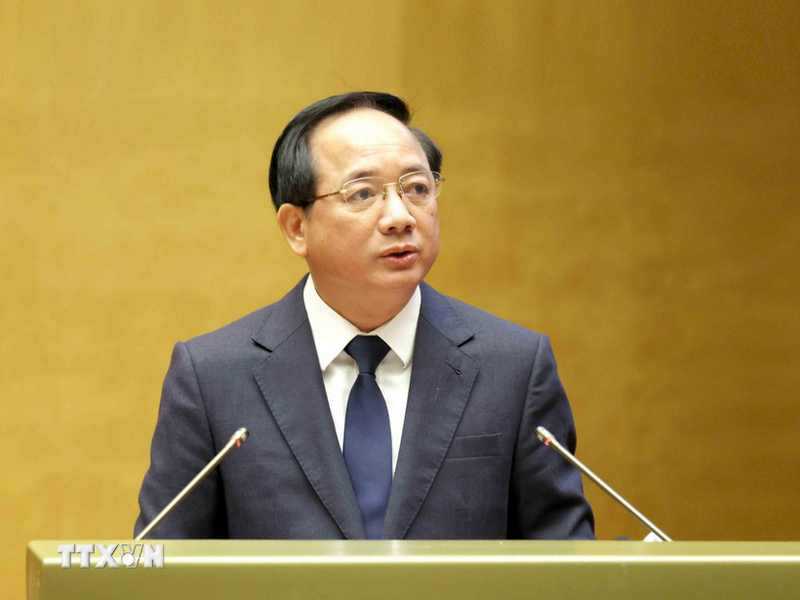
Comrade Trinh Van Quyet introduces the thematic report at the conference. Photo: VNA
He emphasized that the 14th National Congress is historic in scale, not merely summing up a term but also shaping a new development mindset, establishing a growth model, and creating an institutional foundation for a long journey extending to the middle of the 21st century.
The Congress’ special significance is reflected in three major focal points.
First, the transition to a phase of “developmental breakthrough.” After nearly 40 years of Renewal, the country has accumulated sufficient capacity and standing. However, the old growth model, reliant on capital, natural resources, and low-cost labor has revealed its limits. The 14th National Congress marks a shift toward intensive development based on knowledge, science and technology, and innovation, a transformation in thinking from “stability for development” to “development for sustainable stability.”
Second, a long-term strategic vision. The Congress sets the goal of becoming a developing country with modern industry and upper-middle income by 2030, and a developed, high-income country by 2045. To realize these objectives, the Party has designed a comprehensive set of solutions, ranging from institutional reform and breakthroughs in science and technology to unleashing the power of culture and human potential.
Third, comprehensive success in both theory and practice. The Congress achieved theoretical success by courageously facing reality and clearly identifying bottlenecks.
In policy orientation, for the first time, the system of development viewpoints was built on a systemic, multi-pillar approach. Notably, the Congress powerfully ignited trust and aspirations for development across the entire nation, turning the Party’s goals into a shared call to action.
According to comrade Trinh Van Quyet, the documents of the 14th National Congress reflect a strong renewal in the Party’s leadership methods, shifting from “policy thinking” to “governance and implementation thinking.”
A methodological breakthrough lies in the integration of three major reports into a single, unified Political Report. This integration overcomes overlap and fragmentation, creating a coherent intellectual framework that enables officials and Party members to study and implement the Resolution more effectively.
The documents decisively move from reviewing a term to designing a long-term development strategy, serving as a “strategic roadmap.” In particular, leadership methods shift from “orientation resolutions” to “action-oriented resolutions.”
This is evidenced by the Party’s issuance and implementation of nine strategic resolutions ahead of the Congress, directly linking action programs to the Political Report, thereby addressing the problems of “much talk, little action” and “sound resolutions but slow implementation.”
Comrade Trinh Van Quyet noted that the documents of the 14th National Congress crystallize intellect and strategic vision around the following core issues.
First, the supplementation of the “theory of the Renewal path.” This marks a maturation of theoretical thinking, distilled from 40 years of Renewal practice. Together with Marxism-Leninism and Ho Chi Minh Thought, this theory serves as a guiding light for the path toward socialism.
Second, the establishment of “strategic autonomy” thinking. Amid global volatility, Vietnam is shifting from a posture of “adaptation” to one of proactive “creation.” Strategic autonomy means independently choosing a development path, mastering technology, and integrating deeply while safeguarding national interests.
Third, the completion of development institutions, identified as the “breakthrough of breakthroughs.” Institutions are approached as an integrated, transparent, and effective ecosystem to unleash all social resources.
Fourth, a new growth model in which science and technology, innovation, and digital transformation are placed at the core, becoming the primary drivers replacing traditional growth engines that have reached their limits.
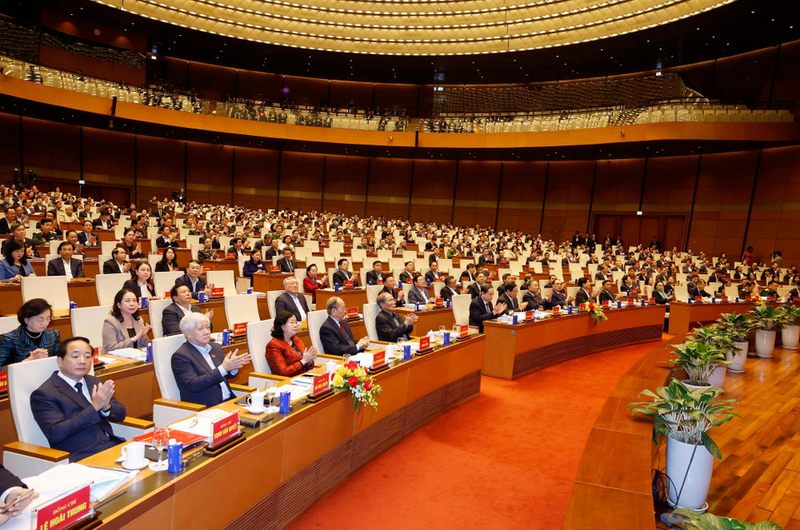
Conference delegates. Photo: VNA.
Fifth, the promotion of endogenous strength: placing people at the center, culture as the foundation, education as the foremost national policy, and the private sector as the most important driving force. The ultimate objective is the happiness of the people.
Sixth, strengthening national defense and security while developing external relations commensurate with the country’s stature. Protecting the Fatherland early and from afar, diplomacy not only for development but also to contribute to peace-building, affirming Vietnam’s identity and soft power.
Turning resolutions into tangible change
Regarding implementation tasks, comrade Trinh Van Quyet stressed the need to turn resolutions into tangible changes in real life through fundamental solutions.
First, achieving a high level of consensus in awareness, shifting from formalistic study to discussions on concrete solutions, so that the Resolution truly reaches the hearts of the people.
Second, treating rapid and synchronized institutionalization as the breakthrough. It is necessary to urgently review and remove barriers and “sub-licenses,” prioritizing the codification of mechanisms for the market economy, science and technology, and decentralization and devolution.
Third, renewing governance toward modern approaches based on data and quantitative results (KPIs). Concrete outputs and public satisfaction should be the benchmarks for evaluating officials.
Fourth, taking science and technology, innovation, and digital transformation as the primary mode of action. Accordingly, digital transformation serves as the central operational approach, restructuring national governance toward a transparent digital government, digital economy, and digital society.
Fifth, building a cadre contingent with strategic vision and the courage to think boldly and act decisively. This is the decisive factor for the success or failure of all policies.
Sixth, an overarching spirit of action, decisiveness, effectiveness.
Comrade Trinh Van Quyet underscored that stagnation, avoidance of responsibility, and “much talk, little action” will not be accepted. Each level, sector, and locality must ask itself: What concrete actions have we taken to realize the Congress’s goals? The success of the Congress should not be measured by words, but by economic growth, the quality of life of the people, societal trust, and Vietnam’s standing on the international stage.
Deputy Minister Truong Thanh Hoai urges Vinachem to develop two key labs meeting international standards to advance its role in strategic tech value chains.
The Hung Yen provincial Industrial Promotion Program for 2026-2030 supports enterprise digital transformation and boosts science technology application and innovation.
Deputy Minister Truong Thanh Hoai urges Vinachem to develop two key labs meeting international standards to advance its role in strategic tech value chains.
Prime Minister calls for stronger power conservation and rooftop solar expansion to ensure stable electricity supply and safeguard national energy security.