

Decentralized C/O issuance to ease procedures for exporters
19:05 | 23/03/2025 15:43 | 21/11/2026Trade
The decentralization of certificate of origin (C/O) issuance is being implemented in 33 of 34 provinces and cities.


The consensus reached at the 33rd Asia-Pacific Economic Cooperation (APEC) Economic Leaders' Week in China is opening up new directions for regional cooperation, particularly in trade, investment, innovation and supply chain connectivity. For Viet Nam, the outcomes of the trip by General Secretary of the Central Committee of the Communist Party of Viet Nam and State President To Lam not only helped strengthen relations with partners but also laid an important foundation for the country to take on the role of APEC 2027 host.
In an interview following the trip, Minister of Foreign Affairs Le Hoai Trung highlighted the key outcomes of APEC 2026 Economic Leaders' Week, Viet Nam’s contribution and the progress made in Viet Nam - China bilateral cooperation.
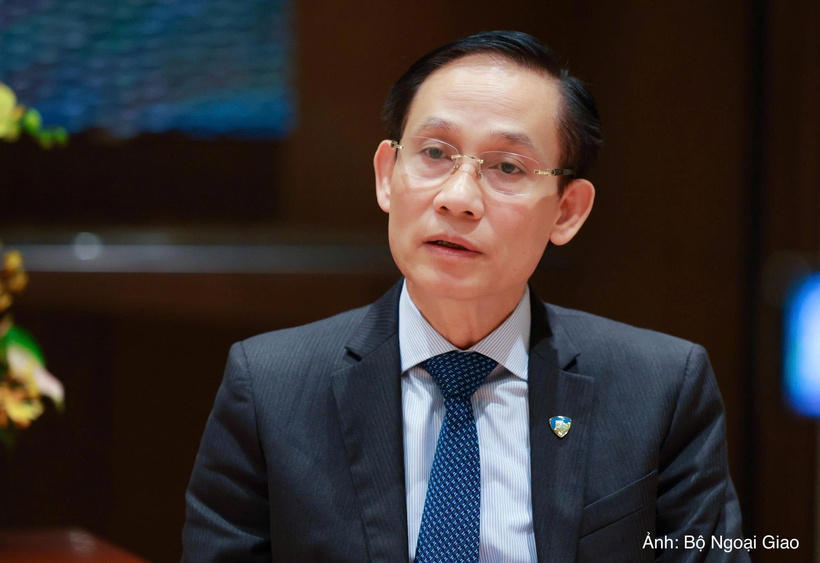
Minister of Foreign Affairs Le Hoai Trung. Photo: MOFA
APEC 2026 promotes new growth drivers
According to Minister Le Hoai Trung, the 33rd APEC Economic Leaders' Week took place as the global and regional economies undergo profound transformations, presenting both opportunities and challenges for economies.
In this context, the success of the meeting was reflected not only in the documents and initiatives adopted but, more importantly, in members maintaining consensus on the direction of cooperation and the region's future development.
One of the key outcomes was that APEC continued to affirm its role as the leading forum for dialogue, cooperation and economic integration. For the first time in four years, top leaders of all 21 member economies attended, including the highest-level participation of major economies.
This participation is significant in building trust, promoting dialogue and seeking common ground among economies with different levels of development, institutions and views.
Notably, the meeting reached consensus on regional connectivity and cooperation in digital technology and emerging technologies, and continued to advance the Free Trade Area of the Asia-Pacific (FTAAP) agenda.
The leaders also agreed to step up cooperation on artificial intelligence, thereby expanding new areas of cooperation in line with the three priorities of APEC 2026: "Openness, Innovation and Cooperation." According to Minister Le Hoai Trung, these outcomes not only meet the need to adapt to current economic volatility but also lay the foundation for long-term cooperation programs, creating further momentum for sustainable growth and regional economic integration.
In addition to policy consensus, the role of the business community was clearly affirmed. The APEC CEO Summit 2026 brought together more than 2,000 delegates from hundreds of leading global and regional businesses. Many proposals were put forward, focusing on innovation, digital transformation, green transition, human resource development and supply chain connectivity.
Business participation not only helped strengthen public-private cooperation but also linked policy orientations with the practical needs of production and business. Minister Le Hoai Trung said China's successful hosting of APEC 2026 helped affirm the forum's role and shape directions for cooperation in the coming period.
In particular, the outcomes achieved in Shenzhen create favorable conditions for Viet Nam to continue promoting its role and expand the space for cooperation as host of APEC 2027.
Viet Nam proactively shapes the APEC 2027 agenda
Beyond participating as an active member, Viet Nam also demonstrated its responsibility as the economy set to host APEC 2027.
According to Minister Le Hoai Trung, during APEC 2026, Vietnamese ministries and sectors coordinated closely with host China, actively proposed initiatives, took part in drafting documents and chaired and coordinated the forum's cooperation mechanisms. These activities also gave concrete form to the shared understandings of the two countries' senior leaders in the Viet Nam - China Joint Statement of April 2026 on coordinating with and supporting each other to successfully host APEC 2026 and 2027.
Party General Secretary and State President To Lam’s leadership of the high-level Vietnamese delegation to APEC 2026 Economic Leaders' Week further affirmed the importance Viet Nam attaches to regional cooperation.
At the discussion session of the APEC Economic Leaders' Meeting, Party General Secretary and State President To Lam was the first leader to speak after General Secretary of the Communist Party of China Central Committee and Chinese President Xi Jinping. In addition, his speech at the APEC CEO Summit conveyed messages about Viet Nam's development vision, reform efforts and breakthrough solutions to achieve the country's development goals.
The speeches also affirmed Viet Nam's commitment to working with other members to build a dynamic, connected, resilient and prosperous Asia-Pacific region. An important milestone of the trip was Viet Nam's official assumption of the role of APEC 2027 host.
At the handover ceremony, Party General Secretary and State President To Lam introduced the theme of APEC 2027, "Together building a new era of resilience, innovation and shared prosperity," with three priorities: raising productivity; promoting regional trade and investment; and enhancing economic resilience and dynamism and the quality of people's lives.
According to Minister Le Hoai Trung, Viet Nam's theme and priorities received a positive response from members, as they both ensure continuity with APEC's long-term goals and meet the region's new development needs.
Through meetings with leaders of economies, international organizations and the business community, Viet Nam also garnered support for the APEC 2027 agenda while strengthening relations with partners and expanding cooperation opportunities for national development.
The active participation of the Vietnamese business community in APEC activities this time further demonstrated its capacity to contribute to regional cooperation, as well as the prospects for strengthening direct connections between businesses and localities of member economies.
Deepening Viet Nam - China economic and trade cooperation
In addition to multilateral activities, bilateral meetings and exchanges between Vietnamese and Chinese leaders also achieved important results, particularly in the economy, trade, investment and infrastructure connectivity.
According to Minister Le Hoai Trung, the highlight was the talks between Party General Secretary and State President To Lam and Party General Secretary and State President Xi Jinping.
The two sides reaffirmed the long-term strategic significance of Viet Nam - China relations and agreed on orientations to improve the effectiveness of substantive cooperation, linked to the interests of the people and businesses of both countries. Priority areas include the economy, trade, investment, strategic infrastructure connectivity, science and technology, and innovation.
Notably, the two sides agreed on the orientation of promoting more balanced and healthier trade and strengthening energy cooperation, in line with Viet Nam's development needs in the new period. Alongside central-level cooperation, working sessions with leaders of Chinese localities opened up specific directions for cooperation.
At a meeting with Secretary of the Guangdong Provincial Party Committee Huang Kunming, the two sides discussed measures to tap the potential for cooperation with China's leading economic, industrial, and science and technology centers, including Guangzhou, Shenzhen and the Guangdong-Hong Kong-Macao Greater Bay Area.
The focus is on promoting trade, high-quality investment, digital transformation and high-tech industries, and strengthening production and supply chain linkages, thereby enabling businesses of both countries to participate more deeply in high value-added sectors.
Meanwhile, a meeting with Secretary of the Yunnan Provincial Party Committee Mo Gaoyi focused on leveraging Yunnan's geo-economic advantages and its role as a gateway connecting Viet Nam with Southwestern China. The two sides focused on promoting transport infrastructure connectivity, especially railway cooperation; improving customs clearance efficiency; and developing the border-gate economy, logistics, trade, tourism and people-to-people exchanges.
Forums on science and technology, innovation and development strategy connectivity in Shenzhen, and a cooperation connectivity conference in Kunming, also helped turn cooperation orientations into programs and projects, bringing practical benefits to businesses and people.
Beyond economic cooperation, youth, cultural and people-to-people exchanges continued to strengthen the social foundation of bilateral relations. These included the "Red Journey" study and research program for young people, attended and addressed by Party General Secretary and State President To Lam, as well as cultural exchange activities with the participation of his spouse, Ngo Phuong Ly.
The outcomes of the trip not only helped deepen the Viet Nam - China Comprehensive Strategic Cooperative Partnership but also expanded opportunities for economic, trade and investment cooperation, creating further momentum for regional integration. In particular, from the consensus reached at APEC 2026 to the support for the APEC 2027 agenda, Viet Nam is gaining more favorable conditions to promote its proactive and active role in Asia-Pacific economic cooperation.
According to Minister of Foreign Affairs Le Hoai Trung, APEC 2027 in Viet Nam is attracting strong interest and high expectations from member economies and the international community. This is both a recognition of Viet Nam's prestige, standing and contribution, and a driving force for the country to successfully host APEC 2027, bringing practical benefits and lasting value to the region.
19:05 | 23/03/2025 15:43 | 21/11/2026Trade

19:05 | 23/03/2025 12:03 | 21/11/2026Trade

19:05 | 23/03/2025 12:00 | 21/11/2026News and Events

19:05 | 23/03/2025 11:59 | 21/11/2026News and Events

19:05 | 23/03/2025 06:20 | 21/11/2026News and Events


