The EVFTA gives Vietnamese goods a competitive edge in Austria, opening up opportunities to diversify exports and deepen bilateral trade and business ties.
The EVFTA strengthens the competitive edge of Vietnamese goods
According to the Viet Nam Trade Office in Austria, citing data from the Customs Department under the Ministry of Finance, bilateral trade between Viet Nam and Austria reached nearly USD 3 billion in the first 10 months of 2026, up 12.8% year over year. Viet Nam recorded a trade surplus of USD 2.1 billion. Vietnamese exports to Austria alone totaled USD 2.5 billion, an increase of 13.2%.
These positive figures reflect the two countries' ability to sustain and expand trade ties despite continued volatility in the global economy. However, the fact that phones and electronic components account for as much as 77% of Viet Nam's export turnover highlights the limited diversification of Vietnamese exports to Austria. Other product categories, including textiles and garments, footwear, seafood, agricultural products, wooden furniture, and agricultural supplies, still have considerable potential to expand their presence in the market.
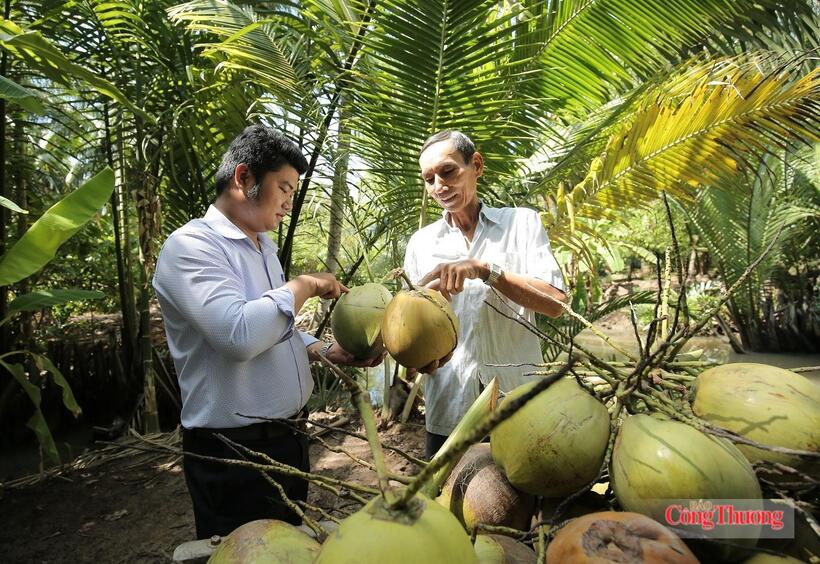
Viet Nam is one of the world's leading producers and exporters of coconut fiber, with extensive raw material production areas in the Mekong Delta.
According to the Viet Nam Trade Office in Austria, the E.U.-Viet Nam Free Trade Agreement (EVFTA) is creating favorable conditions for Vietnamese businesses to enhance their competitiveness by significantly reducing tariff costs. Under the agreement, the E.U. is phasing out import tariffs on Vietnamese goods according to an agreed schedule, making Vietnamese products more price-competitive and increasingly attractive to European retailers and consumers, including those in Austria.
Product groups expected to benefit significantly include textiles and garments, footwear, electronics and components, and agricultural products. For coffee, fruit, seafood, and various other agricultural products, EVFTA tariff preferences provide additional opportunities to access the market and strengthen their competitiveness against goods from countries that do not have comparable free trade agreements with the E.U.
Beyond tariff benefits, the EVFTA also offers Vietnamese businesses greater opportunities to access the Austrian market directly, reducing their reliance on intermediaries in other E.U. countries. This is particularly relevant given Austria's geographical characteristics as a landlocked country located in the heart of Europe, where import and export activities often depend on intermediary hubs and incur higher transportation costs.
Geographically, Austria is also considered a dynamic gateway for Vietnamese goods seeking access to the wider European market, particularly Central and Southern Europe. Goods can reach landlocked markets in the region through Slovenia's strategic Port of Koper on the Adriatic Sea, which is connected to Viet Nam via the Mediterranean Sea and the Red Sea. This logistics route offers a meaningful option for Vietnamese businesses exploring opportunities to expand across the region.
In addition, the Viet Nam Trade Office in Austria points out that trade relations between Viet Nam and Austria are underpinned by a clear degree of economic complementarity. Viet Nam has strengths in the production and export of electronics, textiles and garments, footwear, wooden furniture, and agricultural products, while Austria has advantages in high technology and services. In the opposite direction, Austrian businesses have opportunities to expand exports of machinery and industrial equipment to Viet Nam as domestic demand for investment and manufacturing development continues to grow. This complementarity provides a foundation for the two countries not only to increase merchandise trade but also to develop cooperation in a range of higher value-added sectors.
From demand for clean agriculture to new opportunities for cooperation
One of the promising areas of cooperation between Viet Nam and Austria today is clean agriculture, high-tech agriculture, and the supply of environmentally friendly agricultural inputs.
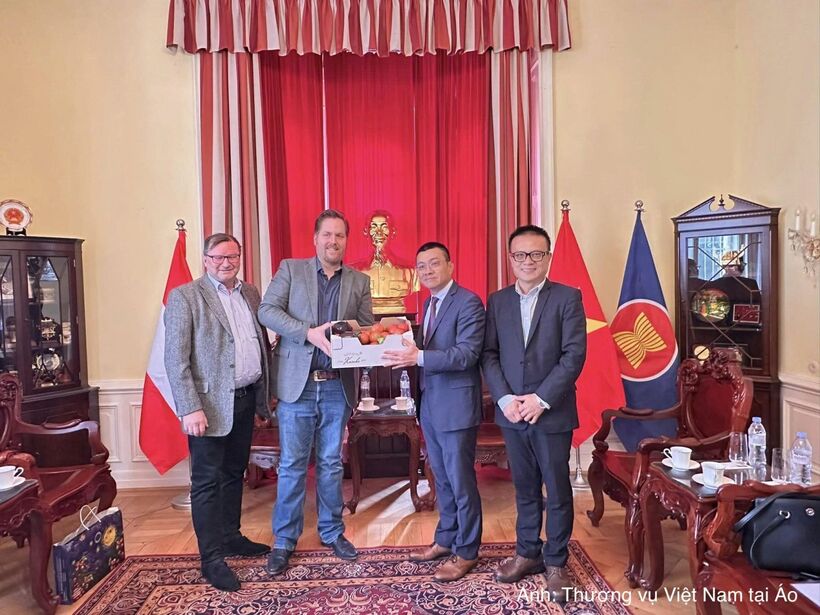
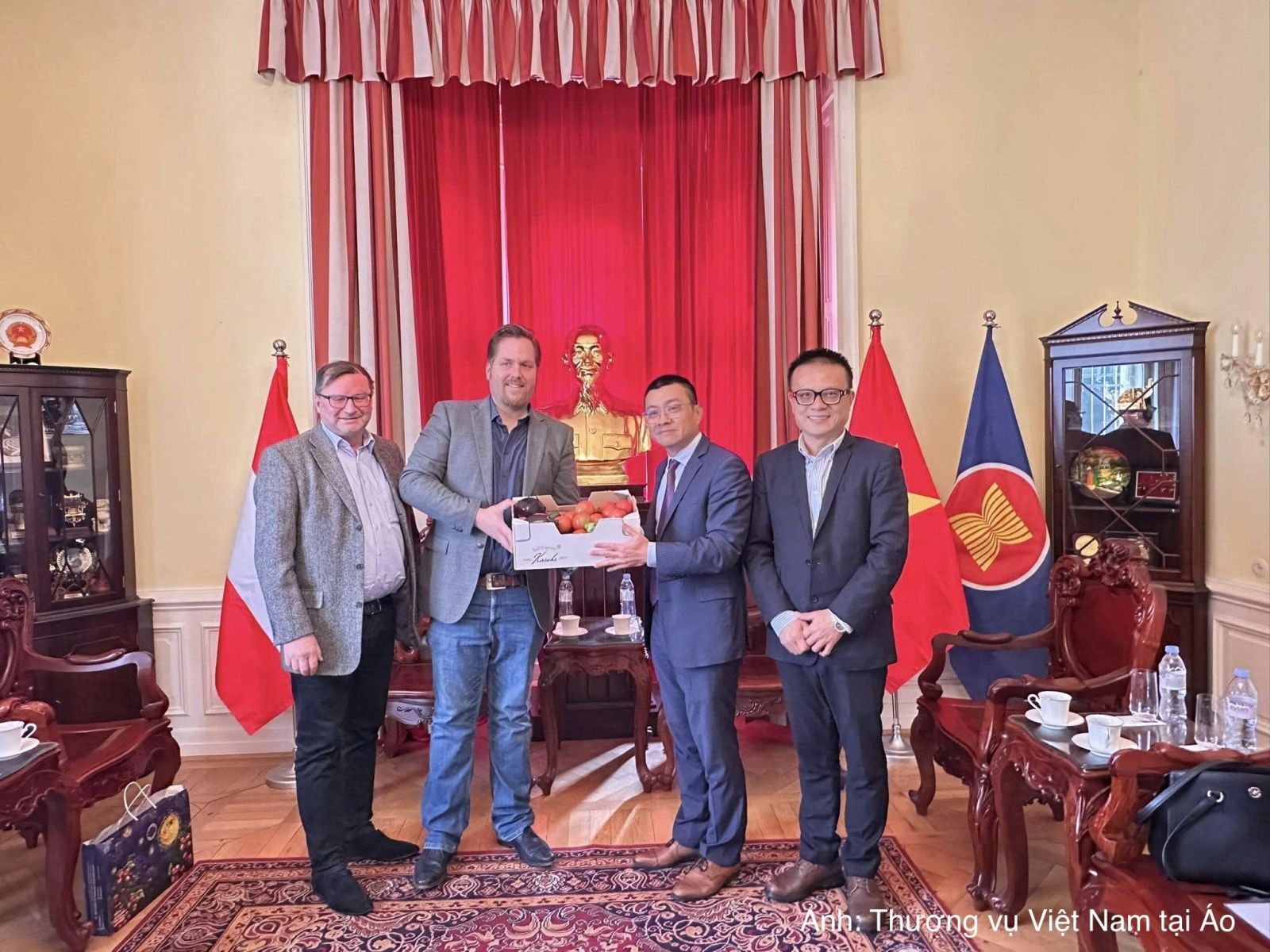
Ambassador Vu Le Thai Hoang met with Norbert Walter, President of the Vienna Chamber of Agriculture and Vice President of the Austrian Chamber of Agriculture.
The Viet Nam Trade Office in Austria reported that on November 9, 2026, at the headquarters of the Vietnamese Embassy in Austria, Ambassador Vu Le Thai Hoang received Norbert Walter, President of the Vienna Chamber of Agriculture and Vice President of the Austrian Chamber of Agriculture. The two sides discussed Austria's demand for Vietnamese workers in the agricultural sector, policies governing foreign seasonal workers, and opportunities to promote bilateral cooperation.
Alongside labor cooperation, business networking in clean agriculture is opening up concrete trade opportunities. On this occasion, the Viet Nam Trade Office in Austria visited and held working sessions with several Austrian companies specializing in greenhouse vegetable and fruit production and packaging.
During the meetings, Austrian businesses presented emerging trends in soilless greenhouse cultivation, which uses environmentally friendly growing media derived from natural organic materials. Coconut coir growing media, in particular, is gaining popularity thanks to its strong water retention capacity, high aeration, stable pH levels, and biodegradability. Austrian companies expressed interest in finding Vietnamese suppliers capable of providing a stable supply of consistently high-quality products that meet E.U. market standards.
In response to this demand, the Viet Nam Trade Office in Austria introduced Viet Nam as one of the world's leading producers and exporters of coconut coir, with extensive raw material areas in the Mekong Delta. Many Vietnamese companies already have experience exporting growing media to European markets. Notably, the EVFTA provides an additional competitive advantage for Vietnamese products in Austria.
The Trade Office pledged to introduce reputable suppliers and facilitate direct connections and exchanges between businesses on both sides. This represents a practical approach to trade promotion, focusing on specific business needs rather than stopping at general product introductions and the search for potential opportunities.
As international markets continue to fluctuate and global trade tensions increase the need to diversify trading partners, strengthening bilateral economic ties between Viet Nam and Austria is becoming increasingly important. The EVFTA has established a favorable foundation through tariff preferences. However, to fully capitalize on the agreement, businesses need to take a proactive approach to market research, improve product quality, meet E.U. standards, and strengthen direct connections with local partners.
From positive trade performance to new opportunities for cooperation in clean agriculture, relations between Viet Nam and Austria are gaining additional momentum. The challenge now is to translate the advantages offered by the EVFTA and the complementarity between the two economies into concrete contracts, supply chains, and substantive business partnerships, thereby expanding market opportunities for Vietnamese goods in Austria and across Europe.
Viet Nam aims to expand grassroots e-commerce beyond online product listings, focusing on digital skills, local supply chains, and sustainable sales growth.
Minister Le Manh Hung met with major Japanese corporations to explore investment opportunities in Viet Nam's mineral industries and strengthen strategic supply chains.
Minister of Industry and Trade Le Manh Hung met with Daiki Mihara, Executive Officer in charge of Regional Business and Customer First, Automobile Operations at Honda Motor Co., Ltd. of Japan.
The E.U.'s new packaging rules require Vietnamese food exporters to review materials, strengthen compliance documentation, and redesign packaging for recyclability.
At the 20th La Francophonie Summit, Viet Nam will promote cooperation in economics, science, technology, and innovation, with a focus on sustainable development.
The EVFTA gives Vietnamese goods a competitive edge in Austria, opening up opportunities to diversify exports and deepen bilateral trade and business ties.
The Ministry of Industry and Trade is promoting closer links between training and businesses to develop a workforce that meets industry and trade sector needs.
GREENTECH HA NOI 2026 showcases green technologies and energy-efficient solutions that help businesses cut emissions, optimize costs, promote sustainable production.
On the sidelines of the BRICS Summit in New Delhi, Senior Lieutenant General Nguyen Truong Thang held a meeting with Indian Defence Secretary Rajesh Kumar Singh, agreeing to expand defence cooperation.