Railways, logistics and smart border gates are expected to create new momentum for economic and trade connectivity between Viet Nam and Southwest China.
On the morning of November 20, in Kunming, Yunnan Province, China, the Ministry of Industry and Trade of Viet Nam, in coordination with the People's Government of Yunnan Province, held the Forum on Connecting Viet Nam's Development Strategies with the Southwest China Region. The forum was attended by Party General Secretary and State President To Lam, who delivered guidance, and Comrade Wang Yong, Member of the Central Committee of the Communist Party of China and Vice Chairman of the National Committee of the Chinese People's Political Consultative Conference.
Also attending were Politburo members, leaders of central Party commissions, ministries and agencies, six Vietnamese ministers, and leaders of 10 provinces and cities. The Chinese delegation included leaders from Yunnan, Guangxi, Chongqing, Sichuan and Guizhou. With more than 800 registered delegates representing 570 businesses from the two countries, this was the largest-ever forum connecting Viet Nam with the Southwest China region.
Within the framework of the forum, proposals to improve transport infrastructure connectivity, particularly through standard-gauge railways, develop logistics and modernize border gates were highlighted as key areas for cooperation. These issues were also emphasized by Minister of Construction Tran Hong Minh and Lao Cai Provincial Party Committee Secretary Duong Quoc Huy, from the perspectives of interregional infrastructure and cross-border economic connectivity.
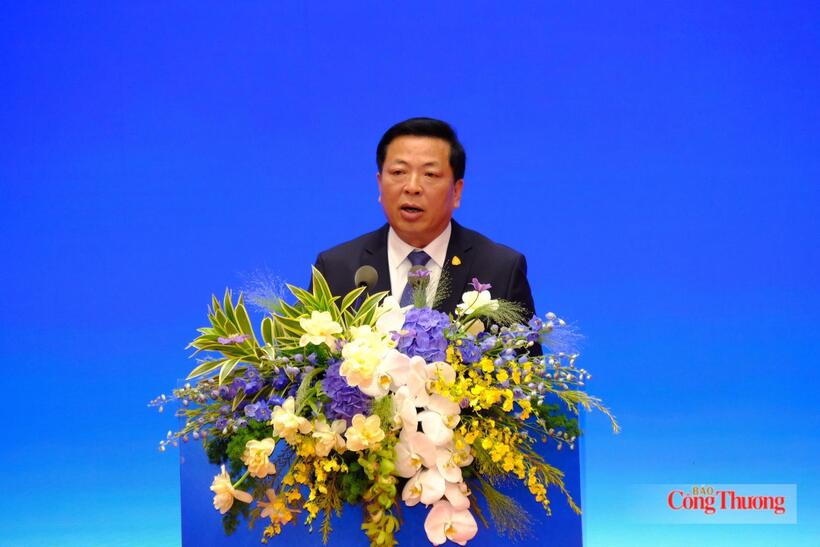
Minister of Construction Tran Hong Minh.
Railways to expand logistics cooperation
At the forum, Minister of Construction Tran Hong Minh emphasized: "Promoting cross-border transport infrastructure connectivity, with a focus on standard-gauge railway systems between Viet Nam and China, is a strategic priority."
According to the minister, in the Joint Statement issued in April 2026 during Party General Secretary and State President To Lam's state visit to China, the two sides agreed to accelerate railway connectivity and increase freight transport volumes. They also agreed to speed up the development of railway and road infrastructure connectivity, making railway cooperation a new highlight in the strategic cooperation between the two countries.
Building on these high-level cooperation orientations, Minister Tran Hong Minh particularly highlighted two standard-gauge railway lines in Northern Viet Nam: the Lao Cai-Ha Noi-Hai Phong line, connecting with Yunnan, and the Dong Dang-Ha Noi-Quang Ninh-Hai Phong line, connecting with Guangxi. Once implemented, these routes will establish additional transport corridors linking industrial centers and inland raw material production areas in China with seaports in Viet Nam.
"When this railway line, together with the standard-gauge Dong Dang-Ha Noi-Quang Ninh-Hai Phong railway line connecting with Guangxi, is implemented, the two routes will become efficient transport corridors, helping shorten logistics times and directly connect China's industrial centers and inland raw material production areas with seaports in Viet Nam. This will open up greater access to global export markets, generate benefits for both countries and promote people-to-people exchanges," Minister Tran Hong Minh said.
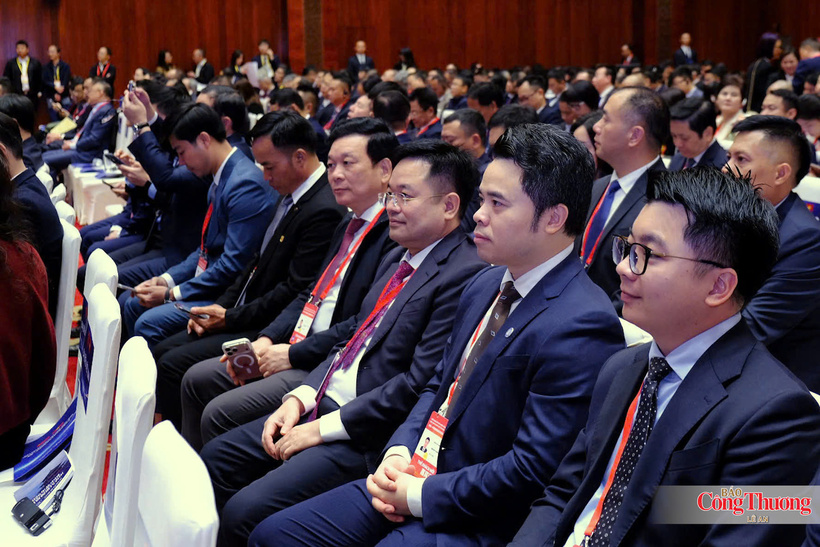
Delegates attend the forum.
The value of these railway lines therefore extends beyond their freight transport capacity. They also have the potential to reorganize the flow of goods between the two economies. With production centers, raw material regions and seaports seamlessly connected, businesses will have more transportation options, shorter transit times and greater opportunities to participate in regional supply chains.
To turn this goal into reality, the Minister of Construction called on reputable Chinese general contractors and construction companies with strong technological capabilities to partner with Vietnamese consortiums and businesses. He also encouraged both sides to apply advanced and modern construction technologies to bring cross-border railway lines into safe operation as soon as possible while ensuring quality.
Another priority is the coordinated development of logistics hubs along the Kunming-Lao Cai-Ha Noi-Hai Phong corridor. Minister Tran Hong Minh said that investment studies should focus on transshipment stations, logistics complexes and technical support facilities in the Kunming area to enhance the capacity for intermodal container transport.
The minister also emphasized the need to strengthen exchanges and share experience in railway investment, construction, operation, maintenance and repair. Cooperation in workforce training, institutional development, and the harmonization of construction standards and regulations with international practices is also necessary. These are essential conditions not only for implementing connectivity projects but also for ensuring their effective and sustainable operation over the long term.
Lao Cai seeks to turn its gateway advantage into a growth driver
While the Ministry of Construction views railway connectivity from the perspective of national strategic infrastructure, for Lao Cai, this priority is directly linked to cross-border trade and the effective development of economic corridors.
As a province sharing a border with Yunnan, Lao Cai serves as a gateway connecting Northern provinces of Viet Nam with China's economic and commercial centers and the wider ASEAN region.
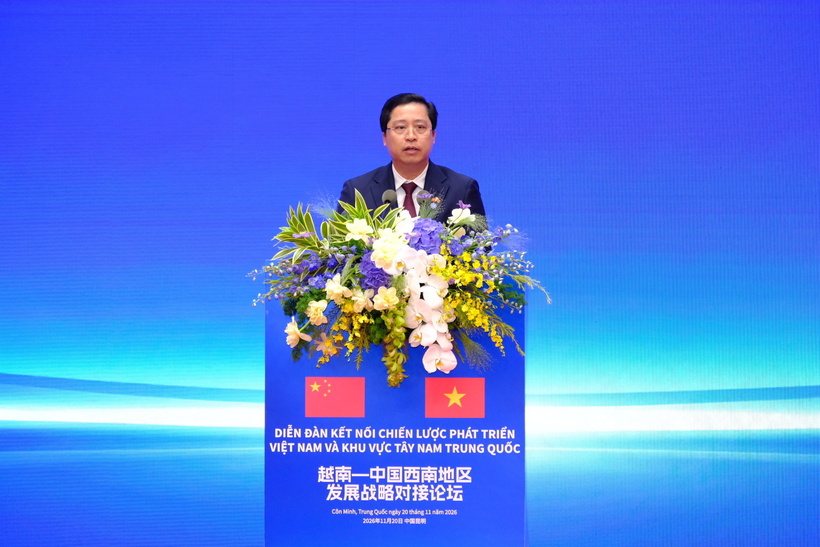
Lao Cai Provincial Party Committee Secretary Duong Quoc Huy said cross-border trade activities through the province's border gates had continued to show positive developments. In the first 10 months of 2026, the province's import-export turnover through its border gates reached approximately USD 3.5 billion, up 45% year over year. The figure is projected to reach around USD 4 billion for the full year.
Lao Cai Provincial Party Committee Secretary Duong Quoc Huy.
According to Duong Quoc Huy, these results demonstrate the significant potential for cooperation between Lao Cai, Yunnan and other localities across Southwest China, particularly in transport infrastructure connectivity, logistics and cross-border trade development.
On that basis, Lao Cai's provincial leadership proposed that the two sides accelerate implementation of the Lao Cai-Ha Noi-Hai Phong standard-gauge railway line. It also called for seamless connectivity between Lao Cai Station and the Hekou area, as well as with railway lines extending further into China's interior toward major economic centers such as Chengdu and Chongqing.
"Coordinated connectivity across different modes of transport will help expand freight transport capacity, reduce logistics costs and improve the efficiency of trade between the two sides," Duong Quoc Huy emphasized.
Alongside railway development, Lao Cai proposed accelerating the upgrading of the Noi Bai-Lao Cai Expressway and implementing infrastructure projects connecting border gates, including the Ban Vuoc border bridge. The province also called for research into developing cross-border waterway transport along the Red River.
These proposals demonstrate that the province is not focusing on a single transport route but instead aims to establish a multimodal connectivity network to improve the movement of goods between the two sides.
Notably, Lao Cai proposed studying and promoting the establishment of a cross-border economic cooperation zone between Lao Cai and Yunnan, alongside the development of industrial parks, logistics facilities, bonded warehouses and smart border gates.
The Kim Thanh-Bac Son smart border gate, located along the Kunming-Lao Cai-Ha Noi-Hai Phong-Quang Ninh corridor, has been identified as an important direction for enhancing customs clearance capacity, facilitating import and export activities and strengthening supply chain connectivity.
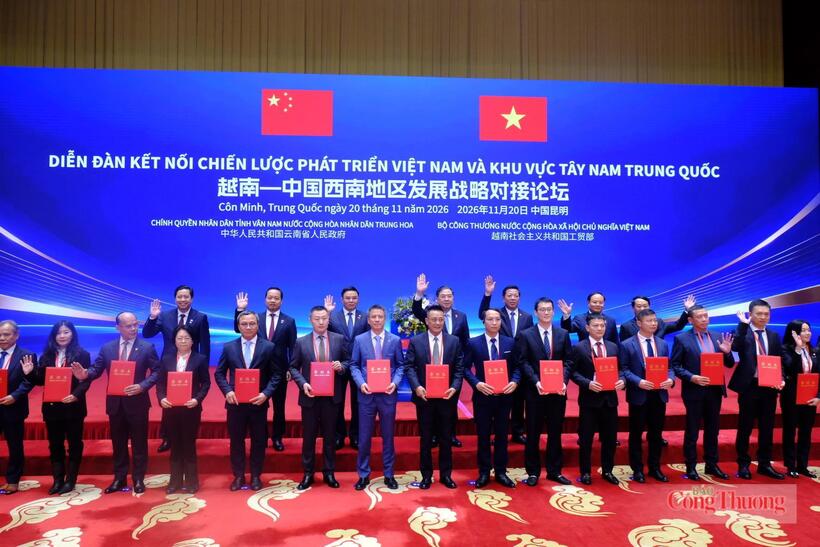
Business representatives from the two countries pose for a group photo.
Beyond infrastructure, Lao Cai also seeks to strengthen business linkages with Yunnan, Sichuan, Chongqing, Guizhou and Guangxi. The province proposed focusing cooperation on the processing, consumption and two-way distribution of medicinal herbs, agricultural products and consumer goods.
This is a practical direction for cooperation, as improvements in transport and logistics will not only create opportunities for large corporations to expand their markets but also provide greater opportunities for local manufacturers and businesses.
From the orientations set out by the Ministry of Construction to Lao Cai's specific proposals, infrastructure connectivity is clearly being positioned in direct relation to trade, investment and supply chain development. Railways provide the main transport arteries, logistics networks and border gates facilitate the movement of goods, while business linkages translate connectivity advantages into tangible economic activities.
The challenge in the coming period will be to advance infrastructure projects in a coordinated manner, strengthen coordination mechanisms and attract greater participation from the business communities of both countries.
Once these connections are realized, the Kunming-Lao Cai-Ha Noi-Hai Phong-Quang Ninh corridor will be better positioned to enhance Viet Nam-China trade while expanding connectivity between Southwest China, ASEAN and international markets.
The Forum on Connecting Viet Nam's Development Strategies with the Southwest China Region identified five priority areas for cooperation: logistics, railway connectivity, smart border gates, cross-border economic cooperation zones and cross-border trade.
These closely interconnected components are aimed at establishing a more integrated connectivity network between Viet Nam and localities across Southwest China, facilitating the movement of goods, developing supply chains and expanding the scope of economic and trade cooperation.
Rising global rice prices, stronger import demand from South Korea and Viet Nam's successful bid to supply 35,000 tons are providing positive signals for rice exports.
Railways, logistics and smart border gates are expected to create new momentum for economic and trade connectivity between Viet Nam and Southwest China.
Ba Den Mountain welcomed its 5 millionth cable car visitor of 2026 on October 23, as travelers sought cultural experiences as well as spiritual retreats in Tay Ninh.
Railways, logistics and smart border gates are expected to create new momentum for economic and trade connectivity between Viet Nam and Southwest China.
General Secretary and President To Lam affirmed that, having been born after a long period of global division and conflict, APEC is a symbol of efforts to heal, connect and promote dialogue and cooperation for shared prosperity.
General Secretary and President To Lam stressed that Viet Nam takes on the responsibility of hosting APEC 2027 with great honor and a profound sense of responsibility for the common future of the region.