The Viet Nam - UAE Comprehensive Economic Partnership Agreement (CEPA) is helping to cut tariffs, expand market access and boost Viet Nam's exports of goods and services to the UAE.
CEPA creates more room for Vietnamese goods in the UAE
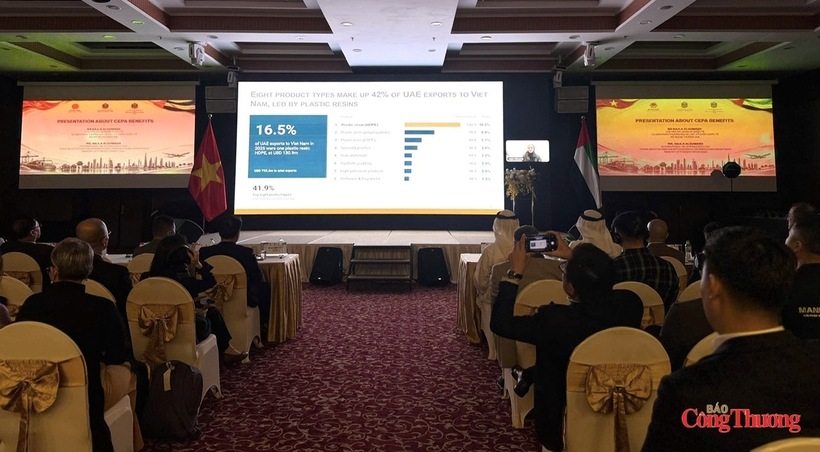
Economic and trade relations between Viet Nam and the UAE have developed positively in recent years. Speaking at the conference to promote the Viet Nam-UAE Comprehensive Economic Partnership Agreement (CEPA), co-organized by the Ministry of Industry and Trade (MOIT) and the UAE Embassy in Viet Nam on the afternoon of November 17, UAE Minister of Foreign Trade Thani bin Ahmed Al Zeyoudi said Viet Nam is currently one of the UAE's largest non-oil trading partners in ASEAN, while the UAE is Viet Nam's leading trading partner in the Arab world. UAE-Viet Nam relations should not stop at trade commitments but should be expanded through market development, stronger investment flows and closer links between the two countries' private business communities.
A representative of the UAE Ministry of Foreign Trade presents the CEPA online at the conference.
"The CEPA was signed to deepen bilateral economic relations and foster growth and prosperity for both countries. The two governments will continue to work together to ensure that the agreement's commitments deliver practical benefits to businesses and open up new opportunities for products and services not only in the UAE market but also in other regions," the minister said.
For the UAE, expanding its network of trading partners is a key direction toward achieving its goal of doubling the size of its economy by 2030. Najla AlSuwaidi, in charge of International Relations Management at the UAE Ministry of Foreign Trade, said the CEPA is not merely a tariff reduction agreement but also creates a more favorable framework for cross-border business. The agreement aims to reduce or eliminate trade barriers, simplify regulations and expand market access for businesses. "Essentially, the CEPA creates a favorable mechanism, like a fast lane for trade between the UAE and its partner countries, through lower tariffs, simpler regulations and broader market access," she stressed.
One of the direct benefits for exporters is tariff preferences. According to the UAE Ministry of Foreign Trade representative, some products may enjoy a 0% import tariff, while others will receive significant tariff exemptions or reductions. This enables businesses to cut costs, improve competitiveness and expand business opportunities in the partner market.
In addition to trade in goods, the CEPA includes commitments on trade in services and economic cooperation. The agreement also establishes a framework for the cross-border supply of services, the movement of natural persons and commitments between the parties.
Notably, the UAE is continuing to expand its CEPA network. According to AlSuwaidi, the country has signed 21 or 22 such agreements and is negotiating with about 17 other countries. Although a common approach is applied in negotiations, each agreement is tailored to the partner concerned, based on product characteristics, timeframes and the specific commitments of the parties.
For Viet Nam, the CEPA not only facilitates exports to the UAE but also opens up opportunities for deeper access to the network of markets with which the Middle Eastern country trades.
Looking up HS codes and meeting rules of origin
Businesses can claim tariff preferences when they correctly identify their products, meet origin requirements and complete the required procedures. This was also the focus of guidance given at the conference by a certificate of origin expert from the UAE Ministry of Foreign Trade.
Accordingly, to take advantage of the CEPA's preferences, the first step for businesses is to identify the Harmonized System (HS) code of their goods. This is an important basis for determining the regulations applicable to each product when exporting to the partner market.
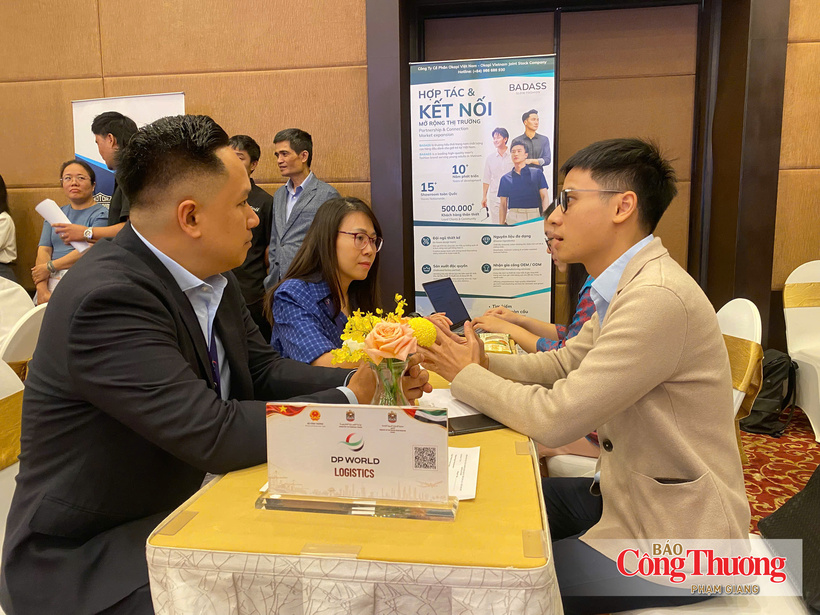
Businesses attend the matchmaking session on the sidelines of the conference.
Businesses need to identify the exporting and importing countries and then look up the corresponding HS code to find out the applicable tariffs and rules of origin. Identifying the correct product code is important because each product may be subject to different conditions and preference levels.
The UAE Ministry of Foreign Trade representative also said businesses can visit the ministry's website to learn about the regulations, where information on rules of origin and value-added content requirements is set out for each product.
Goods that meet the agreement’s rules of origin and documentation requirements may qualify for preferential tariffs, supported by a certificate of origin (C/O). Businesses can also look up information on the websites and portals of the relevant authorities in both Viet Nam and the UAE to understand the requirements for each product.
Notably, the UAE Ministry of Foreign Trade has provided lookup tools to help businesses access information more easily. These include data dashboards, reporting tools, handbooks and guidance documents on rules of origin and product-specific rules.
Through the chapters, information sections and lookup systems, businesses can search for trade benefits by HS code, especially tariff preferences. This provides a basis for businesses to assess their ability to make use of the CEPA before starting export activities.
Businesses should therefore prepare to use CEPA preferences during market research and export documentation. In addition, proactively using the portals, data, reports and guidance documents of the relevant authorities will give businesses a better basis for accurately determining their entitlements and avoiding missing out on preferences due to a lack of understanding of the regulations.
With its commitments on goods, services, tariffs and trade facilitation, the CEPA is creating an additional framework for Vietnamese businesses to expand their operations in the UAE. However, how effectively the agreement is used depends largely on how proactive businesses are in learning about policies, meeting rules of origin and organizing their export activities.
On the sidelines of the conference, a B2B matchmaking session was held, attracting strong interest from businesses of both countries.
Party General Secretary and State President To Lam and Russian President Vladimir Putin commended the achievements made in continuously advancing the Viet Nam-Russia Comprehensive Strategic Partnership.
Party General Secretary and State President To Lam delivered a keynote address at the APEC CEO Summit 2026, outlining Viet Nam’s development priorities and calling for stronger regional cooperation to promote sustainable and inclusive growth.
Party General Secretary and State President To Lam stated that Viet Nam consistently regards the consolidation and development of relations with China as a strategic choice and top priority in its foreign policy of independence, self-reliance, self-strengthening, multilateralization and diversification.
The Viet Nam - UAE Comprehensive Economic Partnership Agreement (CEPA) is helping to cut tariffs, expand market access and boost Viet Nam's exports of goods and services to the UAE.
The MOIT and the UAE Embassy held a conference to help Vietnamese firms make the most of the CEPA, which took effect in February 2026, to expand exports to the UAE.
Viet Nam is strengthening links between domestic food producers and retailers to expand distribution channels and boost the competitiveness of local products.
The EVFTA gives Vietnamese goods a competitive edge in Austria, opening up opportunities to diversify exports and deepen bilateral trade and business ties.