MoIT rushes to clear 500 tea containers stranded in Pakistan
19:05 | 23/03/2025 15:56 | 26/12/2025Trade
Nearly 500 tea containers stranded in Pakistan are causing heavy losses, prompting urgent the Ministry of Industry and Trade (MoIT) intervention.


On the morning of December 25, the Central Steering Committee for Science, Technology, Innovation, and Digital Transformation (Central Steering Committee in short) held a conference to review its 2025 performance and set key tasks for 2026. The event was conducted in a hybrid format connecting with localities. Party General Secretary To Lam, Head of the Central Steering Committee, chaired the conference.
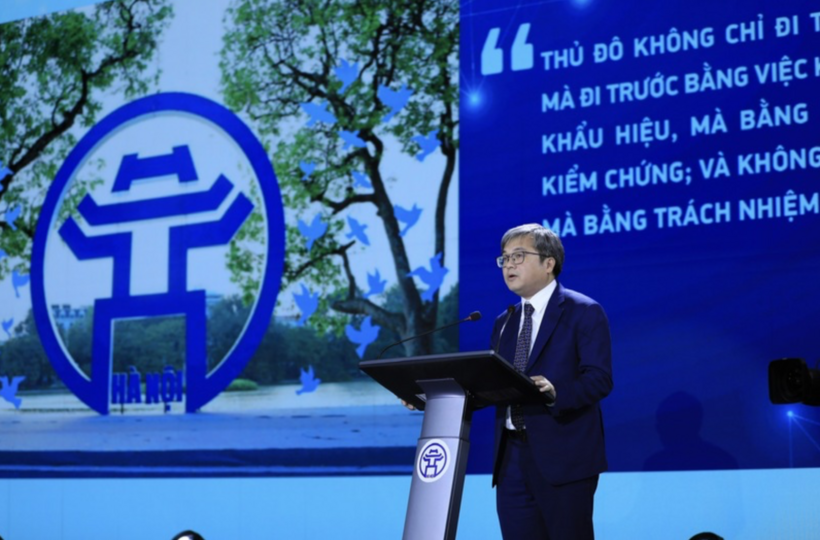
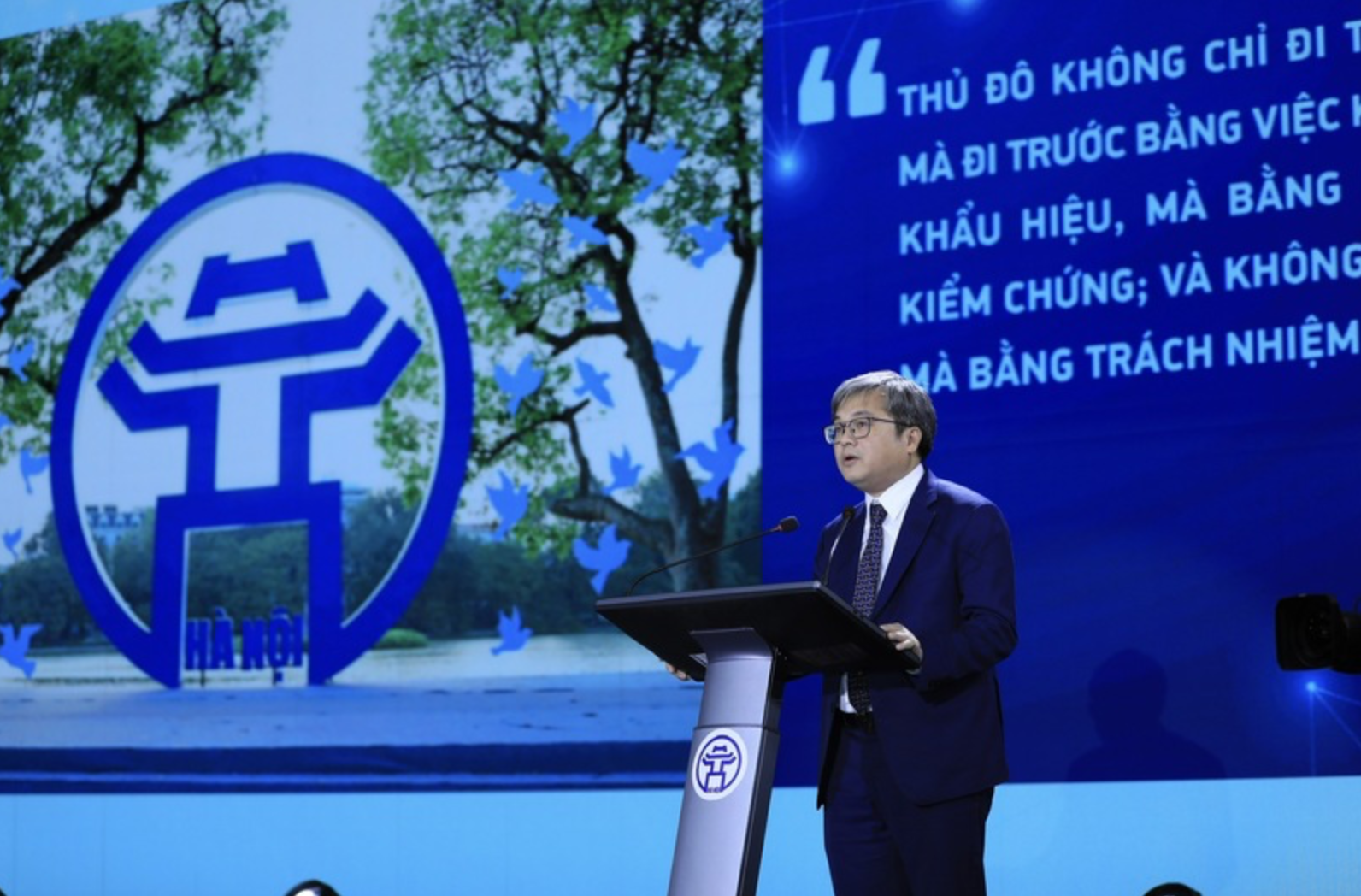
Vice Chairman of the Hanoi People's Committee Truong Viet Dung delivers a speech at the event.
Addressing the conference, Vice Chairman of the Hanoi People’s Committee Truong Viet Dung shared the Capital’s constructive approach to implementing Resolution No.57, reflecting a spirit of pioneering, acting first, and assuming accountability...
Transitioning from administrative management to fostering development space
According to Vice Chairman of the Hanoi People’s Committee Truong Viet Dung, Resolution No.57 establishes science, technology, innovation, and digital transformation as foundational drivers for growth and enhancing national competitiveness.
As the Capital, Hanoi views the implementation of Resolution No.57 not merely as executing a major policy, but as a process of experimenting with and constructing a new development model. In this framework, the State moves beyond mere administration to reshape development organization, as traditional growth drivers approach their limits.
Against this backdrop, Hanoi clearly recognizes that true breakthroughs stem not from launching more programs or funding scattered projects, but from resolving the major contradictions of modern development: the tension between the demand for rapid growth and the need for sustainability; between resource concentration and fragmented management; and between the aspiration for innovation and the absorptive capacity of the state apparatus and society.

Delegates at the event.
Consequently, Hanoi has chosen the more challenging path: pioneering to experiment, acting first to validate, and assuming accountability upfront. The city views this as a practical contribution to refining the national institutional framework.
The Vice Chairman noted that after one year of implementing Resolution No.57, the city clearly recognizes that the core mission is not merely to promote innovation in a narrow sense. Instead, it aims to construct an innovation ecosystem capable of driving development one where institutions, space, data, and human capital are fundamentally reorganized.
In this holistic framework, high-tech parks and smart cities are not viewed as isolated projects but as dual pillars of space, infrastructure, and governance. This structure paves the way for science and technology to become substantive and permeate every aspect of socio-economic life.
Constructing an innovation ecosystem and high-tech space
Vice Chairman Truong Viet Dung stated that Hanoi recognizes innovation can only thrive within a comprehensive ecosystem. In this environment, stakeholders do not merely coexist; they are interconnected, guided, and bound by mutual accountability within the value chain.
He noted that Hanoi’s consecutive leadership in the Provincial Innovation Index is not the ultimate objective, but rather an indication that the system is developing the necessary policy absorption capacity and connectivity. This positions the city to transition into a phase of proactively constructing and leading the pilot of new development models.
Hanoi’s core breakthrough lies in a fundamental shift in its approach to institutions. The city is transitioning from a mindset of “periodic support” to one of “constructive investment for innovation.”
In this model, the State does not substitute for the market but focuses on building the ecosystem's foundational components. It embraces controlled experimentation, measuring success by outcomes and substantive impact rather than merely controlling processes.
On this basis, Hanoi has issued a comprehensive set of resolutions to develop the innovation ecosystem, established intermediary institutions, and deployed controlled testing mechanisms. This approach allows for adaptive implementation, enabling the city to execute, adjust, and refine institutions simultaneously.
Practical experience demonstrates that breakthroughs do not stem from scattered incentives, but from organizing development space and governance models aligned with technology cycles. Hoa Lac High-Tech Park is identified as the spatial core of the Capital’s science and technology ecosystem.
The city has vigorously implemented decentralization and delegation, shifting from a “project management” mindset to one of “development partnership.” Accordingly, Hanoi regards the sustainable growth of investors and endogenous technological capacity as the true measures of governance effectiveness.
Building on this foundation, Hanoi is reorganizing the entire development space surrounding Hoa Lac into a science and innovation urban hub. The city is establishing a 600-hectare smart urban zone to support the high-tech park, integrating research, training, production, and living spaces. This initiative aims to form large-scale R&D centers capable of addressing strategic technological challenges, thereby resolving the core issue of attracting, retaining, and developing high-quality human resources.
Strategic connectivity infrastructure, specifically Metro Line No.5 (Van Cao - Hoa Lac), which broke ground on December 19 is recognized not merely as a transport project, but as a tool for restructuring the Capital’s development space. It facilitates the creation of a new growth pole with significant spillover effects.
Smart cities - A pillar of data-driven governance
Vice Chairman Truong Viet Dung stated that, upholding the spirit of “Civilization - Identity - Creativity,” Hanoi approaches the smart city concept primarily as a new model of urban governance. In this framework, data is identified as a strategic resource and the foundation for decision-making.
The fundamental shift involves moving from sector-based management to data-driven governance and system interconnectivity, gradually transitioning from reactive to proactive governance. Technology is defined solely as a tool to organize development space more rationally, improve public service delivery, and enable decision-making based on quantitative evidence. The city is adopting a focused approach by piloting specific development spaces, allowing for simultaneous implementation, evaluation, and adjustment.
Drawing from practical implementation, Hanoi clearly recognizes that for science, technology, innovation, and smart cities to truly become development drivers, the decisive factor extends beyond correct policy. It requires a sufficiently flexible institutional space and robust execution capacity. In this spirit, Hanoi stands ready to assume responsibility for the controlled piloting of new mechanisms. This includes clear requirements for outputs, independent evaluation, and scalability, adhering to the Capital’s role of pioneering, acting first, and testing first.
Experience demonstrates that breakthroughs occur only when innovation is coupled with execution discipline and governance quality. Fully conscious of the Capital's leading role and building on what has been implemented, tested, and accounted for, the city defines 2026 not merely as a year of continuation, but as a pivotal year in the realization of Resolution No.57.
In this spirit, the city remains steadfast in its approach. The Capital leads not merely through its status, but by undertaking difficult tasks; not through slogans, but through verifiable results; and not through declarations, but through ultimate accountability.
Moving beyond the role of a mere “resolution implementer,” Hanoi aspires to become a “testing ground for new models and a proponent of new standards.” This will serve as a practical basis for recommendations to the Central Government to further refine the institutional framework, enhance execution capacity, and replicate effective models of science, technology, innovation, and digital transformation nationwide.
As the Capital, Hanoi views the implementation of Resolution No.57 not merely as executing a major policy, but as a process of experimenting with and constructing a new development model. In this framework, the State manages and reshapes development organizations as traditional growth drivers approach their limits.
19:05 | 23/03/2025 15:56 | 26/12/2025Trade

19:05 | 23/03/2025 15:55 | 26/12/2025Industry
19:05 | 23/03/2025 15:48 | 26/12/2025News and Events
19:05 | 23/03/2025 15:06 | 25/12/2025News and Events
19:05 | 23/03/2025 10:32 | 25/12/2025Cooperation