Located at the center of the regional transportation network spanning from the Pacific Ocean to the Indian Ocean, ASEAN holds a critical geostrategic position, serving as a hub for vital maritime and aviation routes. ASEAN nations have been striving to enhance transport connectivity toward efficiency, harmony, and environmental sustainability.
 |
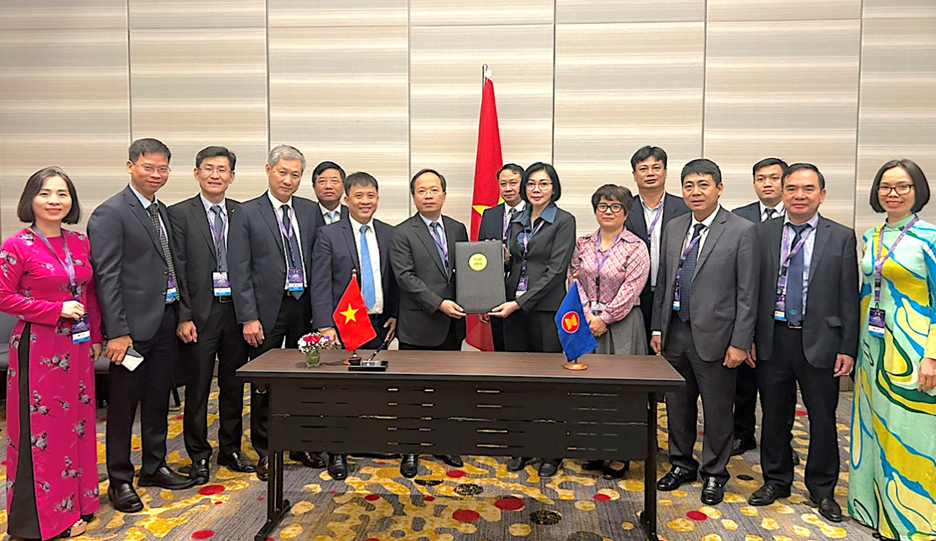
| Vietnamese Deputy Minister of Transport Nguyen Duy Lam signs Protocol 5 on Own Stopover Rights between Points within the Territory of any other ASEAN Member State - Photo: Giao Thong Newspaper |
The 30th ATM Meeting adopted the ASEAN Kuala Lumpur Road Safety Standard Framework 2024, emphasizing the importance of enhancing vehicle safety, road safety regulations, and standardizing traffic signs and rules across the region.
Within the framework of the meeting, the ministers also adopted the ASEAN Guidelines on Light Electric Vehicles to promote low-carbon options for personal transportation and urban logistics. Additionally, the Urban Freight Transport Guidelines were approved to develop sustainable and efficient logistics systems in ASEAN cities.
To enhance maritime supply chain capacity, the ministers adopted the Guidelines on Public-Private Partnerships in the Port Sector and the Guidelines on Port Digitization and Automation, promoting best practices and sustainable port operations within ASEAN.
Regarding the development of the 2026-2030 ASEAN Transport Sectoral Plan (ATSP), the ministers agreed to focus on addressing the growing demands for seamless connectivity, global trade, climate commitments, and economic growth. This ensures that ASEAN remains competitive and connected in the global context, while aligning with and supporting the 2026-2030 ASEAN Economic Community Strategic Plan. The ATSP is expected to be adopted at the 2025 ATM Meeting.
At the 30th ATM, Vietnamese Deputy Minister of Transport Nguyen Duy Lam highly appreciated the ASEAN Guidelines on Port Digitization and Automation, noting their usefulness for Vietnam and other ASEAN countries in the operation and management of infrastructure. He also expressed Vietnam’s agreement with the proposals from the Senior Transport Officials (STOM).
In his opinion, electric vehicles, port digitization and automation, public-private partnerships in infrastructure development, and urban freight transport are all timely and urgent topics.
Deputy Minister Nguyen Duy Lam also introduced Vietnam’s plans for implementing green transition and carbon emission reduction commitments in the transport sector, aiming to fulfill the Vietnamese Government’s commitment at COP 26 to achieve net-zero emissions by 2050.
To promote the liberalization process in the aviation sector and allow ASEAN countries to expand passenger transport services more flexibly and conveniently within the region, Deputy Minister Nguyen Duy Lam, on behalf of the Vietnamese Government, along with the Ministers/Heads of Transport Delegations of other ASEAN countries, signed Protocol 5 on Own Stopover Rights between Points within the Territory of any other ASEAN Member State, within the framework of the ASEAN Multilateral Agreement on the Full Liberalization of Passenger Air Services./.