Electronics and phone exports from Viet Nam reached USD 207.02 billion in the first 10 months of 2026, up strongly year over year.
Exports surge, with two product groups accounting for more than 41% of national export value
According to preliminary data released by the Customs Department under the Ministry of Finance on November 4, merchandise exports in October 2026 reached USD 64.67 billion, up 8.7% from the previous month. Cumulative exports for the first 10 months totaled USD 499.23 billion, an increase of 27.5% year over year. Imports in October reached USD 57.36 billion, down 1.4% month over month, while cumulative imports for the 10-month period amounted to USD 511.31 billion, up 37.4%. Computers, electronic products and components, together with phones and components, accounted for 41.5% of the country's total export value and 43.9% of total imports.
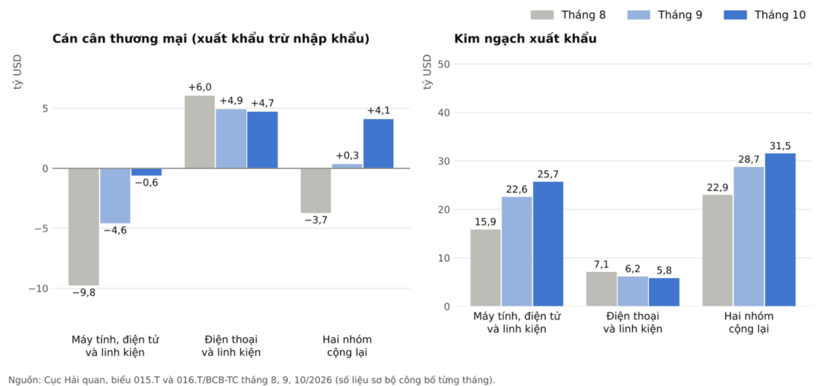
Trade balance and export value of computers, electronics, phones and components in August, September and October 2026 (USD billion).
For computers, electronic products and components, exports in October reached USD 25.68 billion, up 13.8% from the previous month and approximately 2.6 times the level recorded in the same period of 2025. Cumulative exports for the first 10 months reached USD 149.41 billion, up 71.0%, accounting for 29.9% of total national exports. Imports in October stood at USD 26.28 billion, down 3.2% month over month. For the first 10 months, imports totaled USD 215.25 billion, up 74.4%, representing 42.1% of the country's total imports. The high import value primarily reflects demand for input components used in manufacturing and export-oriented assembly.
Exports of phones and components reached USD 5.84 billion in October, approximately 15% higher than in the same period of 2025, although down 5.4% from the previous month. Cumulative exports for the first 10 months amounted to USD 57.61 billion, up 18.4%, accounting for 11.5% of total national exports. Imports in October reached USD 1.14 billion, down 9.2% month over month, while cumulative imports for the 10-month period totaled USD 9.26 billion, down 1.6%.
Production expands, while components remain critical to the supply chain
Domestic manufacturing has provided the foundation for export growth. According to the National Statistics Office under the Ministry of Finance, the national Industrial Production Index (IIP) rose 12.4% in the first 10 months of the year, with the manufacture of electronic products, computers and optical products increasing 15.2%. Estimated laptop production reached 53.5 million units, up 25.86%, while tablet production totaled 14.7 million units, up 36.61%.
Regarding components, detailed data through the end of September showed that exports of computer and electronic components reached USD 69.03 billion, up 99.82% and accounting for 55.8% of the group's total export value. Memory products alone generated USD 36.67 billion in exports, up 128.71%, while phone component exports reached USD 18.71 billion, up 10.80%.
The trade balance has also improved significantly over the past three months. Combined, the two product groups recorded a trade deficit of USD 3.72 billion in August, followed by a surplus of USD 340 million in September and a surplus of USD 4.10 billion in October.
Phones and components continued to maintain trade surpluses of USD 6.04 billion, USD 4.92 billion and USD 4.70 billion, respectively, over the three months. Meanwhile, the trade deficit in computers, electronic products and components narrowed from USD 9.76 billion in August to USD 4.58 billion in September and USD 600 million in October. The October deficit was the lowest since April 2018, helping lift the country's overall trade surplus to USD 7.31 billion for the month.
For the first 10 months of 2026, the two groups combined recorded a trade deficit of approximately USD 17.5 billion, with exports totaling USD 207.02 billion and imports reaching USD 224.51 billion.
During the final two months of the year, exports of electronics and components are likely to maintain their upward momentum, supported by two key factors.
The first is international demand and pricing for memory products. According to a report by the Industry and Trade Information Center, global semiconductor sales reached USD 159.7 billion in August 2026, up 144.3% year over year, based on data from the Semiconductor Industry Association (SIA). Meanwhile, TrendForce forecasts that DRAM prices will increase by 10% - 15% in the fourth quarter of 2026. Viet Nam's memory exports had already reached USD 36.67 billion through the end of September, up 128.71%. If international prices continue to rise, export revenues from components could receive an additional boost.
The second factor is domestic production. The increases of 25.86% in laptop output and 36.61% in tablet production over the first 10 months have helped expand the supply base for year-end orders. Imports of computers and electronic products fell 3.2% in October from the previous month. Since components are typically imported before finished products are manufactured and exported, this development warrants further monitoring to assess production activity and order volumes in November and December.
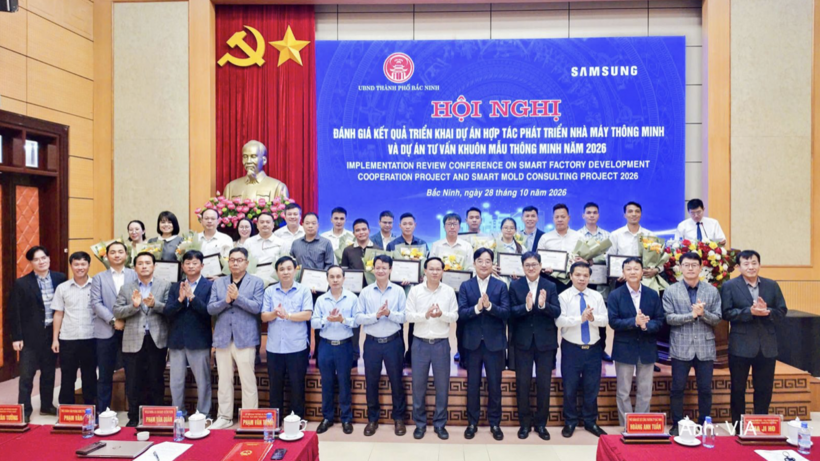
Representatives of the Bac Ninh authorities, leaders of the Industry Agency and Samsung Viet Nam pose for a group photo with businesses participating in the 2026 Smart Factory Development Cooperation Project and Smart Mold Consulting Project.
Strengthening links between FDI enterprises and domestic businesses: Key priorities and considerations
According to a report by the Industry and Trade Information Center, components such as microprocessors, semiconductor chips, memory products, displays and circuit boards are currently sourced primarily from overseas. Meanwhile, domestic enterprises have begun participating in the supply of certain components, accessories and supporting services. This provides a foundation for strengthening business linkages, in line with the objectives of the Supporting Industries Development Program for 2026 - 2035, issued under Decision No. 929/QD-TTg dated May 25, 2026.
A number of recent initiatives are helping translate this policy direction into concrete action. The Southern Region Smart Factory Development Cooperation Project, jointly implemented by Samsung Viet Nam and the Ho Chi Minh City Department of Industry and Trade since May 2026, supports Vietnamese businesses in digitalizing their manufacturing operations.
At a forum held in Bac Ninh on November 4, the province was reported to have attracted approximately 3,700 FDI projects, with total registered capital of around USD 52.5 billion as of September 2026. Participants emphasized the importance of developing supporting industries and increasing the domestic content ratio.
Going forward, businesses are encouraged to continue investing in technical workforce training, strengthening their capabilities in component design and testing, and meeting the standards required by multinational corporations.
At the same time, businesses exporting data-connected products to the European Union market should closely monitor Regulation (EU) 2024/2847 concerning cyber resilience. The regulation will take effect on December 11, 2027, and requires cybersecurity to be maintained throughout the entire product life cycle.
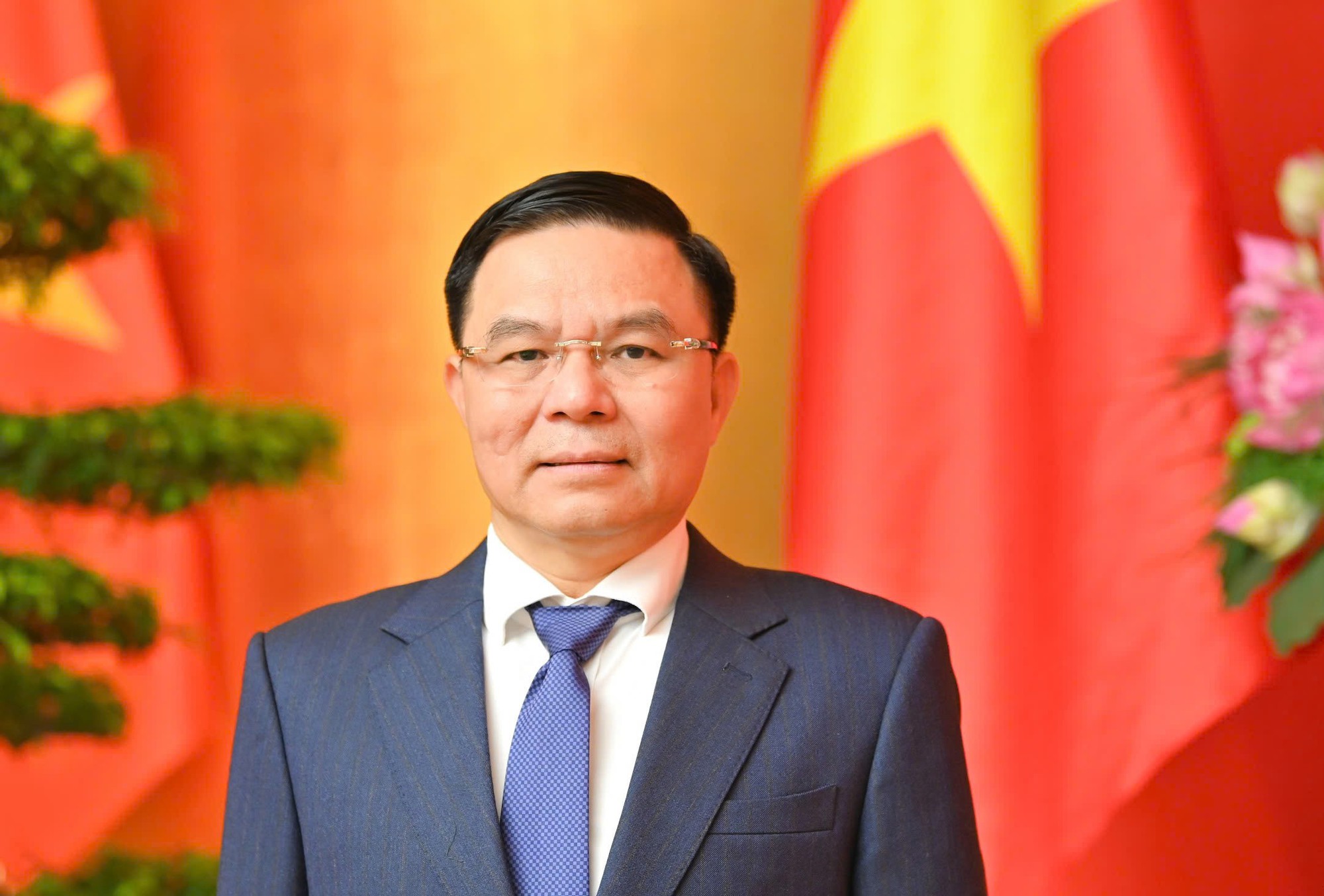
On the occasion of Viet Nam Law Day, November 9, 2026, Minister of Industry and Trade Le Manh Hung has sent a congratulatory message to all officials and civil servants working in institutional and legal development across the industry and trade sector.
The visit is expected to turn agreements and commitments reached by high-ranking leaders into practical cooperation schemes and projects across various fields, and make positive contributions to each country’s development goals as well as global and regional peace, cooperation and development.
The Newspaper of Industry and Trade presents a podcast series on the implementation of the Politburo's Resolution No. 57-NQ/TW in the industry and trade sector.
A new international-standard 3S dealership in Ho Chi Minh City will provide integrated vehicle sales, maintenance, repair and genuine spare parts services for transport businesses.
Newspaper of Industry and Trade introduces a podcast series on the implementation of Politburo Resolution No. 57 in the Ministry of Industry and Trade.