Vietnam’s tea exports rose nearly 30% in January 2026, but falling prices highlight the urgent need to shift from bulk sales to higher-value, branded products.
Market shifts signal a race for quality
According to data from the Customs Department, in January 2026 Vietnam exported 12,390 tonnes of tea, earning nearly USD 21 million, up 28% in volume and 27% in value compared to the same period in 2025.
Amid continued volatility in global agricultural trade, this growth is noteworthy, indicating that market demand for Vietnamese tea remains positive.
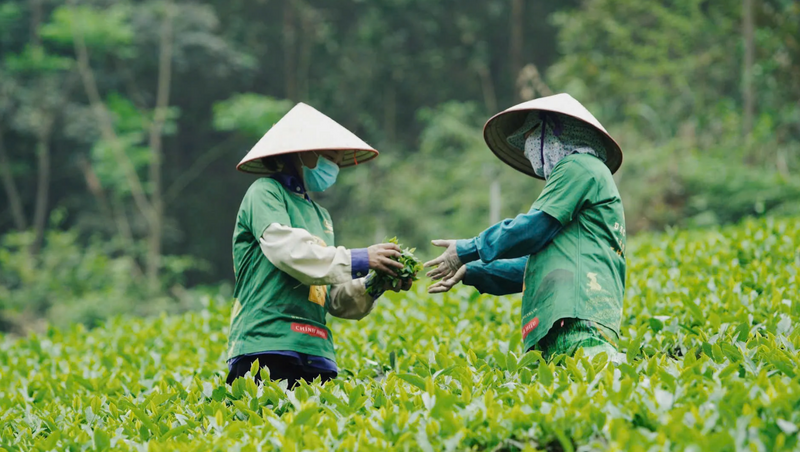
Vietnam exported 12,390 tonnes of tea in January 2026, earning nearly USD 21 million, up 28% in volume and 27% in value year-on-year. Photo: Hong Tham
However, the average export price reached only USD 1,686 per tonne, down 2.29% from December 2025 and slightly down 0.45% year-on-year. This development reflects a familiar reality: growth continues to rely largely on expanding output, while value addition has yet to see a corresponding breakthrough.
The structure of export markets is also undergoing noticeable changes. Exports to Russia, India and Poland increased sharply; notably, the Philippines recorded triple-digit growth, surging 544.7% in volume and 312.2% in value compared to January 2025.
Conversely, two major markets China and Taiwan (China) showed contrasting trends. Exports to China improved, while shipments to Taiwan (China) declined. The three largest markets in January were Pakistan, Taiwan (China) and China, accounting for 25.8% of total tea export turnover.
Of these, exports to China reached 1.14 thousand tonnes worth USD 1.52 million, accounting for 9.2% of total volume; Taiwan (China) reached 1.13 thousand tonnes worth USD 2.2 million, accounting for 9.16%. Notably, Pakistan, which accounted for 35.2% in January 2025, fell to 7.5% in January 2026, with output of 930 tonnes down more than 70% year-on-year.
These figures suggest that market structures are increasingly dependent on quality, traceability and the ability to meet technical standards. As markets tighten requirements on food safety, chemical residues and environmental responsibility, product narratives and certification systems have become essential “passports.” This is precisely the moment for the tea industry to shift from a mindset of “selling raw materials” to “selling value.”
Moving beyond low-priced bulk tea to reposition Vietnamese tea
Against this backdrop, production models linked to regional branding are demonstrating a more sustainable path.
In Yen Binh commune, Thai Nguyen province, Ban Moc Agricultural Cooperative has chosen to develop Shan Tuyet tea along organic lines, standardizing processes while telling a story rooted in local culture.
Its two flagship products Shan Tuyet green tea and Shan Tuyet black tea are positioned in segments that emphasize quality and natural value. The raw materials are harvested from ancient tea trees growing naturally in forests at elevations above 800 meters above sea level.
In remarks to the Newspaper of Industry and Trade, Ma Van Thong, Director of Ban Moc Agricultural Cooperative, said that at this altitude, the cool year-round climate, wide day-night temperature differences, dense fog and nutrient-rich soil allow tea buds to grow slowly and accumulate distinctive flavors, creating the characteristic natural white “snow” layer. Rushing production for higher yields would make it difficult to preserve that original flavor.
While many areas prioritize output, the cooperative has opted for organic cultivation, minimizing chemical use, applying manual care and allowing trees to grow according to natural cycles. Stable quality and long-term credibility are considered the core foundation for brand building. The cooperative has obtained PGS organic certification, an important factor in building consumer trust.
Current consumption trends also favor this approach. Buyers increasingly focus on origin, production processes and health value rather than merely packaging appearance. The cooperative’s customers are mainly those prioritizing clean, organic products with clear traceability.
Tea lines are graded based on processing complexity. Shan Tuyet black tea, with its more elaborate and time-intensive process, is priced higher than traditional green tea. Pricing based on quality and labor value rather than competing on low prices helps position products in a higher segment.
From another perspective, in remarks to the Newspaper of Industry and Trade, Ha Duc Thang, Director of V-Shantea Cooperative in Son La province, noted that many tea-growing regions still sell bulk tea at very low prices. In some cases, export prices are so low that they hardly reflect the true value of raw materials and farmers’ efforts.
According to Thang, continuing along the path of bulk tea exports will not improve farmers’ incomes or create sustainable value for enterprises. The only viable path is to innovate production methods and invest in knowledge, technology and branding.
“We are building the V-Shantea brand, where ‘San’ stands for Shan Tuyet, ‘Tea’ represents tea, and ‘V’ symbolizes Vietnam. Through this, we hope to change international perceptions of Vietnamese tea from low-priced black tea to high-value tea lines with genuine quality and distinct identity,” he said.
Tea exports in January 2026 rising nearly 30% is an encouraging signal, but it is not sufficient to secure long-term positioning. Amid intensifying competition, only products meeting high standards, backed by clear stories and well-invested branding, will be able to enhance value.
Building the Vietnamese tea brand goes beyond packaging design or media promotion. It requires a synchronized process from raw material regions and production processes to certification systems and cultural storytelling associated with the product. When consumers understand and trust that value, they are willing to pay higher prices.
The FTA Vietnam - EFTA creates new opportunities for Vietnamese businesses while encouraging stronger competitiveness, compliance and sustainable development.
Ministry of Industry and Trade removed more than 9,000 infringing products and blocked over 2,000 online stores in a nationwide crackdown on counterfeit goods.
Sustainable production and consumption are becoming business imperatives as companies invest in greener technologies, circular design and digital transformation.
Vietnam's domestic market remained resilient in the first half of 2026 despite global turbulence, with inflation under control and retail sales continuing to grow.
From 29 June, Vietnam’s domestic carbon market officially entered its pilot phase, marking a transition from emissions management through administrative command-and-control measures to a market-based mechanism.
The FTA Vietnam - EFTA creates new opportunities for Vietnamese businesses while encouraging stronger competitiveness, compliance and sustainable development.
In an interview with the press regarding the Free Trade Agreement (FTA) between Vietnam and the European Free Trade Association (EFTA), Deputy Minister of Industry and Trade Nguyen Sinh Nhat Tan emphasized that the agreement will lay the foundation for economic relations between Vietnam and EFTA to enter a new stage of development.
At a second-quarter 2026 conference, the MoIT urged Vietnam's Trade Offices abroad to strengthen intelligence and help exporters adapt to changes and expand exports.
Vietnam and Israel discuss strengthening VIFTA implementation to expand trade, investment and cooperation, aiming to boost bilateral economic ties and market access.
More than 100 businesses attend the Vietnam-Japan Investment and Trade Cooperation Conference in Osaka to strengthen investment, trade and supply chain connectivity.