Nordic ambassadors in Vietnam have shared insights on digital transformation in public services and commended Vietnam’s implementation of a two-tier local government model.
The Nordic countries consistently rank among the world’s leaders in welfare, digital transformation, and public governance. Their governance models are widely praised for integrating universal social protection systems, advanced digital public services, and exceptionally high levels of transparency and public trust.
On the sidelines of the seminar “Effective Decentralization in the Digital Era - Sharing Experiences Between Vietnam and Nordic Countries,” co-organized by the Ho Chi Minh National Academy of Politics and the embassies of Denmark, Finland, Sweden, and Norway on March 18, Nordic ambassadors in Vietnam offered valuable perspectives on decentralization and delegation of authority. They also expressed strong appreciation for Vietnam’s administrative reforms and its adoption of a two-tier local government structure.
Citizens at the Center of Service Delivery
Norway stands out for its welfare model characterized by universal access, strong municipal accountability, and high public trust. Municipalities play a central role in delivering healthcare, social services, and employment support, while the central government establishes clear legal frameworks, financial mechanisms, and digital infrastructure. This balance enables decentralization to function effectively without compromising equity or service quality.
Norwegian Ambassador to Vietnam Hilde Solbakken noted that Norway’s decentralization process is grounded in clear national frameworks while ensuring strong local autonomy. Parliament sets national goals, standards, and citizens’ entitlements, whereas local authorities are responsible for implementation. This approach ensures that citizens across the country receive comparable public services, even though specific solutions may vary by locality.
Norwegian Ambassador to Vietnam Hilde Solbakken. Photo: Bao Thoa
She further emphasized that a key factor is the clear delineation of responsibilities. The state focuses on policymaking, regulation, and national-level revenue allocation, while municipalities handle day-to-day service delivery. The combination of well-defined authority, stable financial resources, and strong local capacity helps maintain consistency in both policy and implementation.
Finland has made sustained investments in education and nationwide digital skills programs. As a result, 82% of its population possesses basic digital skills, well above the European Union average of 55.6%, according to the Digital Decade 2025 report. This foundation enables both citizens and businesses to easily access and adopt digital public services, accelerating digital transformation across both public and private sectors.
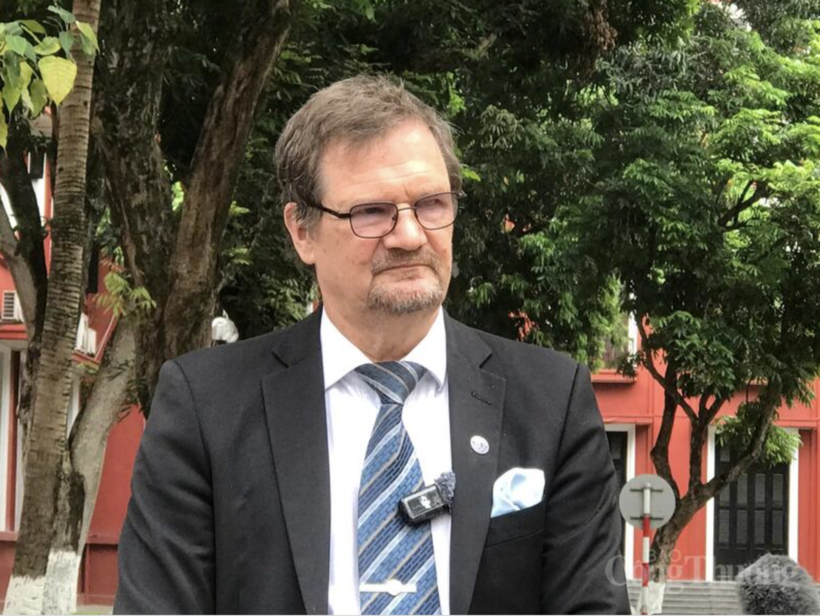
Finnish Ambassador to Vietnam Pekka Voutilainen highlighted that Finland’s service system operates on a two-tier, or nearly three-tier, structure, with local governments overseeing a wide range of areas, from healthcare to taxation and other essential services. This model allows local authorities to act proactively and flexibly in designing and delivering services tailored to the specific needs of their communities.
Finnish Ambassador to Vietnam Pekka Voutilainen. Photo: Bao Tho
He stressed that digital transformation should simplify procedures rather than make them more complex. At the same time, it must be accompanied by robust data protection and cybersecurity measures to mitigate risks such as cybercrime and financial loss. Digital public services should be designed to be simple and accessible, with private sector participation complementing both local and central governments in delivering citizen-centric services.
In Denmark, municipalities play a pivotal role in providing core welfare services such as healthcare, social care, and education, supported by a clear fiscal framework and close coordination between central and local authorities. Denmark is also known for its advanced digital governance, which enhances accessibility, efficiency, and transparency in public service delivery.
Danish Ambassador Nicolai Prytz noted that citizen- and business-oriented digitalization of public services brings significant benefits. It not only reduces costs but also markedly improves operational efficiency. At the same time, it enhances user experience, allowing citizens to complete numerous administrative procedures via smartphones instead of visiting government offices, queuing, and potentially making multiple trips.
Sweden’s comprehensive social welfare system is the result of continuous reform, designed to remain resilient amid demographic shifts and labor market changes.
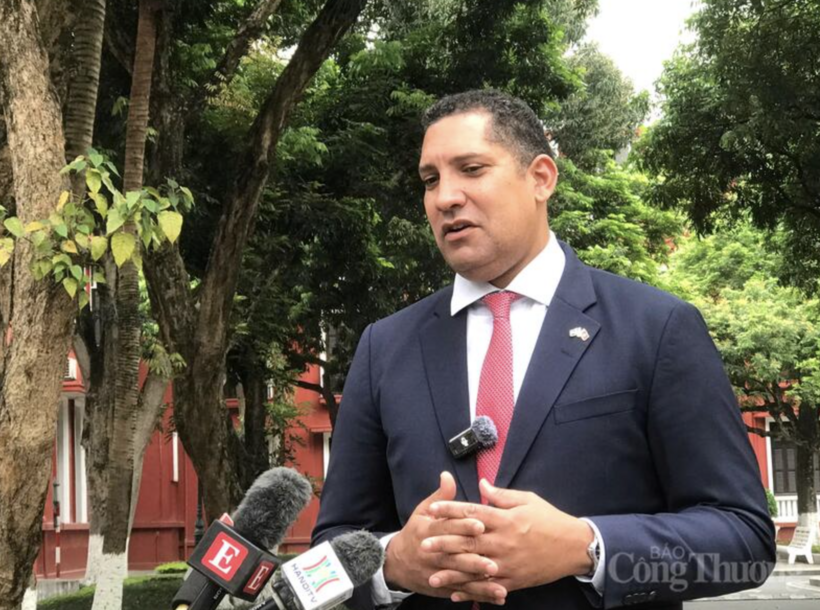
Swedish Ambassador to Vietnam Johan Ndisi explained that Sweden has approximately 290 municipalities, which are responsible for services such as education and local infrastructure. This is also reflected in the tax system: most citizens pay taxes primarily to local governments, while only higher-income individuals are subject to additional national taxes.
He added that Sweden is currently exploring the application of new technologies to improve public service delivery and streamline administrative procedures. A critical principle is ensuring that no one is left behind. “When deploying technology, we must consider not only younger users but also ensure that older people can access and use these services, while accommodating linguistic diversity in society,” he said.
Swedish Ambassador to Vietnam Johan Ndisi. Photo: Bao Thoa
Safeguarding public trust
Ambassador Hilde Solbakken observed that Vietnam’s transition to a two-tier local government system is similar to models adopted in many countries. Regardless of whether there are two or three tiers, Norway’s experience shows that maintaining public trust in the state and public institutions is essential.
“In Norway and other Nordic countries, successful implementation takes time. Local governments need time to build capacity to effectively exercise newly delegated powers and deliver quality public services. They also need time to learn and adapt to new processes. This is a gradual transition,” she noted.
She suggested that key factors for successful decentralization include clearly defining roles and responsibilities between central and local governments; ensuring adequate human and financial resources at the local level; and maintaining transparency and openness so that citizens understand decision-making processes and can exercise their right to participate.
Swedish Ambassador Johan Ndisi also remarked that Vietnam has made rapid progress in certain areas, whereas similar reforms in Nordic countries often take longer. A fundamental principle of decentralization, he said, is aligning responsibilities with resources at each level of governance. He also underscored the importance of effective data utilization, particularly the need to strengthen the protection of citizens’ data.
Industry and Trade Newspaper would like to introduce a podcast series on the implementation of the Politburo's Resolution No. 57 in the Industry and Trade sector.
GREENTECH HA NOI 2026 showcases green technologies and energy-efficient solutions that help businesses cut emissions, optimize costs, promote sustainable production.
The programme connects Vietnamese businesses with Chinese investors, expanding opportunities for investment, technology cooperation and supply chain links.
Viet Nam and Poland are exploring complementary strengths in furniture manufacturing, machinery, raw materials and technology to develop regional supply chains.
The MoIT calls for proactive risk management and supply diversification to prevent energy supply disruptions amid global geopolitical and market uncertainties.
GREENTECH HA NOI 2026 showcases green technologies and energy-efficient solutions that help businesses cut emissions, optimize costs, promote sustainable production.
On the sidelines of the BRICS Summit in New Delhi, Senior Lieutenant General Nguyen Truong Thang held a meeting with Indian Defence Secretary Rajesh Kumar Singh, agreeing to expand defence cooperation.
Viet Nam has identified strengthening energy security and resilience, accelerating a clean and just energy transition, and promoting innovation, investment and regional connectivity as three strategic priorities in responding to profound changes in the global energy landscape.
The Viet Nam-Japan Business Forum 2026 will take place in Hanoi, bringing together around 250 delegates for trade and investment matchmaking and business networking.