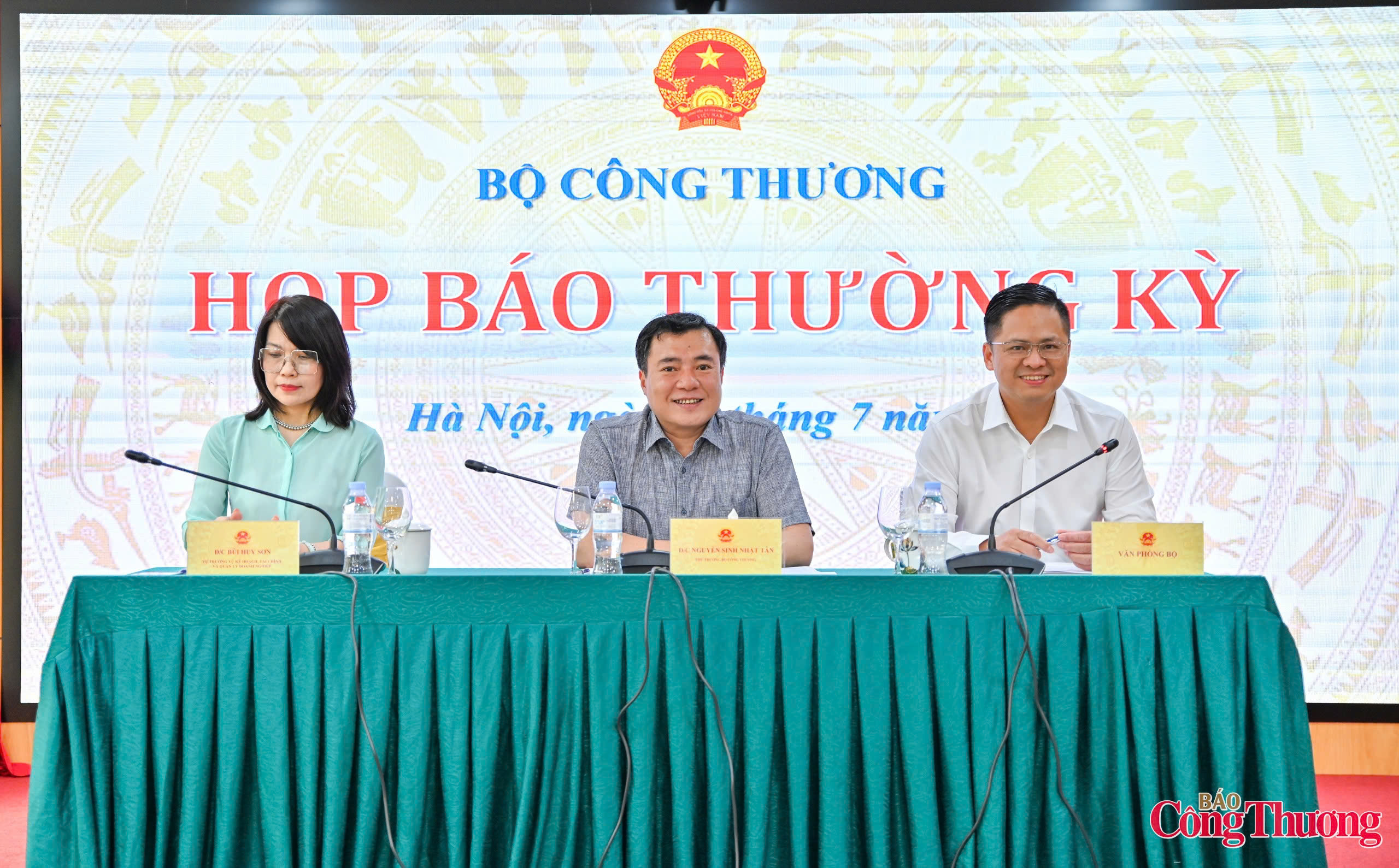
On the afternoon of July 7 in Hanoi, the Ministry of Industry and Trade (MoIT) held its regular press briefing for the second quarter of 2026.
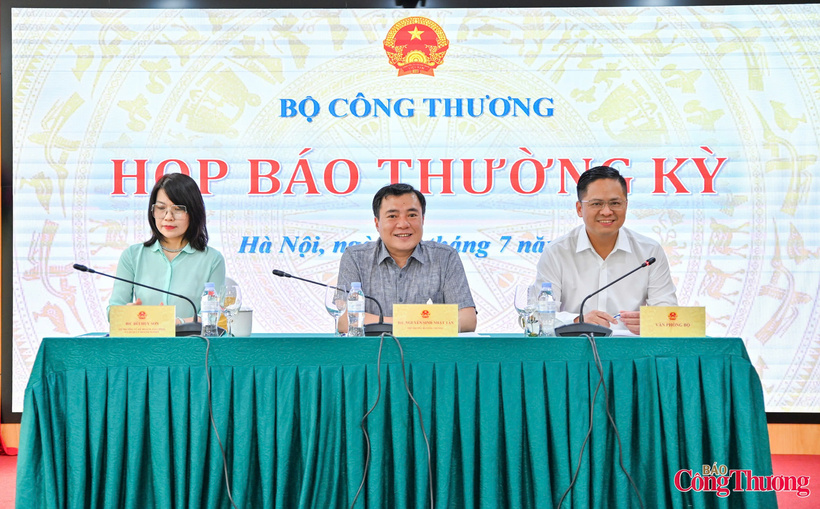
The press briefing was chaired by Deputy Minister of Industry and Trade Nguyen Sinh Nhat Tan. Representatives from MoIT’s departments and agencies, along with members of the press, also attended the event.
The press briefing was chaired by Deputy Minister of Industry and Trade Nguyen Sinh Nhat Tan. Photo: Nam Nguyen
Industrial production remains a key driver of economic growth
Reporting at the press briefing, Mai Thi Thu Hien, Deputy Director of the Department of Planning, Finance and Enterprise Management under the MoIT, said that during the first six months of 2026, the global landscape continued to evolve rapidly, with increasingly complex and unpredictable developments. Strategic competition among major powers, the growing use of trade protection measures, geopolitical conflicts, as well as volatility in global energy markets and supply chains created considerable pressure on production, trade and investment activities.
Ministry of Industry and Trade holds regular press briefing for the second quarter of 2026. Photo: Nam Nguyen
Against this backdrop, the MoIT closely followed the directions of the Party Central Committee, the National Assembly, the Government and the Prime Minister, while proactively implementing a wide range of measures to promote industrial development, ensure national energy security, develop the domestic market and boost exports. These efforts continued to reinforce the ministry’s role as one of the key contributors to Vietnam’s GDP growth of 8.18% in the first half of 2026.
Amid rising energy demand and heightened volatility in global energy markets, the MoIT proactively managed the supply of electricity, petroleum and other essential energy sources to fully meet the needs of production, business activities and daily life. The national power system operated safely and stably, with electricity generation and imports reaching approximately 171.07 billion kWh, up 9.57% year-on-year, meeting the requirements of socio-economic development.
Regarding the petroleum market, the ministry closely monitored developments in international markets, promptly advised on appropriate regulatory measures, and coordinated with key petroleum traders to ensure adequate supply and maintain domestic market stability. No supply disruptions occurred, even during periods when the conflict in the Middle East caused sharp fluctuations in global oil prices. At the same time, the ministry advised on implementing the roadmap for nationwide use of biofuel gasoline from June 1, 2026, contributing to the transition toward a greener and more sustainable energy system.
The Index of Industrial Production (IIP) was estimated to increase 11.2% year-on-year in the second quarter of 2026, with the manufacturing and processing sector rising 11.3%, while electricity production and distribution expanded 12.4%. For the first six months of the year, the IIP was estimated to grow 10.8% compared with the same period last year, higher than the 8.7% growth recorded in the corresponding period of 2025. Manufacturing and processing increased 11.4%, compared with 10.5% a year earlier, while electricity production and distribution rose 9.6%, up from 4.1% in the first half of 2025.
Several localities recorded exceptionally strong industrial growth, including Ha Tinh, Ninh Binh, Phu Tho, Nghe An, Thai Nguyen, and Bac Ninh. By the end of the first half of the year, 13 out of 34 localities had met or exceeded their annual industrial growth targets. However, 15 out of 34 localities remained below target, highlighting the need to accelerate industrial production in the second half of the year.
Trade maintains strong growth momentum
Alongside industrial production, total retail sales of goods and consumer service revenue continued to record robust growth, with an estimated increase of 13.9% year-on-year in the second quarter of 2026. In the first six months of the year, the figure was estimated to rise 12.9% compared to the same period last year, approaching the full-year target.
Goods supply remained sufficient, the market stayed broadly stable, and there were no shortages or unusual price fluctuations in essential commodities. The MoIT effectively implemented a range of measures to stimulate domestic consumption, strengthen supply-demand connectivity, develop distribution networks and e-commerce, and promote the campaign “Vietnamese people give priority to using Vietnamese goods,” thereby reinforcing domestic purchasing power and supporting businesses in expanding their markets.
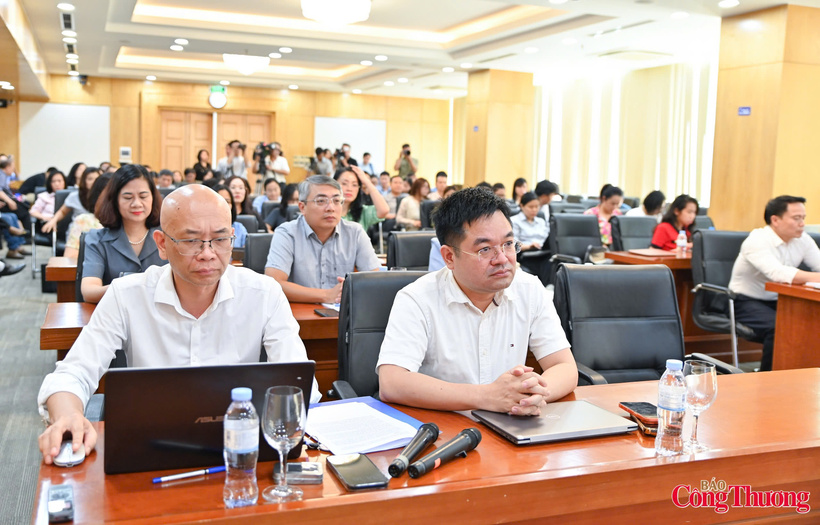
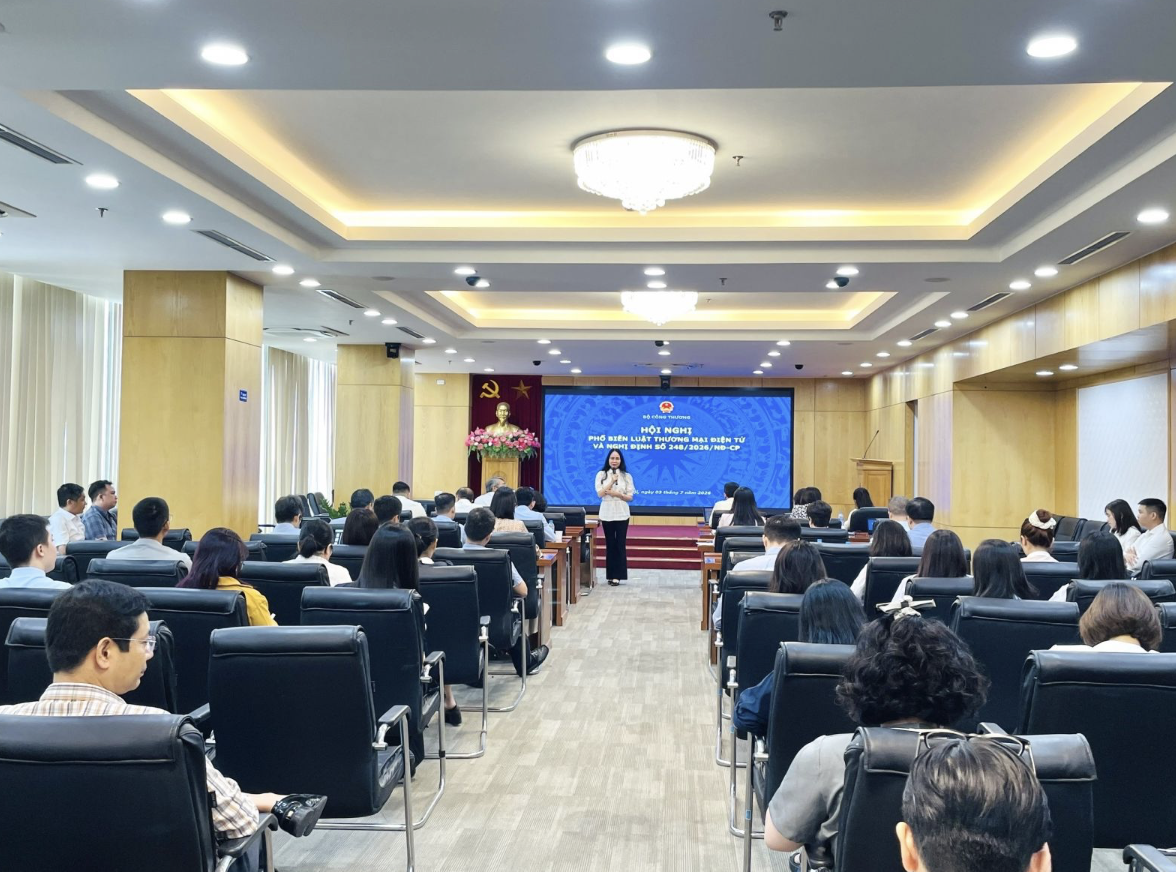
The press briefing is attended by representatives from MoIT's departments and agencies, along with a large number of journalists from news agencies and media organizations. Photo: Nam Nguyen
Regarding foreign trade, export turnover reached USD 143.6 billion in the second quarter of 2026, up 22.7% year-on-year, while imports totaled USD 156.6 billion, an increase of 39.1% over the same period last year. In the first six months of the year, total import-export turnover reached approximately USD 549.69 billion, up 27.1% year-on-year, including:
Merchandise exports totaled USD 266.52 billion, up 21.0% year-on-year. Of the total, the domestic economic sector generated USD 53.51 billion, up 4.6%, accounting for 20.1% of total exports, while the foreign-invested sector, including crude oil, reached USD 213.01 billion, up 26.0%, accounting for 79.9%. A total of 29 commodities posted export turnover exceeding USD 1 billion, representing 92.1% of total exports, including five commodities with export value surpassing USD 10 billion, accounting for 62.6%. Exports of processed industrial products reached USD 239.8 billion, making up 90.0% of total export turnover. The US remained Vietnam’s largest export market, with export turnover reaching USD 86.5 billion. Vietnam recorded a trade surplus of USD 75.3 billion with the US, up 21.3% year-on-year.
Imports reached USD 283.17 billion, an increase of 33.4% over the same period last year. The domestic economic sector imported goods worth USD 78.46 billion, up 24.3%, while the foreign-invested sector imported USD 204.71 billion, up 37.3%. There were 38 imported commodities valued at more than USD 1 billion, accounting for 92.1% of total import turnover, including two commodities with import value exceeding USD 10 billion, representing 51.0%. China remained Vietnam’s largest source of imports, with import turnover reaching USD 115.2 billion.
Vietnam’s trade deficit with China stood at USD 77.3 billion, up 39.0% year-on-year. Import growth was mainly driven by machinery, equipment, components and raw materials serving production, reflecting businesses’ expanding investment and production capacity. Imports of production materials totaled USD 266.4 billion, accounting for 94.1% of total imports, of which machinery, equipment, tools and spare parts represented 56.0%, while raw materials and fuels accounted for 38.1%.
Vietnam recorded a merchandise trade deficit of USD 2.64 billion in June. For the first six months of the year, the trade deficit reached USD 16.65 billion, compared to a trade surplus of USD 7.95 billion in the same period last year. The domestic economic sector posted a trade deficit of USD 24.95 billion, while the foreign-invested sector, including crude oil, recorded a trade surplus of USD 8.3 billion.
MoIT also made effective use of free trade agreements to diversify export markets while strengthening its early warning system and supporting businesses in responding to trade remedy measures as well as new requirements related to green development, product traceability and carbon emissions.
Implementing a wide range of key tasks
According to Mai Thi Thu Hien, during the second half of 2026, the MoIT will continue to closely follow the directions of the Party Central Committee, the National Assembly and the Government, while proactively monitoring domestic and international developments in order to promptly advise on appropriate policy measures and focus on implementing several key tasks.
First, the ministry will continue to firmly safeguard national energy security by ensuring adequate supplies of electricity, petroleum and other essential energy sources, accelerating the implementation of key power generation and transmission projects, and effectively carrying out the revised Power Development Plan VIII.
Second, it will promote industrial development by removing obstacles facing businesses, advancing the manufacturing and processing industry, supporting industries and high-tech sectors, while coordinating with local authorities to expedite industrial and energy projects capable of being commissioned within 2026.
Third, the ministry will further develop the domestic market through effective consumer demand stimulus programs, modern distribution systems, e-commerce and logistics, while strengthening market surveillance and combating smuggling, trade fraud and counterfeit goods.
Fourth, MoIT will continue promoting exports and improving the quality of trade growth by further diversifying markets, making full use of free trade agreements, supporting businesses in meeting new standards imposed by importing markets, and strengthening trade remedy capabilities.
At the same time, the ministry will continue improving institutions, reforming administrative procedures, accelerating digital transformation, accompanying the business community, promptly addressing difficulties, enhancing competitiveness, and enabling enterprises to participate more deeply in global value chains.
With a proactive, flexible, determined and effective approach, the MoIT will continue working closely with ministries, sectors, localities and the business community to firmly safeguard national energy security, promote industrial development, further leverage the domestic market, expand exports, and strive to fulfill the sector’s development targets to the highest possible level, thereby contributing to the successful implementation of Vietnam’s socio-economic development goals for 2026.
The FTA Vietnam - EFTA creates new opportunities for Vietnamese businesses while encouraging stronger competitiveness, compliance and sustainable development.
Ministry of Industry and Trade removed more than 9,000 infringing products and blocked over 2,000 online stores in a nationwide crackdown on counterfeit goods.
Sustainable production and consumption are becoming business imperatives as companies invest in greener technologies, circular design and digital transformation.
Vietnam's domestic market remained resilient in the first half of 2026 despite global turbulence, with inflation under control and retail sales continuing to grow.
From 29 June, Vietnam’s domestic carbon market officially entered its pilot phase, marking a transition from emissions management through administrative command-and-control measures to a market-based mechanism.
Ministry of Industry and Trade removed more than 9,000 infringing products and blocked over 2,000 online stores in a nationwide crackdown on counterfeit goods.
Vietnam's domestic market remained resilient in the first half of 2026 despite global turbulence, with inflation under control and retail sales continuing to grow.
The Ministry of Industry and Trade introduced the Law on E-commerce and its implementing decree, establishing new rules for online business and consumer protection.