Vietnam has launched a pilot carbon market on June 29, marking a shift where emissions are priced and businesses compete through technology and governance capacity.
From June 29, Vietnam officially launched a pilot carbon market, opening a new phase in which emissions are priced through market-based mechanisms. For enterprises, this marks a new form of competition centered on data, technology and governance capacity.
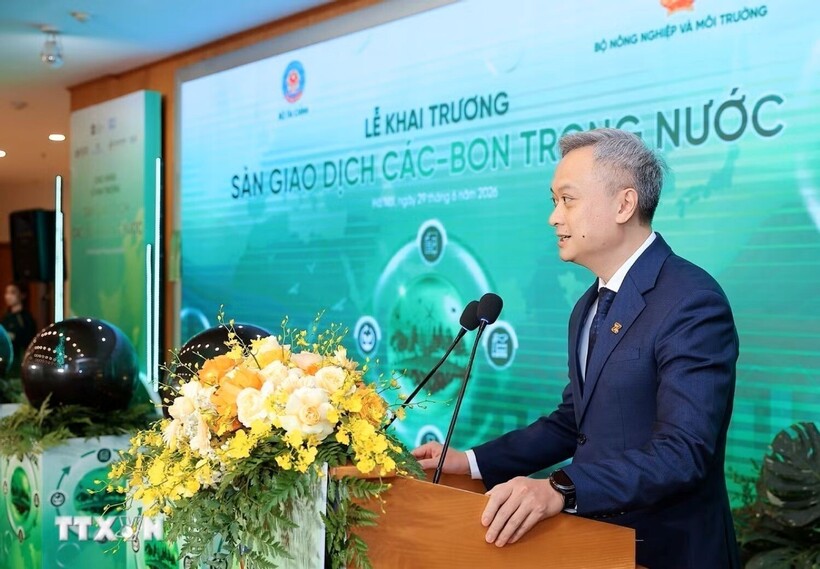
HNX Chairman Nguyen Anh Phong, Chairman of the Hanoi Stock Exchange, delivers remakrs at the opening ceremony of Vietnam’s domestic carbon trading platform, marking the official launch of the country’s pilot carbon market. Photo: VNA.
Carbon begins to carry a price, forcing businesses to rethink competitiveness
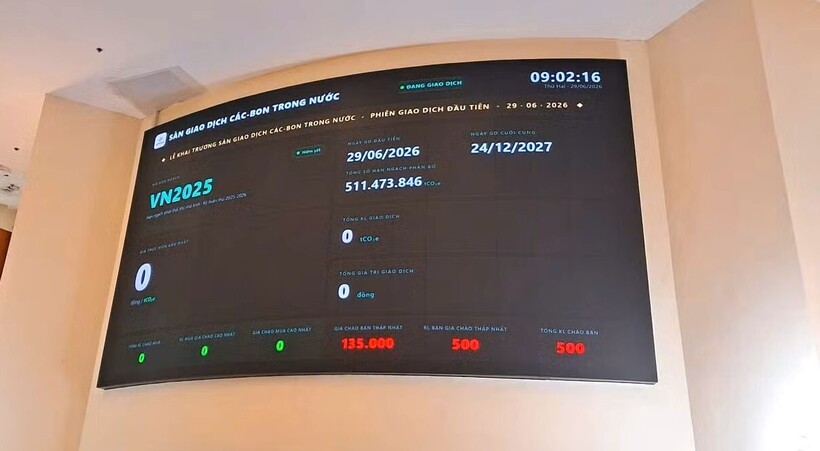
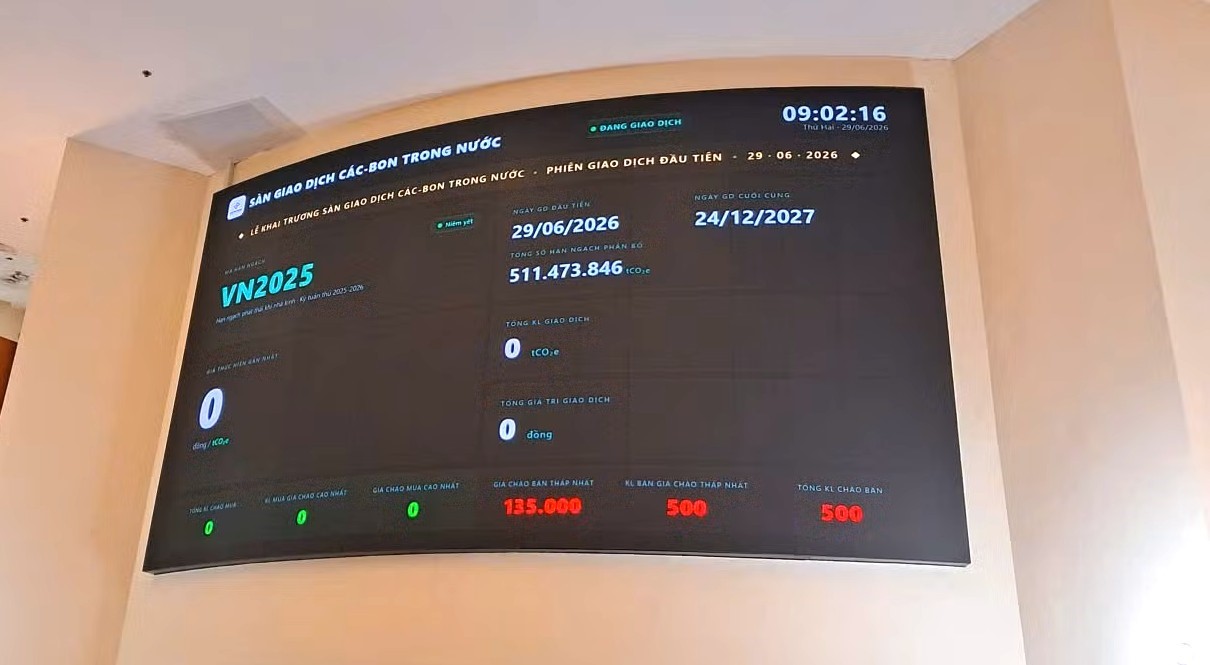
According to the Department of Climate Change under the Ministry of Agriculture and Environment, approximately 511.47 million tons of CO2 emission allowances have been allocated for the 2025 - 2026 period. A total of 92 enterprises in three major high-emitting sectors, including thermal power, steel and cement, are participating in this initial phase. Trading activities will run from June 29, 2026 to December 24, 2027, before the market officially becomes fully operational from 2029.
Carbon exchange officially begins operation on June 29. Photo: Tuan Anh.
The launch of the carbon exchange is not only an implementation step toward Vietnam’s net-zero emissions commitment by 2050 but also the beginning of the process of pricing carbon within the economy. From this point, carbon becomes a new cost factor, directly affecting production efficiency, competitiveness and corporate investment strategies.
Unlike the earlier phase focused solely on greenhouse gas inventories, enterprises must now not only quantify emissions but also calculate the economic value of each ton of CO2 generated. Under the current mechanism, companies emitting below their allocated quota may sell surplus allowances on the market. Conversely, those exceeding their limits must purchase additional allowances or use carbon credits to offset emissions, with a cap of 30% of their allocated quota. This means emission reduction is no longer purely an environmental responsibility but has become a financial decision.
Nguyen Tien Hai, Technical Director of the Vietnam Energy and Environment Consultancy Joint Stock Company (VNEEC), said the essence of the carbon market is to establish a price for greenhouse gas emissions. When allowances and carbon credits are traded under market mechanisms, enterprises gain an economic incentive to invest in clean technologies, energy efficiency and better resource utilization.
According to Hai, facilities emitting below their allocated quotas can transfer surplus allowances, generating additional revenue to offset the cost of technology upgrades. On the other hand, high-emitting units must consider the trade-off between purchasing additional allowances and investing in emission reduction technologies.
Notably, once carbon is priced, many investments previously considered purely environmental costs may become profitable assets by reducing future allowance obligations. In the broader perspective, effective emission control also helps enterprises meet increasingly stringent requirements from global supply chains, international investors and carbon adjustment mechanisms being adopted in many export markets.
Carbon data becomes a new “asset”
If the carbon market creates a new economic driver, emission data becomes the foundation determining whether enterprises can participate effectively.
At Hoa Phat Dung Quat Steel Joint Stock Company, greenhouse gas management has been implemented relatively early. According to Luong Thi Thu, Deputy Head of the Safety and Environment Department, the enterprise began conducting greenhouse gas inventories in 2022, using this as a baseline year to develop its emission reduction roadmap.
Alongside this, the company has invested in digitalizing production, raw material and energy consumption data on a centralized management system, enabling daily updates of emissions instead of aggregated reporting only during periodic submissions.
According to Thu, the system currently serves internal management purposes, but in the long term it will become part of product-related information, directly affecting export market access and competitiveness.
The experience of Hoa Phat Dung Quat shows that the carbon market not only sets emission reduction requirements but also forces enterprises to transform their governance models.
Nguyen Tien Hai noted that accurate greenhouse gas inventories help enterprises clearly understand actual emissions, balance them against allocated quotas, and proactively choose between buying, selling allowances or investing in emission reduction measures.
Conversely, inaccurate data may lead enterprises to miscalculate compliance obligations, make inappropriate trading decisions or face risks during independent verification and validation processes.
For high-emitting sectors such as steel, cement and thermal power, emissions arise from multiple sources, including fuel, electricity, input materials and technological processes. This makes data collection and standardization a complex task requiring coordinated efforts across multiple departments.
The biggest challenge is not the calculation method
Through consulting work with numerous enterprises, VNEEC found that the main difficulty does not lie in emission calculation methodologies but in data systems.
Thermal power enterprises will also be among the participants in Vietnam’s pilot carbon trading platform.
Many enterprises still store information in a fragmented manner across departments. Fuel invoices are managed by accounting units, production data belongs to factories, raw material data is tracked by procurement teams, while electricity and equipment operation data are handled by technical departments.
The lack of a central coordinating unit makes data consolidation time-consuming, prone to errors and difficult to explain during verification by independent assessors.
Many enterprises still rely on spreadsheets or paper records, lacking integration and version control. Meanwhile, greenhouse gas personnel are often part-time staff, with no dedicated carbon management units established.
Another limitation is that many enterprises only conduct inventories during reporting periods instead of monitoring emissions monthly or quarterly. This makes it difficult to detect rising emission trends early, adjust production activities or prepare allowance trading strategies in advance.
In a context where carbon is gradually becoming a new production cost, accurate data not only helps enterprises comply with regulatory requirements but also supports investment planning, cost control and production efficiency improvement.
Vietnam’s official pilot carbon market therefore represents more than the launch of a new trading platform. It marks a shift from administrative emission control to a market-based mechanism, where emission reduction efficiency is reflected in economic value.
In this new environment, technology is a necessary condition, but data is the decisive foundation. Enterprises that can master emission data, build transparent governance systems and proactively invest in emission reduction will not only reduce compliance costs but also gain competitive advantages in the emerging green economy. Conversely, those that fail to adapt may face rising carbon costs and the risk of losing competitiveness in international markets.
The Ministry of Industry and Trade is digitising science and technology management to reduce paperwork, shorten processing times and improve transparency.
The Ministry of Industry and Trade is promoting closer links between training and businesses to develop a workforce that meets industry and trade sector needs.
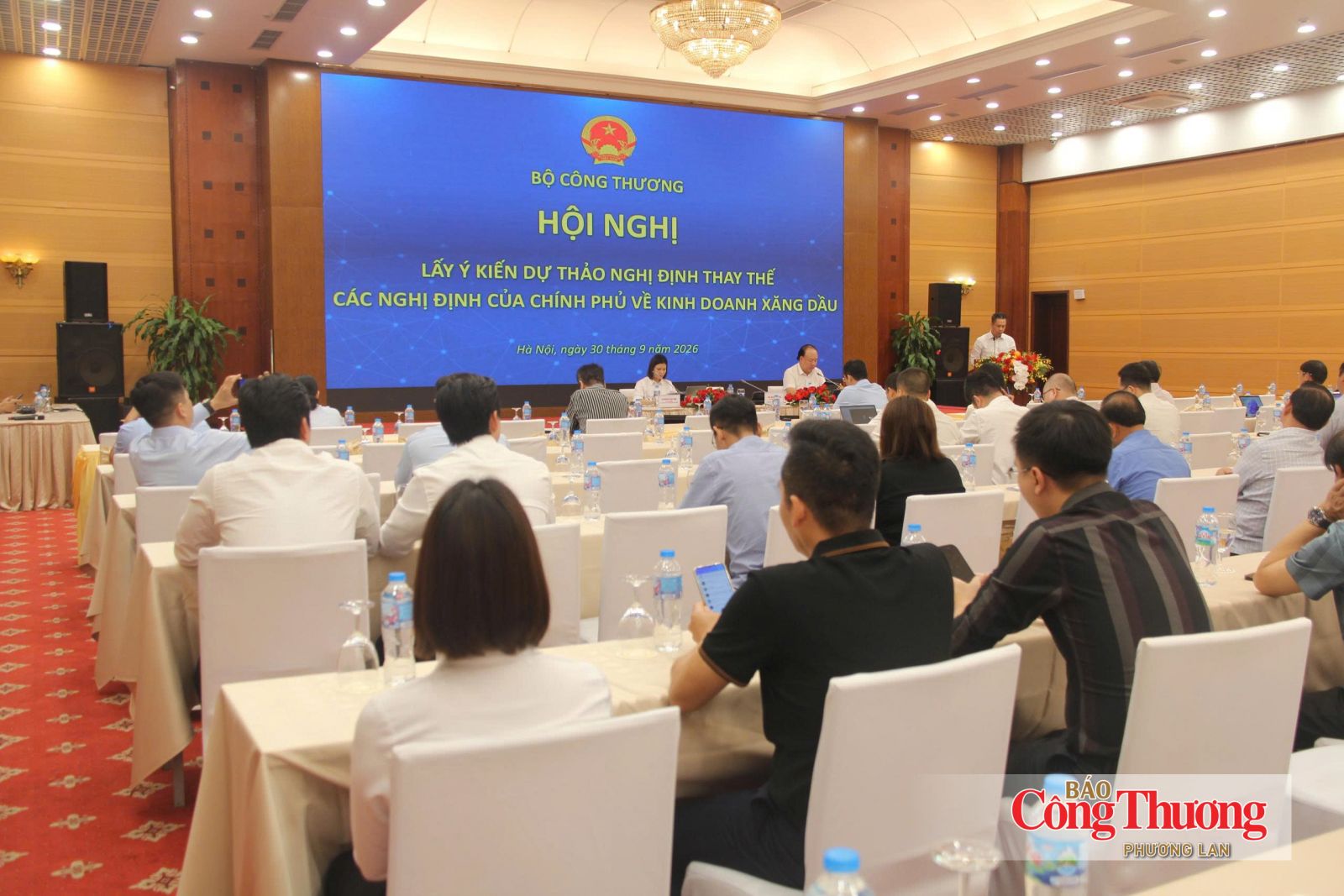
On September 30 in Ha Noi, the Ministry of Industry and Trade (MoIT) held a conference to gather broad feedback on a draft decree replacing the Government’s existing decrees on petroleum trading.
Viet Nam seeks to seize a new window of opportunity for supporting industry by removing bottlenecks and shifting from localization ratios to mastering capabilities.
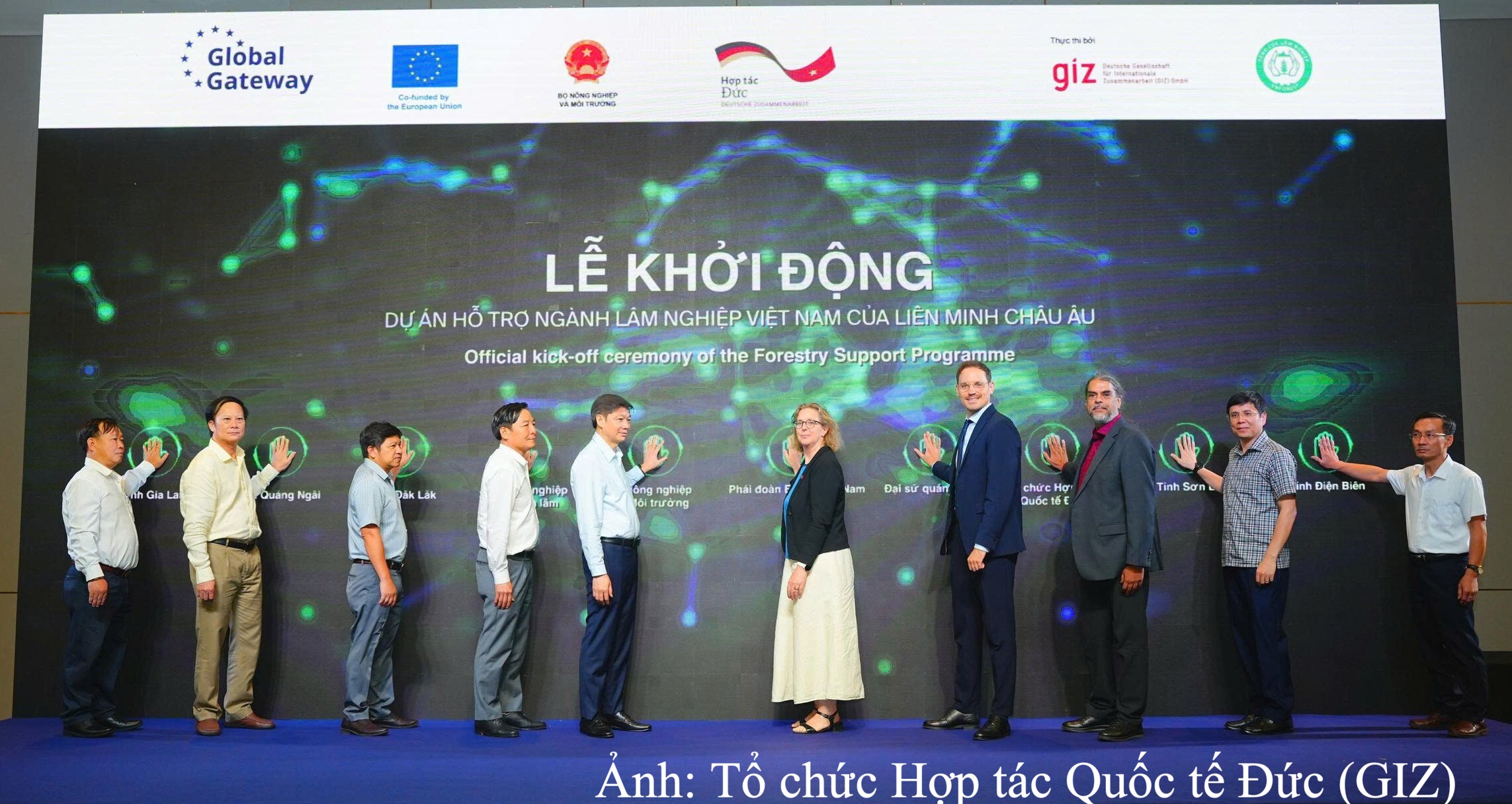
Viet Nam, the EU, and Germany have launched a forestry project to restore and sustainably manage natural forests, advancing green growth and climate resilience.
From 29 June, Vietnam’s domestic carbon market officially entered its pilot phase, marking a transition from emissions management through administrative command-and-control measures to a market-based mechanism.
Vietnam has launched a pilot carbon market on June 29, marking a shift where emissions are priced and businesses compete through technology and governance capacity.