Vietnam and Sweden strengthen cooperation to modernise the grid, expand transmission capacity and accelerate renewable integration for a sustainable energy future.
Vietnam is prioritising the modernisation of its power grid and the enhancement of transmission capacity. Cooperation with Sweden is opening new opportunities to strengthen electricity infrastructure and integrate renewable energy.
Boosting collaboration for a modern power system
Facing rapidly rising electricity demand, fast-growing renewable energy deployment and ambitions to export green electricity to neighbouring countries, Vietnam is encountering major challenges in grid stability, long-distance transmission and renewable integration.
To address these issues, the country is seeking large-scale, cost-effective transmission solutions and smart-grid technologies capable of long-distance power transfer, real-time monitoring and high industrial power quality. Sweden, a global frontrunner in energy infrastructure and digital grid innovation, offers proven expertise and partnership models.
Against this backdrop, the Embassy of Sweden and Business Sweden held the seminar themed “EnergyConnect - Building Efficient Electricity Infrastructure for a Sustainable Future” on December 1.
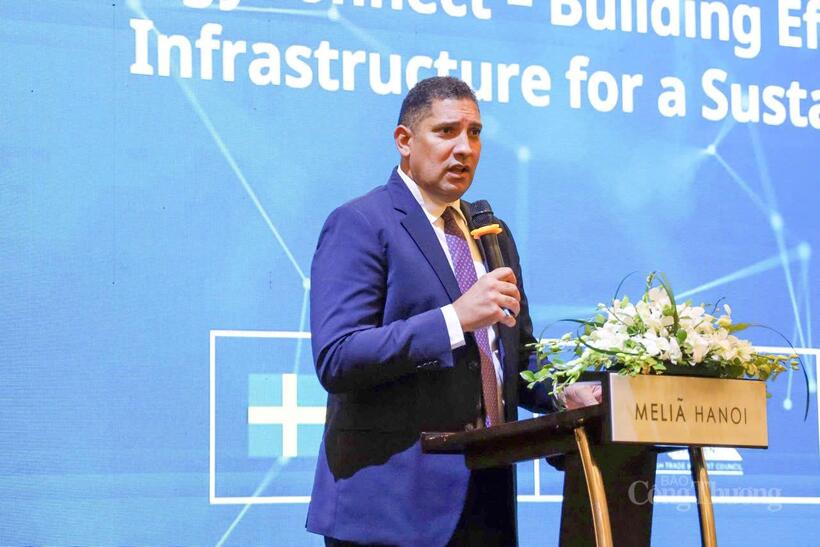
In his opening remarks, Swedish Ambassador to Vietnam Johan Ndisi underlined the event’s practical significance for the energy transition of both countries.
Swedish Ambassador to Vietnam Johan Ndisi delivers his remarks at the event.
Regarding bilateral ties, Ambassador Ndisi emphasised that Vietnam and Sweden enjoy a long-standing partnership built on trust. Earlier this year, Prime Minister Pham Minh Chinh’s visit to Sweden marked the signing of a sectoral strategic partnership, establishing a shared vision on science-technology, innovation and digital transformation, with energy continuing to serve as a key pillar.
The Ambassador noted that Vietnam is undergoing a profound energy transformation, with electricity demand expected to grow 10 - 15% next year and installed capacity approaching 88GW. This momentum calls for greater grid stability, long-distance transmission capability and renewable integration amid increasingly complex climate conditions.
Drawing from Sweden’s experience, where more than 98% of electricity comes from renewable sources and nuclear energy, supported by one of the world’s most reliable transmission systems, Ambassador Ndisi affirmed that Sweden is well positioned to accompany Vietnam. The country also leads in HVDC technologies, power-quality solutions, smart-grid systems and AI-based diagnostics, which align closely with Vietnam’s geographically imbalanced supply and demand landscape.
He stressed that the seminar provides a platform for policy and technical dialogue toward achieving net-zero emissions. “A stable power system and a modern transmission network are essential foundations for the green transition. The strong partnership between Vietnam and Sweden will continue to support a sustainable energy future for both countries,” the Ambassador said.
Shaping a modern and synchronised national grid
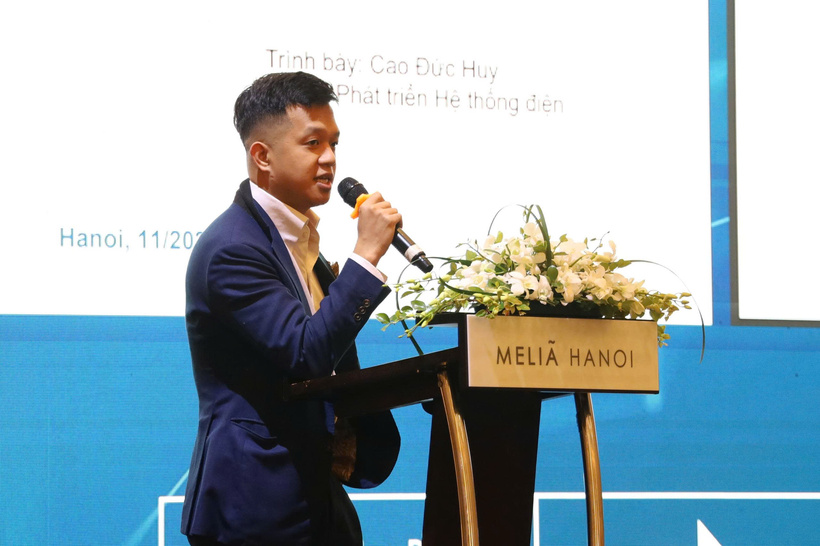
At the event, Cao Duc Huy from the Power System Development Department of the Institute of Energy presented the report “Revised Vietnam's Power Development Plan VIII: Grid Targets for 2030 and 2050”.
He noted that the Institute carries out around 200 projects annually, offering strategic, planning and investment consultancy in the energy sector, while maintaining cooperation with numerous domestic and international partners, including Swedish development agencies.
Cao Duc Huy from the Power System Development Department of the Institute of Energy presents the report “Revised Vietnam's Power Development Plan VIII: Grid Targets for 2030 and 2050” at the event.
According to him, the adjusted Power Development Plan VIII (PDP8) sets very high expectations for both load and installed capacity. By 2030, national power demand is projected to reach 100GW, comparable to the Republic of Korea’s 2025 level, before rising to 228GW by 2050. This represents nearly double the current demand within the next five years.
Installed capacity is expected to reach 236 GW by 2030, almost triple today’s level, and could rise to 839GW by 2050, with renewables accounting for a major share. This scale of expansion places tremendous pressure on the transmission system.
Therefore, development must focus not only on expanding capacity but also on modernising, enhancing flexibility and enabling smart operation to accommodate high shares of renewables. For the 2030 horizon, the transmission network will continue to rely mainly on 500kV AC lines, with eight new inter-regional routes to be added, stretching a total of 2,400 km, 1.5 times the current 500-kV network length.
After 2030, transmission demand from the central and southern regions to the north is expected to surge sharply due to the concentration of renewable sources in the central and southern provinces, while the north has more limited potential.
By 2035, the required transmission capacity from the central region to the north may reach 69,000MW over distances of 700 - 1,000km. At this scale, AC technology will no longer be suitable, necessitating the adoption of HVDC.
The Institute therefore proposes developing at least two three-terminal HVDC systems, with an expected voltage of 800kV, capacity from 5,000 - 10,000MW and lengths of 700 - 1,000km. Additional backup routes from the south-central and southern regions to the north are also being considered. By 2050, converter station capacity may reach 52 - 72GW, with conductor line capacity at 7,200 - 13,300MW.
However, Huy noted that planned transmission investment needs amount to around USD 3 billion annually, far exceeding current levels. The main challenge is not only “how much to invest” but “how to invest”.
Although the adjusted PDP8 outlines a preliminary division between state-funded and socialised transmission projects, mechanisms for investor returns and capital mobilisation remain unclear.
Three major challenges were identified: capital mobilisation, human resources and land; limited experience with new technologies such as HVDC and high-renewable-penetration system equipment; and policy gaps, particularly regarding transmission investment returns and ancillary service mechanisms.
“PDP8’s adjusted targets are highly ambitious, creating major challenges in investment, technology and policy. In this context, international cooperation, including with Sweden, will play a crucial role in supporting Vietnam,” Cao Duc Huy said.
The seminar aims to lay the groundwork for technical exchanges, strategic cooperation and policy dialogue to support the development of a sustainable, future-ready power system in Vietnam. It also provides a forum to share PDP8-related challenges in transmission and distribution; explore large-scale, cost-effective long-distance transmission solutions; present Swedish innovations in power quality; and identify financing models, legal frameworks, human-capital development pathways, pilot-project partnerships, technology transfer and joint ventures.
Industry and Trade Newspaper would like to introduce a podcast series on the implementation of the Politburo's Resolution No. 57 in the Industry and Trade sector.
GREENTECH HA NOI 2026 showcases green technologies and energy-efficient solutions that help businesses cut emissions, optimize costs, promote sustainable production.
The programme connects Vietnamese businesses with Chinese investors, expanding opportunities for investment, technology cooperation and supply chain links.
Viet Nam and Poland are exploring complementary strengths in furniture manufacturing, machinery, raw materials and technology to develop regional supply chains.
The MoIT calls for proactive risk management and supply diversification to prevent energy supply disruptions amid global geopolitical and market uncertainties.
GREENTECH HA NOI 2026 showcases green technologies and energy-efficient solutions that help businesses cut emissions, optimize costs, promote sustainable production.
On the sidelines of the BRICS Summit in New Delhi, Senior Lieutenant General Nguyen Truong Thang held a meeting with Indian Defence Secretary Rajesh Kumar Singh, agreeing to expand defence cooperation.
Viet Nam has identified strengthening energy security and resilience, accelerating a clean and just energy transition, and promoting innovation, investment and regional connectivity as three strategic priorities in responding to profound changes in the global energy landscape.
The Viet Nam-Japan Business Forum 2026 will take place in Hanoi, bringing together around 250 delegates for trade and investment matchmaking and business networking.