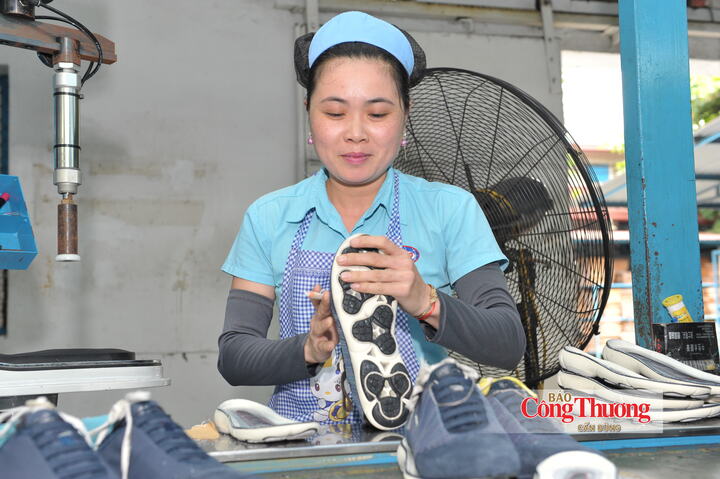
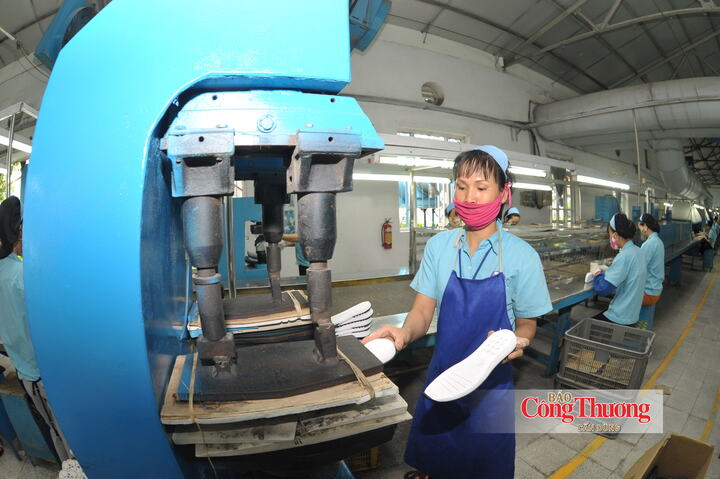
The EVFTA offers Vietnamese footwear tariff advantages in the EU market. To capitalize on these opportunities sustainably, businesses need to secure material supplies, strengthen production capacity and meet green requirements.
EVFTA creates advantages, material self-sufficiency holds the key
More than six years after the implementation of the Viet Nam - EU Free Trade Agreement (EVFTA), Viet Nam’s footwear industry has achieved positive results in tapping into the EU market. However, maintaining competitive advantages, increasing export value and participating more deeply in global supply chains require businesses to take greater control of their material supplies. Beyond meeting rules of origin to qualify for tariff preferences, this is also a foundation for strengthening business autonomy, adapting to green manufacturing trends and meeting increasingly stringent European market standards.
Footwear is one of Viet Nam’s key export products to the EU.
The EVFTA has provided an important impetus for Viet Nam’s footwear exports to the EU. According to Phan Thi Thanh Xuan, Vice President and Secretary General of the Viet Nam Leather, Footwear and Handbag Association (LEFASO), the EU currently accounts for around 24-26% of the industry's total export turnover. The implementation of the EVFTA has brought significant advantages to key footwear products, contributing to export growth in this market.
One advantage for the footwear industry in capitalizing on the EVFTA is that its rules of origin are relatively compatible with the industry's production capacity. According to Xuan, footwear products need to achieve approximately 40% value added in Viet Nam. As a result, almost all footwear export consignments can take advantage of the Agreement's rules of origin.
Alongside the benefits offered by the EVFTA, maintaining established relationships with traditional customers has also helped the footwear industry increase exports to the EU, offsetting declines in some other markets.
Regarding the utilization of tariff preferences, Nguyen Thi Hoang Thuy, Head of the Viet Nam Trade Office in Sweden and concurrently responsible for the Nordic countries, said that more than six years after the EVFTA took effect, Vietnamese businesses had made significant progress in capitalizing on tariff preferences. This is reflected in both export turnover and the proportion of goods using preferential certificates of origin.
According to data from the Ministry of Industry and Trade, the proportion of Viet Nam’s exports to the EU accompanied by preferential C/Os under the EVFTA increased from 14.8% in 2020 to approximately 35.1% in 2025, equivalent to around USD 18.13 billion in export turnover covered by preferential C/Os. This result demonstrates that businesses are becoming increasingly proactive in meeting rules of origin to capitalize on the Agreement's benefits.
However, the level of preference utilization varies across industries. Sectors with well-organized supply chains, the ability to meet specific rules of origin and experience in exporting to the EU tend to make more effective use of FTA advantages.
For the footwear industry, although the rules of origin are relatively favorable, securing greater control over material supply chains remains an issue requiring attention. Phan Thi Thanh Xuan noted that one of the challenges facing Vietnamese businesses in implementing FTAs is their limited ability to take control of raw material and production supply chains. This also affects the ability of many industries to capitalize on tariff preferences.
According to Nguyen Thi Hoang Thuy, to secure materials that qualify as originating in Viet Nam and benefit from EVFTA tariff preferences, businesses need to proactively source materials domestically, particularly footwear components such as shoe soles, leather and rubber soles.
Where domestic supplies are insufficient, businesses can import materials from countries that have FTAs with the EU, such as Japan and the Republic of Korea, to meet the applicable origin requirements and qualify for preferential tariffs.
This approach shows that developing material supplies should not be limited to domestic sources but should instead be considered within the broader network of supply chains capable of meeting EVFTA rules of origin. However, in the long term, strengthening domestic material production capacity remains an important direction for reducing dependence on external suppliers and giving businesses greater autonomy.
Developing green supply chains to enhance competitiveness
Beyond origin requirements, the EU market is imposing increasingly stringent demands on production processes, materials and environmental responsibility. While these requirements present challenges, they also provide an impetus for footwear businesses to innovate their production methods and shift towards environmentally friendly materials.
Nguyen Thi Hoang Thuy recommended that businesses gradually increase the use of recycled and environmentally friendly materials, such as synthetic leather and recycled rubber, to meet green manufacturing standards and consumer preferences in the Nordic region.
This is a notable direction as environmental requirements are increasingly becoming an important factor in how European markets select suppliers. Securing material supplies, therefore, is not simply a matter of ensuring production inputs but is also closely linked to businesses’ ability to adapt to changing consumer preferences and new export market standards.
Businesses need to strengthen their capacity to secure material supplies to make better use of EVFTA tariff preferences.
According to Dr. Nguyen Minh Phong, to turn production advantages into greater participation in the value chain, businesses need to address two challenges simultaneously: achieving greater material self-sufficiency and modernizing management practices.
Alongside securing supplies, businesses need to improve the management of data, materials and production processes, while increasing investment in automated machinery, robots and artificial intelligence. Workers also need to acquire new skills to operate equipment and meet environmental inspection and reporting requirements.
Another issue highlighted by Dr. Nguyen Minh Phong is the need to align foreign investment more closely with domestic businesses. The focus should be on technology transfer, developing domestic suppliers and establishing more self-reliant production chains, rather than concentrating solely on investment capital and the number of projects.
Therefore, increasing added value and strengthening the footwear industry's position in global supply chains require coordinated efforts, including policies supporting upstream industrial development, businesses' efforts to strengthen their internal capabilities and more effective trade promotion activities.
From the state management perspective, Trinh Thi Thu Hien, Deputy Director General of the Agency of Foreign Trade under the Ministry of Industry and Trade, said the Ministry had been implementing various measures to increase the use of preferential certificates of origin and improve the utilization of FTA markets, including the EU.
Specifically, the Ministry has focused on developing mechanisms and policies to establish a transparent framework for goods origin while improving regulations on preventing and combating origin fraud. Guidance for local authorities responsible for C/O issuance has also been strengthened to ensure that goods genuinely meet origin requirements when exported to FTA markets.
In particular, training and hands-on guidance for manufacturing and exporting businesses on FTA rules of origin have continued to be intensified. The Ministry has also coordinated with customs authorities in importing countries to ensure that originating goods receive preferential tariff treatment, while reforming administrative procedures and addressing businesses' difficulties concerning rules of origin and C/O issuance.
For businesses, Phan Thi Thanh Xuan said they must first strengthen their internal capabilities to successfully capitalize on FTAs, as these markets impose numerous requirements that must be met to ensure successful exports. In the EU market, in particular, businesses need to urgently capitalize on EVFTA advantages, as other countries are also accelerating FTA negotiations with the bloc, potentially narrowing Viet Nam's competitive advantages.
Clearly, the EVFTA has opened up significant opportunities for Viet Nam’s footwear exports to the EU. However, tariff advantages cannot automatically translate into competitiveness without proactive supply chains. Developing domestic material supplies, combined with technological innovation, improved management and green manufacturing, will provide the foundation for the footwear industry not only to sustain export growth but also to increase added value and strengthen its position in European supply chains.
The EVFTA offers Vietnamese footwear tariff advantages in the EU market. To capitalize on these opportunities sustainably, businesses need to secure material supplies, strengthen production capacity and meet green requirements.
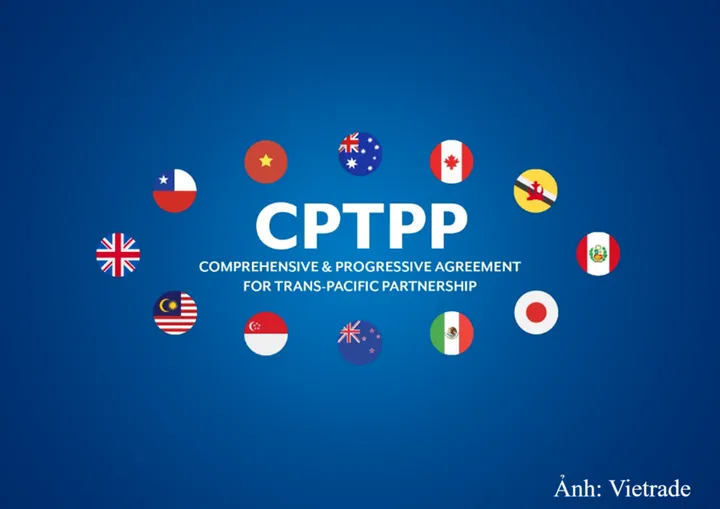
Born from the 12-member TPP after the US withdrawal, the CPTPP has gradually expanded, with the accession of the UK bringing its membership to 12 economies.
Tariff preferences under free trade agreements (FTAs) are creating new opportunities for Vietnamese pepper exports. However, businesses need to proactively meet rules of origin requirements.
Rising global rice prices, stronger import demand from South Korea and Viet Nam's successful bid to supply 35,000 tons are providing positive signals for rice exports.
The EVFTA offers Vietnamese footwear tariff advantages in the EU market. To capitalize on these opportunities sustainably, businesses need to secure material supplies, strengthen production capacity and meet green requirements.
Tariff preferences under free trade agreements (FTAs) are creating new opportunities for Vietnamese pepper exports. However, businesses need to proactively meet rules of origin requirements.
Rising global rice prices, stronger import demand from South Korea and Viet Nam's successful bid to supply 35,000 tons are providing positive signals for rice exports.
Vietnamese and Southwestern Chinese businesses met in Kunming to explore cooperation, as the two sides aim to raise Viet Nam - Yunnan trade to USD 5 billion.