It is essential to clearly define development strategies and identify which sectors Vietnam must take the lead in to assert its position in the global market.
Resolution No. 79-NQ/TW of the Politburo is considered a crucial institutional springboard, creating favorable conditions for the state economic sector to more clearly perform its leading and guiding role in the socialist-oriented market economy.
In an interview with the Newspaper of Industry and Trade, Prof., Dr. Hoang Van Cuong, a National Assembly Deputy of the 15th tenure and a member of the Prime Minister’s Policy Advisory Council, analyzed the substance of the Resolution and the guiding role of the state economy in creating momentum for sustainable economic growth.
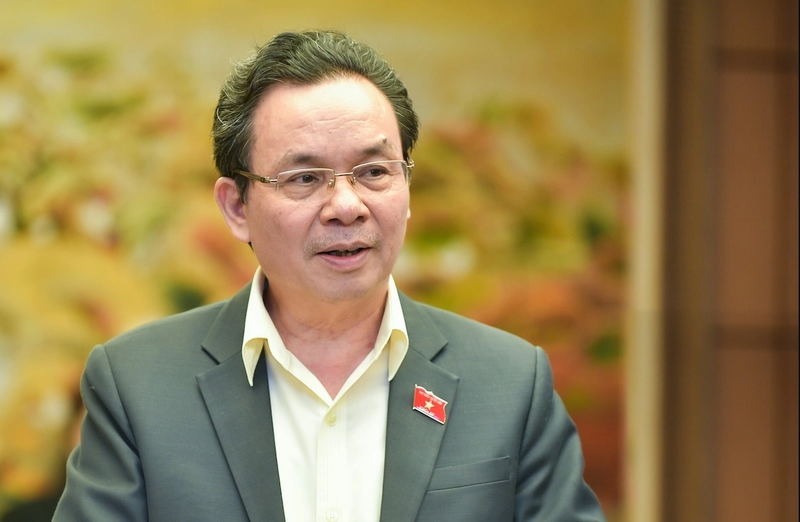
Prof., Dr. Hoang Van Cuong, a National Assembly Deputy of the 15th tenure and a member of the Prime Minister’s Policy Advisory Council.
Leading key industries
The Politburo has recently issued Resolution 79 on the development of the state economy. From practical experience in recent years, how do you assess the role and contributions of the state economic sector in maintaining macroeconomic stability and promoting socio-economic development?
Prof., Dr. Hoang Van Cuong: Resolution 79 has been introduced with a very broad scope, going beyond the traditional understanding of state-owned enterprises. The Resolution encompasses all state-owned resources, ranging from state-owned enterprises and public service units to natural resources, land, the state budget, and development investment funds.
Within this overall framework, state-owned enterprises are identified as a particularly important component. The Resolution sets a clear objective of forming state-owned enterprises with scale and competitive capacity among the leading groups in the region and worldwide. This reflects the Party’s strong confidence and high expectations regarding the guiding role of state-owned groups and corporations in the new development stage.
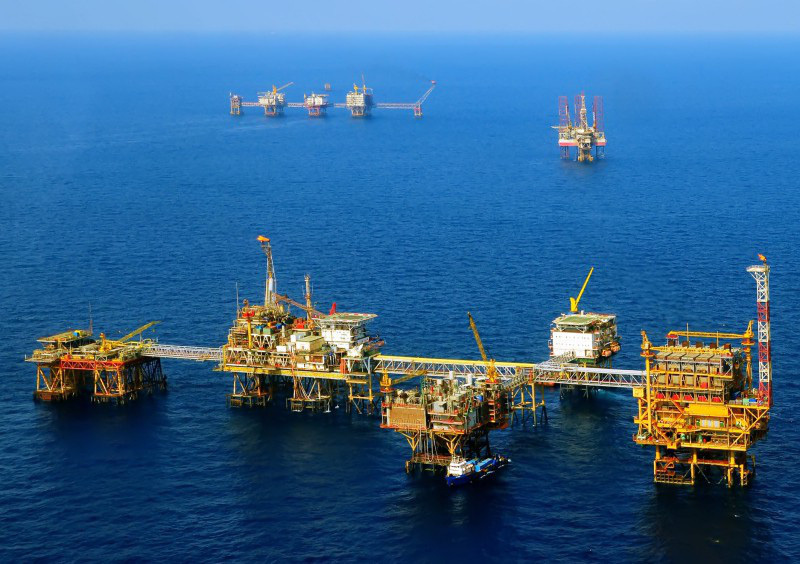
State-owned enterprises in the energy sector have made tangible contributions to the country’s overall growth targets, helping lay the groundwork for double-digit growth.
In recent years, major state-owned enterprises have demonstrated this role quite clearly. In telecommunications, Vietnam has built a modern domestic infrastructure and expanded into international markets, contributing to the affirmation of the country’s position. In the energy sector, after a period of considerable difficulties, state-owned groups have gradually made breakthroughs, laying a solid foundation for energy security and expanding investment abroad.
It is evident that state-owned enterprises have proven their role, position, and significant contributions to macroeconomic stability and socio-economic development, and they are expected to continue serving as strategic pillars of the economy in the time ahead.
The Resolution emphasizes that the state economy must guide and support other economic sectors. In your view, through which specific mechanisms should this guiding role be exercised to avoid “encroachment” or monopolization?
Prof., Dr. Hoang Van Cuong: It is important to stress that the guiding role of the state economy does not mean that the State replaces the market or takes over the role of other economic sectors. Guidance, first and foremost, involves creating development platforms and, on that basis, attracting various economic actors to participate in investment.
The core question lies in determining which industries and sectors to develop and what long-term objectives to pursue. These strategic orientations must be established by the state sector and then implemented through the operations of state-owned enterprises, through policy mechanisms, and through state budget investment in infrastructure, technology, and foundational sectors.
When the State focuses on its role as a facilitator, providing direction and investing in key foundational stages, while the market determines the allocation of specific resources, clear development “tracks” will be formed for the private sector and other economic sectors to participate.
With this approach, the guiding role of the state economy will not result in encroachment or unfair competition, but will instead create a broad and sustainable development space for the entire economy.
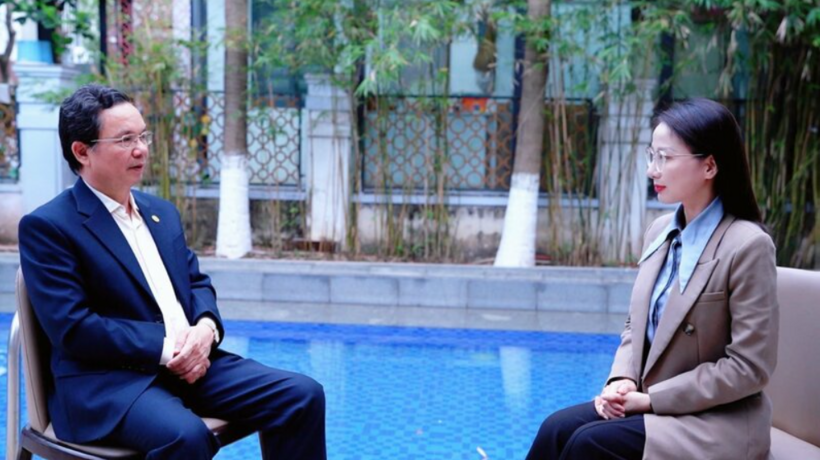
Prof., Dr. Hoang Van Cuong during an interview with the Newspaper of Industry and Trade.
Strategy for state-owned enterprises to go global
Resolution 79 sets a target of having one to three Vietnamese enterprises among the world’s top 500 largest companies by 2030. In your opinion, what changes in development strategy are needed to realize this goal and enhance competitiveness in the global market?
Prof., Dr. Hoang Van Cuong: At present, Vietnam already has several state-owned enterprises that have reached regional and international stature, with increasingly evident competitive capacity. This demonstrates that important prerequisites are already in place. These prerequisites stem from enterprises’ internal strength and from the crucial support of the State’s economic capacity, along with strategic development orientations.
The issue now is to clearly define development strategies. We must determine which sectors, industries, and market segments Vietnam seeks to be present in, and which industries the country needs to take the lead in to assert its position in the global market.
Once strategies are clearly defined, the State should assign tasks to enterprise groups with sufficient capacity to implement them, while designing appropriate support mechanisms, ranging from policy-based investment capital to market assurance instruments.
The immediate focus should be on building a strong and sufficiently large domestic market to serve as a foundation for enterprise development. On that basis, enterprises can gradually expand into international markets, scale up operations, enhance competitiveness, and form groups with substantive positions on the global economic map.
In your view, which development spaces should the state economic sector focus on in order to both fulfill its guiding role and avoid overlap or crowding out the private sector?
Prof., Dr. Hoang Van Cuong: In the current period, the state economy needs to be positioned within new development spaces, with sufficiently clear orientations to avoid overlap with the private sector. The role of state-owned enterprises is to undertake major axes, major tasks, and sectors with long-term foundational significance.
For example, in information technology and telecommunications, state-owned enterprises are playing a relatively effective guiding role. However, it is essential to clearly identify the strategic axes for which state-owned enterprises are responsible, and then provide strong development orientations to attract private enterprises to participate through linkage models, satellite structures, and specialization at each stage.
In emerging areas such as the low-altitude economy, Vietnam has advantages stemming from technological and equipment foundations serving national defense and security. The key issue is to transform these capabilities into multi-purpose development models combining defense and civilian applications. In this space, state-owned enterprises play a guiding role, while capable private groups and enterprises participate through investment and linkage to form supply chains for equipment and services.
Similarly, sectors with long-term strategic and infrastructure characteristics, such as maritime industries, sea transport, and railways, require the State to provide direction and invest in foundational stages. On that basis, the private sector can participate in undertaking specific tasks aligned with its strengths. This approach ensures that the State maintains its guiding role, while the private sector maximizes its capacity at each stage, creating complementarity rather than crowding out.
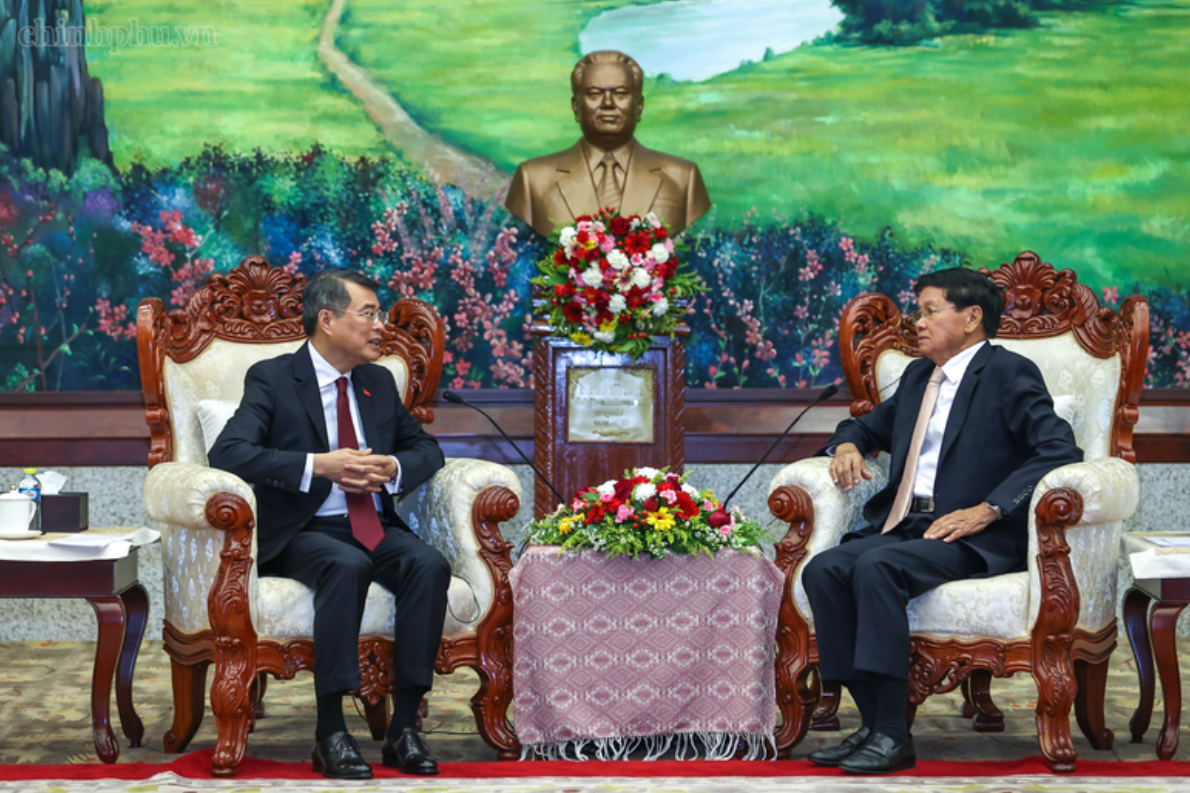
Prime Minister Le Minh Hung on October 8 paid a courtesy call on Lao General Secretary and President Thongloun Sisoulith in Vientiane as part of his on-going official visit to Laos.
The two sides expressed their delight at the positive developments in the bilateral relations in recent years, noting that there remains significant room for greater cooperation and complementarity, particularly in trade, investment and economic ties. They also held extensive discussions on strategic directions to further deepen and strengthen bilateral relations in a more substantive and practical manner.
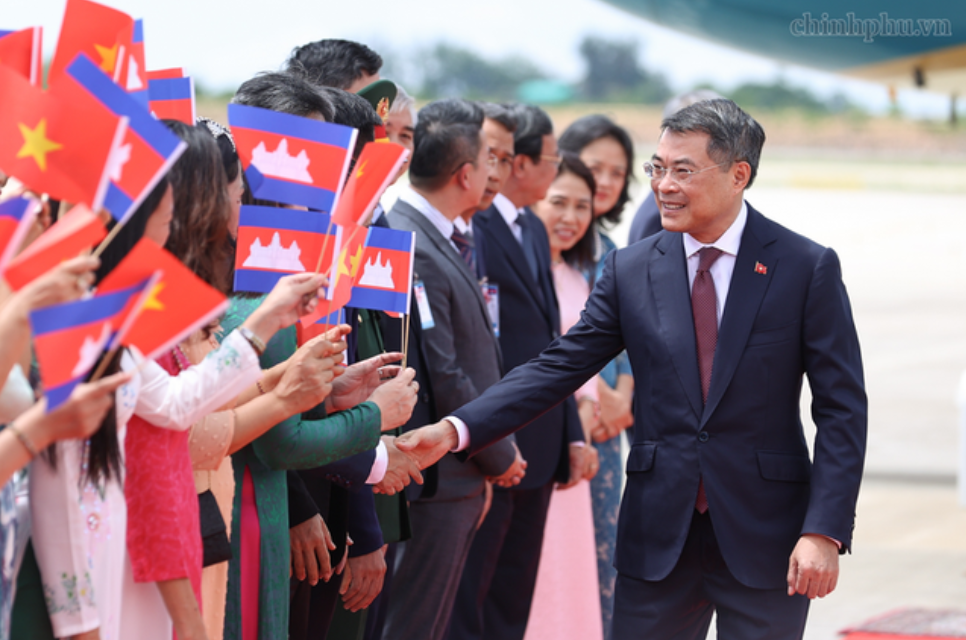
Prime Minister Le Minh Hung arrived in Phnom Penh on Friday afternoon, starting his two-day official visit to Cambodia at the invitation of Cambodian counterpart Hun Manet.
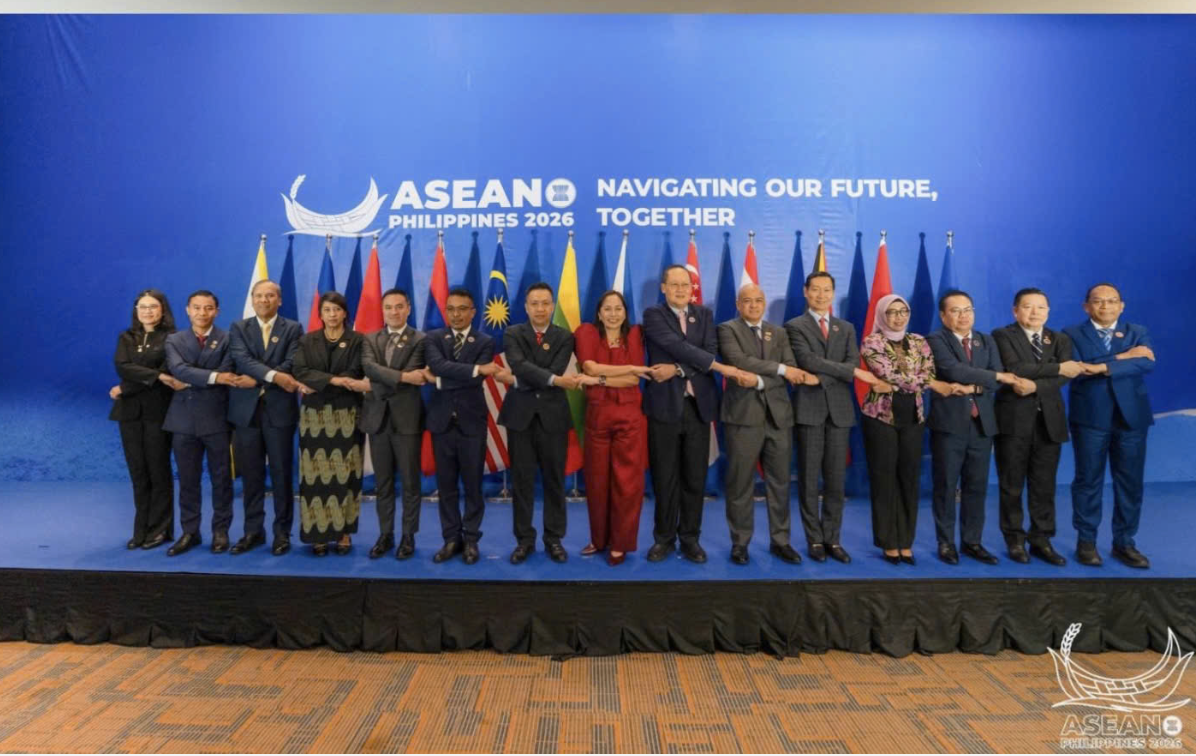
On 7 October 2026, the 44th ASEAN Ministers on Energy Meeting (AMEM 44) was held in Manila, the Philippines, under the chairmanship of Sharon S. Garin, Secretary of the Department of Energy of the Philippines. The meeting brought together energy ministers from ASEAN Member States, the Secretary-General of ASEAN, the ASEAN Centre for Energy, and representatives of ASEAN energy sector bodies and specialised networks. Deputy Minister of Industry and Trade Nguyen Viet Son led the Vietnamese delegati
General Secretary of the Communist Party of Viet Nam Central Committee and State President To Lam, his spouse, and a high-ranking Vietnamese delegation will pay a state visit to Russia and an official visit to France, and attend the International Space Summit in Paris from September 7 to 12.