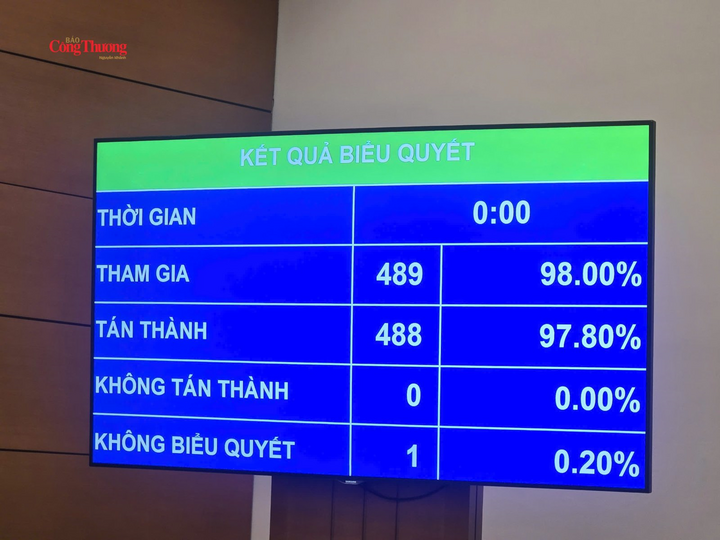
On November 21, the National Assembly adopted the amended Electricity Law with 97.80% of deputies in favor; it will take effect on June 1, 2027.
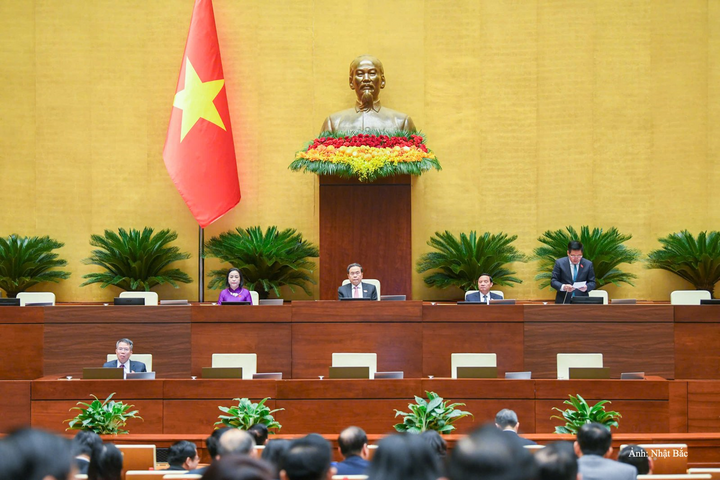
An overview of the session on the morning of November 21.
On the morning of November 21, at the second session of the 16th National Assembly, chaired by President of the National Assembly Tran Thanh Man and moderated by Vice President of the National Assembly Nguyen Hong Dien, the National Assembly voted to adopt the Law amending and supplementing a number of articles of the Electricity Law, with 488 of the 489 deputies present voting in favor, accounting for 97.80% of all National Assembly deputies.
The voting result on the Law amending and supplementing a number of articles of the Electricity Law.
The law will take effect on June 1, 2027. The provisions on offshore wind surveys will take effect on July 1, 2027, in line with the expected effective date of the Law on Marine and Island Resources and Environment, to avoid a legal vacuum.
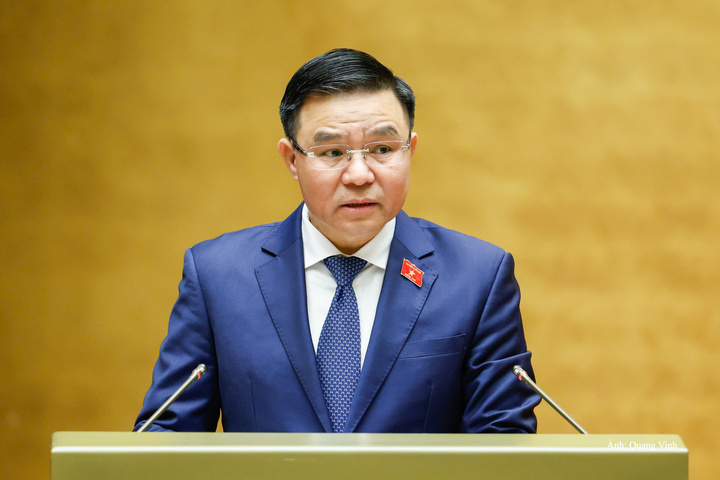
Before the vote, Minister of Industry and Trade Le Manh Hung, authorized by the Prime Minister, reported on the receipt of feedback, explanations and revisions to the draft law. He said the overarching spirit of the draft is to remove bottlenecks, accelerate investment and ensure the security of electricity supply, while maintaining discipline in investment, controlling costs and harmonizing the interests of the State, businesses and the people.
"The Government has comprehensively reviewed the draft, amending only what is truly necessary and ensuring consistency with related laws," Minister Le Manh Hung stressed.
The revisions focus on six groups of issues: the exemption from the investment policy approval procedure; investor selection; direct power purchase and energy storage; offshore wind power; synchronizing power sources and grids and financial mechanisms; and implementation and transitional provisions.
According to the Minister, the Law amending and supplementing a number of articles of the Electricity Law aims to institutionalize the Party's guidelines and turn the mechanisms decided by the National Assembly into projects implemented on schedule, with power sources operating safely and at reasonable costs, contributing to ensuring national energy security.
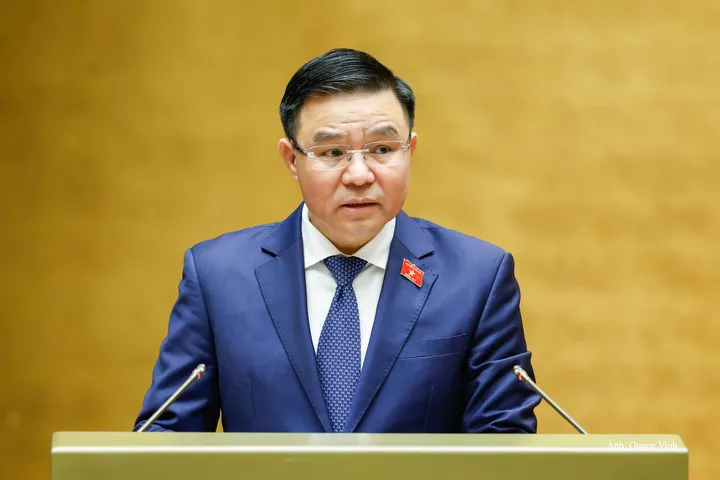
Minister of Industry and Trade Le Manh Hung reports on the receipt of feedback, explanations and revisions to the draft law.
Taking on board the conclusions of the Standing Committee of the National Assembly and the opinions of the Standing Board of the Committee for Science, Technology and Environment, the drafting agency has carefully reviewed the draft to prevent negative practices, group interests and localism, the legalization of mechanisms contrary to the Party's guidelines, and an "ask-and-give" mechanism, while ensuring consistency with the laws submitted at this session and feasibility.
Exemption from investment policy approval, not from land procedures
The exemption from the investment policy approval procedure for certain projects under programs and projects implementing the master plan does not mean exemption from procedures for land allocation, land lease, change of land use purpose or forest use. The investor approval document does not replace documents issued by competent authorities on land and forestry.
Projects applying this mechanism are controlled through a list consistent with the power development plan; proposing localities must allocate land and include it in their land use plans. The Government will provide detailed regulations on the preparation, approval and updating of the list.
The categories of power projects for which investors are selected without auctions or bidding, as set out in Clause 9, Article 1 of the draft law (amending and supplementing Article 18), have been carefully studied, reviewed and assessed by the lead drafting agency to ensure they are consistent with practice.
Regarding Point dd, Clause 1, Article 18, the draft law assigns the Government to provide detailed regulations on the criteria, ex-post inspection and sanctions against investors that fail to fulfill their commitments. In addition, the Government will regulate the ex-post inspection mechanism and sanctions against investors that do not properly fulfill their commitments.
For investor selection through bidding (amending Article 19), the draft removes the phrase "except for adjustments already provided for in the bidding documents" and assigns the Government to regulate the formula for calculating electricity prices in bid documents, ensuring that bidding results are binding.
For direct power purchase (amending Clause 3, Article 47), the law adds the principle that participating parties shall pay electricity costs, power system service costs, settlement costs for differences and other appropriate costs, ensuring accurate and full cost accounting, openness and transparency.
On stand-alone energy storage, the Government said current regulations are relatively complete for both stand-alone systems and those combined with power sources; investment, grid connection, operation and market participation will be detailed in sub-law documents.
Paving the way for offshore wind power
Breakthrough mechanisms for offshore wind power were set out in Resolution No. 55-NQ/TW and Resolution No. 70-NQ/TW. The Electricity Law No. 61/2024/QH15 already provides incentives such as long-term minimum contracted output; exemptions from and reductions in sea area use fees and land rent; and specific pricing mechanisms or support prices for each period.
This amendment adds provisions on the dispatched output of offshore wind projects selling electricity to the national power system, assigning the Government to provide detailed regulations.
To ensure consistency with the Law on Marine and Island Resources and Environment, survey entities will be selected before investors are selected.
The law adds transitional provisions agreed between the Ministry of Agriculture and Environment and the Ministry of Industry and Trade: applications for the allocation of sea areas for surveys received before the law takes effect but not yet resolved will continue to be processed under the regulations in force at the time of receipt, to avoid a legal vacuum.
According to the Government, the synchronization of power sources and grids is already a core principle of the current law and the power development plan; the shortcomings lie mainly in implementation, not in legal provisions.
The law adds "mechanisms for compensating reasonable costs," assigning the Government to provide detailed regulations based on the principles of harmonizing interests and sharing risks among the State, businesses and the people. Clause 2a, Article 51 has been added for small hydropower plants and wind, solar and biomass power plants currently receiving feed-in tariffs (FIT) once their power purchase agreements expire.
The law also further clarifies the responsibility of the Minister of Industry and Trade in eliminating cross-subsidization in electricity prices.
Taking on board the opinions of Government members and the Ministry of Justice, Article 10 has been entirely revised, assigning the Minister of Industry and Trade to organize the implementation of programs and projects implementing the power development plan, in line with Article 47 of the Law on Planning No. 112/2025/QH15. A decree will clearly define the authority for approval and adjustment. In addition, the drafting agency has removed the amendments to the Law on Value-Added Tax No. 48/2024/QH15 to ensure consistency of the legal system, and added a separate effective date for the provisions on offshore wind surveys.
Amid global trade volatility, the CPTPP continues to serve as a high-standard FTA, deepening intra-bloc cooperation and expanding partnerships beyond the bloc.
The EVFTA offers Vietnamese footwear tariff advantages in the EU market. To capitalize on these opportunities sustainably, businesses need to secure material supplies, strengthen production capacity and meet green requirements.
Born from the 12-member TPP after the US withdrawal, the CPTPP has gradually expanded, with the accession of the UK bringing its membership to 12 economies.
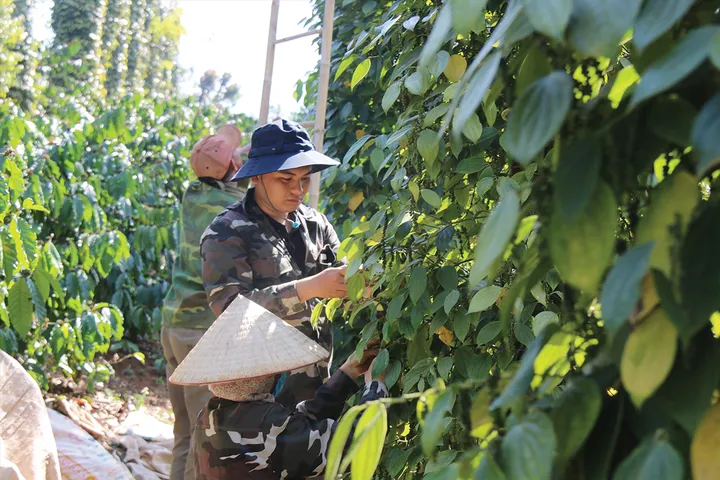
Tariff preferences under free trade agreements (FTAs) are creating new opportunities for Vietnamese pepper exports. However, businesses need to proactively meet rules of origin requirements.
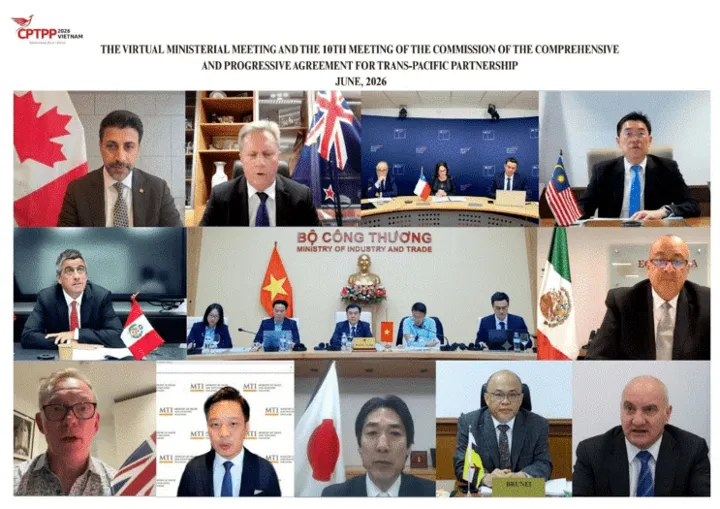
Ha Noi is set to host CPTPP ministerial dialogues with the EU and ASEAN on November 26, 2026, but the dialogues do not mean either is joining the agreement.
Amid global trade volatility, the CPTPP continues to serve as a high-standard FTA, deepening intra-bloc cooperation and expanding partnerships beyond the bloc.
Born from the 12-member TPP after the US withdrawal, the CPTPP has gradually expanded, with the accession of the UK bringing its membership to 12 economies.
General Secretary of the Communist Party of Viet Nam Central Committee and State President To Lam, his spouse, and a high-ranking Vietnamese delegation will pay a state visit to Russia and an official visit to France, and attend the International Space Summit in Paris from September 7 to 12.