Trade infrastructure is a core pillar strengthening the domestic market, boosting consumption and Vietnam’s economic competitiveness.
The Party Committee of the Ministry of Industry and Trade (MoIT) has identified the development of trade infrastructure as a key pillar, contributing to higher total retail sales, stronger domestic consumption and sustainable growth.
Domestic market: A growth “buffer” built on trade infrastructure
Amid profound global economic volatility and persistent disruptions to global supply chains, the Party Committee of the MoIT has chosen a fundamental and long-term approach: developing the trade infrastructure system as a decisive factor to consolidate the domestic market, stimulate consumption and enhance import-export capacity. This is not a short-term response, but a strategic orientation closely linked to Vietnam’s sustainable development goals.
Trade infrastructure is one of the decisive factors in strengthening the domestic market.
According to MoIT reports, the 2021 - 2025 period marked proactive and resolute leadership and direction. Building on the achievements and experience of previous terms, from the very beginning of the current tenure, particularly after the establishment of the MoIT Party Committee in February 2025, the Standing Board of the Party Committee has focused on comprehensive and synchronized leadership across key tasks. A consistent priority has been organizational consolidation and administrative streamlining towards greater effectiveness and efficiency, laying a solid foundation for the successful implementation of the MoIT Party Congress Resolution for the 2020 - 2025 term and the Resolution of the 13th National Party Congress.
In practice, the 2021 - 2025 period reaffirmed the domestic market’s role as an important “buffer” for the national economy, especially as external shocks intensified. Vietnam remains among countries with large and fast-growing domestic markets, underpinned by a population exceeding 100 million and the rapid expansion of the middle class.
Average annual growth in total retail sales of goods and consumer service revenues is estimated at around 8.1%, reflecting stable purchasing power and increasingly diversified consumption patterns. Behind these figures lies a strong transformation of trade infrastructure, shifting from traditional models towards more modern, civilized and internationally integrated systems.
E-commerce has emerged as a new growth driver, recording impressive annual growth of 18 - 25%, reaching USD 25 billion in 2024 and accounting for about 10% of total retail sales and consumer service revenues nationwide. By 2025, the e-commerce market size is estimated at around USD 30 billion, equivalent to nearly 15% of total retail sales. Vietnam has entered the world’s Top 10 fastest-growing e-commerce markets, thereby accelerating the digital economy and the digital transformation of enterprises.
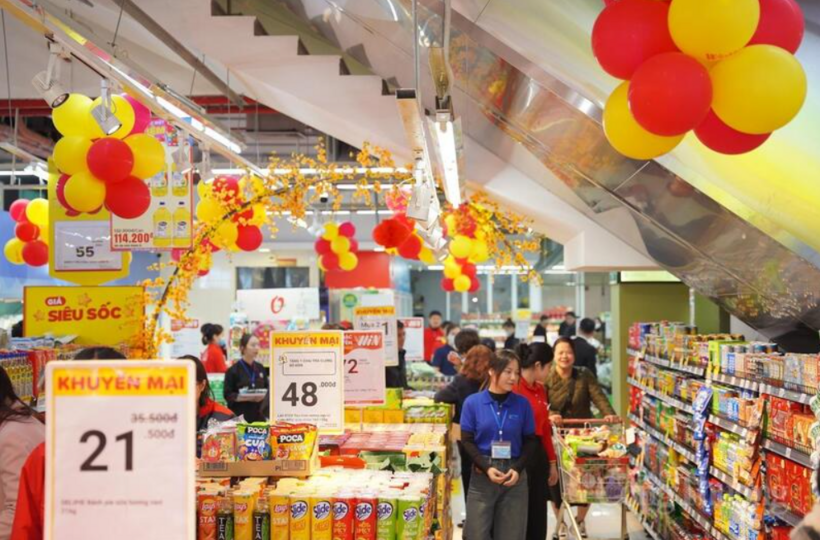
At the same time, modern retail formats such as supermarkets and shopping centres have expanded rapidly in both scale and quality, contributing around 30% of total retail sales. Standards related to food safety, traceability, environmental hygiene and fire prevention have been progressively improved and widely applied, particularly within modern retail systems, better meeting the rising expectations of consumers.
Strengthening trade infrastructure to boost consumption and import-export activities
The MoIT has clearly defined that for the domestic market to develop sustainably and for import-export activities to grow steadily, trade infrastructure must move one step ahead. The 2021 - 2025 period demonstrated tangible progress, with trade infrastructure playing a direct role in stimulating demand and promoting consumption.
If in 2020, Vietnam had around 800 supermarkets, the figure has now surpassed 1,200, alongside more than 300 shopping centres nationwide. These are not merely retail outlets, but crucial “nodes” connecting production with consumption, facilitating the distribution of domestically produced goods, particularly Vietnamese products.
In parallel, logistics infrastructure has been significantly expanded and modernised. Vietnam currently has more than 30,000 modern warehouses and six newly established tier-1 logistics centres, enhancing the efficiency of transportation, circulation and distribution. Thanks to infrastructure improvements, process digitalisation and supply chain optimisation, Vietnam’s Logistics Performance Index (LPI) ranking improved from 53rd in 2007 to 43rd in 2023 globally, a noteworthy advancement.
The development of trade infrastructure is also vividly reflected in major retail enterprises. Danny Le, CEO of Masan Group, said that with the WinMart and WinMart+ supermarket systems, the group had more than 4,300 outlets nationwide by the end of the third quarter of 2025. The company’s long-term vision is to expand WinCommerce to 10,000 stores within the next five years, with plans to open an additional 1,000 - 1,500 outlets in 2026 alone.
Meanwhile, Saigon Co.op, originating as the Ho Chi Minh City Trading Cooperative, has after more than 35 years of development built a network of nearly 1,000 retail points, covering a wide range of formats from convenience stores and supermarkets to hypermarkets, shopping centres and e-commerce platforms.
At the macro level, the Prime Minister recently signed Decision No. 2326/QD-TTg dated October 21, 2025, approving the strategy for the development of Vietnam’s retail market to 2030, with a vision to 2050. The strategy sets out clear orientations to promote the modernisation of the retail distribution system, ensure balanced development between urban and rural areas, strengthen the application of technology and digitalisation in commercial activities, and uphold standards on safety, traceability and environmental protection.
The strong emphasis placed by the MoIT Party Committee on trade infrastructure development not only delivers immediate benefits in stimulating demand and increasing total retail sales and consumer service revenues, but also lays a solid foundation for import-export growth and enhances Vietnam’s long-term economic competitiveness. This strategic choice reflects forward-looking vision and sustainable development thinking in the context of deepening international integration.
The FTA Vietnam - EFTA creates new opportunities for Vietnamese businesses while encouraging stronger competitiveness, compliance and sustainable development.
Ministry of Industry and Trade removed more than 9,000 infringing products and blocked over 2,000 online stores in a nationwide crackdown on counterfeit goods.
Sustainable production and consumption are becoming business imperatives as companies invest in greener technologies, circular design and digital transformation.
Vietnam's domestic market remained resilient in the first half of 2026 despite global turbulence, with inflation under control and retail sales continuing to grow.
From 29 June, Vietnam’s domestic carbon market officially entered its pilot phase, marking a transition from emissions management through administrative command-and-control measures to a market-based mechanism.
The FTA Vietnam - EFTA creates new opportunities for Vietnamese businesses while encouraging stronger competitiveness, compliance and sustainable development.
In an interview with the press regarding the Free Trade Agreement (FTA) between Vietnam and the European Free Trade Association (EFTA), Deputy Minister of Industry and Trade Nguyen Sinh Nhat Tan emphasized that the agreement will lay the foundation for economic relations between Vietnam and EFTA to enter a new stage of development.
At a second-quarter 2026 conference, the MoIT urged Vietnam's Trade Offices abroad to strengthen intelligence and help exporters adapt to changes and expand exports.
Vietnam and Israel discuss strengthening VIFTA implementation to expand trade, investment and cooperation, aiming to boost bilateral economic ties and market access.
More than 100 businesses attend the Vietnam-Japan Investment and Trade Cooperation Conference in Osaka to strengthen investment, trade and supply chain connectivity.