At the Vietnam Economic Forum 2025, business leaders called for a growth model driven by technology, innovation, digital transformation and green transition.
Private sector as a key driver of a new growth model
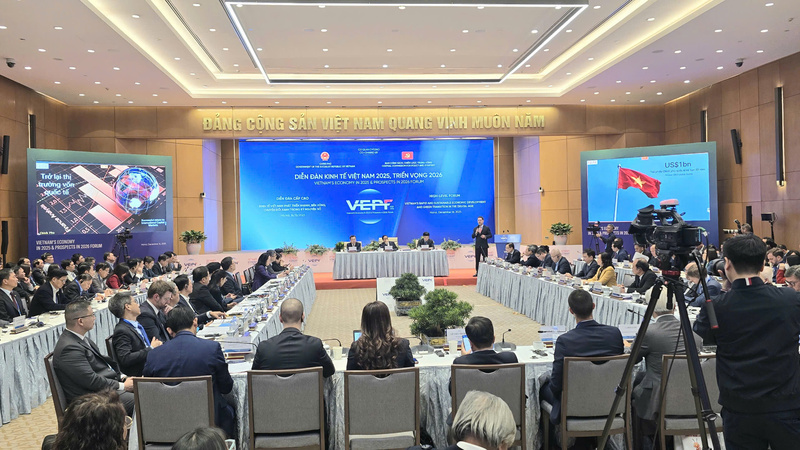
On December 16, the Central Policy and Strategy Commission, in coordination with the Government, held the Vietnam Economic Forum 2025, Outlook 2026 under the theme “Vietnam’s economy: fast and sustainable growth, green transition in the digital era.”
Nguyen Trung Chinh, Executive Chairman of CMC Technology Group, speaks at the Forum.
Speaking at the Forum, Nguyen Trung Chinh, Executive Chairman of CMC Technology Group, stressed that identifying a new growth model based on science, technology and innovation as the core driving forces of Vietnam’s economy is a strategically significant choice.
This is a path Vietnam must pursue consistently and decisively. In this model, two key pillars digital transformation and green transition are seen as the foundation for creating new growth momentum in the coming period.
According to Mr. Chinh, regarding the role of different economic sectors, Resolution No. 68-NQ/TW issued by the Politburo has clearly defined the position of the private sector within Vietnam’s overall development strategy. The key challenge now lies in how to fully unlock the strengths and roles of each sector.
In practice, the artificial intelligence (AI) sector offers a clear example. The release of the National Strategy on AI Development toward 2030 created a strong “awareness wave” across society, positioning AI as a foundational transformation strategy. As the private sector had been preparing for years, the strategy immediately received widespread support once announced.
“In this field, the private sector does not merely participate it plays a leading role in implementing and realizing Vietnam’s national AI strategy,” Chinh emphasized.
Policy proposals to strengthen digital and innovation ecosystems
Drawing from practical experience, the CMC leader put forward several key policy recommendations.
Overview of the high-level session of the Vietnam Economic Forum 2025, Outlook 2026.
First, regarding digital and AI infrastructure, investment should be focused and entrusted to leading enterprises. Developing digital and AI infrastructure should not be limited to state-owned enterprises. The private sector has sufficient financial capacity, technological capability and long-term vision to directly invest in and deploy these critical infrastructures.
Second, on digital economy policies, although Vietnam frequently discusses digital economy development, real-world engagement with investors particularly in Singapore shows that Vietnam’s current digital economy policies remain less competitive than those of regional peers such as Singapore or Thailand.
As a result, global technology giants under the GAFA group (Google, Apple, Facebook, Amazon) have yet to choose Vietnam as a major investment destination. “In direct discussions, we found that the core issue lies in policy,” Chinh said. He proposed that the Government conduct comparative studies of Vietnam’s digital economy policies against those of Singapore and Malaysia to identify gaps and shortcomings. Only by building genuinely competitive policies and even turning policy into a competitive advantage can Vietnam attract major global technology investors.
Third, regarding human resources and the innovation ecosystem, the private sector now accounts for a large share of the economy, while private research institutes and universities are expanding rapidly. CMC is developing an innovation hub model based on cooperation among enterprises, universities and the State, drawing on experiences from Singapore, the Republic of Korea, and other advanced economies that offer strong incentives for innovation centers.
“We are currently working with Hanoi, Ho Chi Minh City and Da Nang to implement this model and hope the State will place trust in the private sector and assign concrete tasks,” Chinh said. He noted that despite its limited land area, Singapore allocates up to 200 hectares for science, technology and innovation zones. With its larger land resources, Vietnam could develop science and technology cities spanning thousands of hectares.
Vietnam’s Government has identified AI as a core pillar of the national digital technology industry. The Ministry of Science and Technology is updating the National AI Strategy to 2030 and preparing a draft AI Law an important step toward strengthening the institutional framework to ensure AI development is transparent, safe and responsible.
Prime Minister Le Minh Hung attends the 48th ASEAN Summit in Cebu, reaffirming Vietnam’s strong commitment to ASEAN cooperation and regional resilience.
The Ministry of Industry and Trade is seeking feedback on a draft decree on power works protection and hydropower safety, set to replace Decree No. 62/2025/ND-CP.
The State visit by Vietnam’s top leader to Sri Lanka on May 7 - 8 underscores deepening bilateral ties, paving the way for expanded cooperation in trade and investment, and stronger engagement with South Asia.
On the afternoon of May 4, Prime Minister Le Minh Hung chaired the Government’s regular meeting for April 2026, the first such session of the 16th-term Government.
More than 300 companies are set to participate in business matching activities at the International Electronics and Smart Appliances Expo Vietnam (IEAE 2026), scheduled to take place from May 28 to 30 in Ho Chi Minh City.
Vietnam has issued a plan to implement the Law on E-commerce, defining tasks, timelines and coordination to ensure effective enforcement from July 1, 2026.
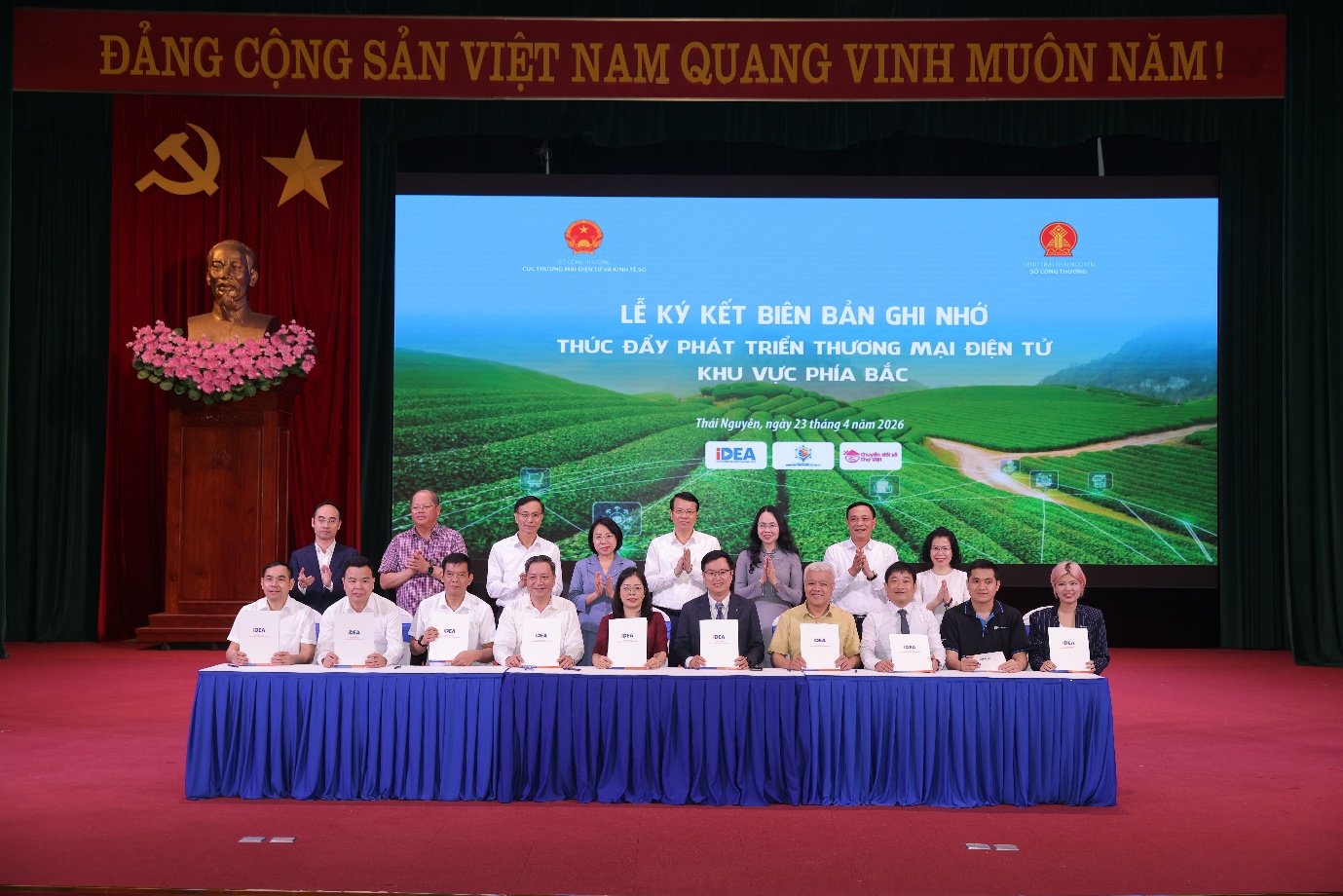
The programme in Thai Nguyen promotes e-commerce in northern Vietnam, linking localities with digital firms to expand markets and boost Vietnamese goods.