|
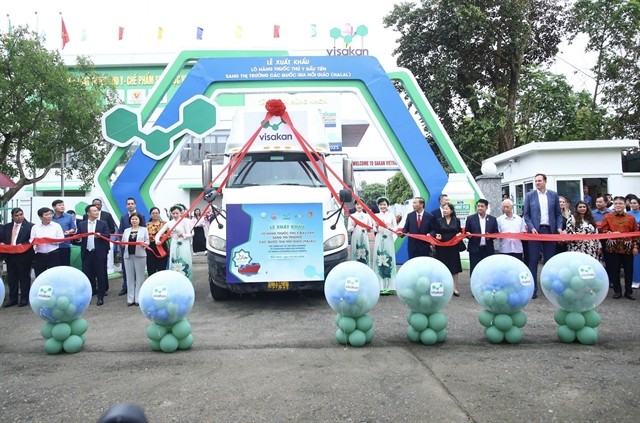
| Visankan’s first shipment of veterinary medicine to a Halal market was sent on Thursday from the northern province of Bắc Ninh. — Photo courtesy of Visakan Investment and Biotechnology Development Joint Stock Company |
BẮC NINH — A member of Hùng Nhơn Group, Visakan Investment and Biotechnology Development Joint Stock Company (Visakan), on Thursday in the northern province of Bắc Ninh exported its first shipment of veterinary medicine valued at over US$200,000 to a Halal market.
These products, which are exported to Indonesia, were manufactured at NonBetalactam and Betalactam plants certified by the Vietnamese Ministry of Agriculture and Rural Development with WHO-GMP/GLP/GSP certifications.
Trần Văn Bình, general director of Visakan, revealed that Visakan operates five production lines producing a variety of medicines and currently offers over 200 licensed products in the domestic market, partnering with animal feed companies, distributors, and livestock and aquaculture farms nationwide.
Beyond Indonesia, the Sakan brand has 23 product lines available in 13 countries and territories globally, with some products exclusively distributed by Visakan. The company aims to achieve revenue of over VNĐ300 billion ($10.7 million) by 2024 and targets revenue exceeding VNĐ1.2 trillion ($48 million) between 2025 and 2030.
At the export ceremony, Vũ Mạnh Hùng, chairman of Hùng Nhơn Group, highlighted the significance of these first exports to the Halal market. He emphasised the vast potential of the Halal market, citing the expected rapid increase in spending on Halal food worldwide.
According to the Global Islamic Economy Report, spending on Halal food is estimated to increase rapidly from $1.4 trillion in 2020 to $1.9 trillion in 2030, and nearly $5 trillion in 2050.
Therefore, this market is a potential opportunity for Vietnamese enterprises thanks to the advantage of abundant raw materials and its location in Asia, where approximately 62 per cent of the world's Muslim population resides, he said.
Alongside the export ceremony of the first batch of veterinary drugs to the Halal market, three enterprises, including Visakan, PT. Ekasapta Wijayatangguh from Indonesia, and De Heus Indonesia, signed a Memorandum of Understanding (MoU) regarding a collaborative programme for the production and supply chain linkage of veterinary drugs and disinfectants in Indonesia.
Under the agreement, Visakan will supply quality veterinary products, PT. Ekasapta Wijayatangguh will manage importation and distribution, and De Heus Indonesia will prioritise using products provided within the collaborative supply chain.