Poland will tighten food safety and quality inspections at borders from 2026, posing higher compliance requirements for agricultural and food exports to the market.
The Vietnam Trade Office in Poland reported that from 2026 and in the following years, Poland will further tighten food safety inspections at border checkpoints before allowing goods to enter the domestic market.
Specifically, at the year-end 2025 review and task deployment meeting for 2026 of the Agricultural and Food Quality Inspection (IJHARS), Dorota Bochenska, Chief Inspector, noted that in 2025 IJHARS conducted numerous quality inspections on agricultural and food products imported from non-EU countries. Many consignments found in violation of Polish regulations were ordered to be destroyed or re-exported.
Common violations identified in agricultural and food products imported from third countries included incorrect labeling, such as the absence of Polish-language information, missing or incomplete ingredient lists, and inaccurate indications of minimum durability dates. Other frequent issues involved mold contamination and the presence of prohibited food additives.
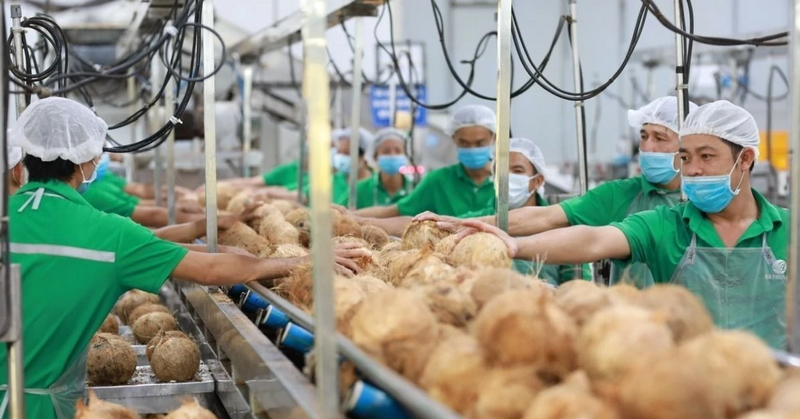
Vietnamese businesses advised to strengthen quality management for exports. Photo: Minh An
According to the Trade Office, IJHARS conducts around 80,000 border inspections annually and is proposing new provisions allowing the inspection of small consignments, even those weighing under 100kg.
To mitigate risks, IJHARS recommends that food products placed on the Polish market and originating outside the European Union (EU) must fully comply with all quality requirements, including composition standards and labeling regulations in force in both Poland and the EU.
Regarding imports from Vietnam, IJHARS reported that in 2025 it detained and inspected a total of eight consignments of Vietnamese origin, including pepper, dried mango, cinnamon, coconut milk, and seasoning cubes, due to non-compliance with hygiene standards, quality requirements, and labeling rules.
Most recently, in January 2026, IJHARS in Gdansk inspected and issued an immediate ban on the import of 52,716 cans of pineapple-flavored coconut water originating from Vietnam, citing the presence of prohibited additives and multiple labeling violations.
From Poland, Nguyen Son, Trade Counsellor at the Vietnam Trade Office in Poland, stated that Poland is expected to further tighten import controls on goods from partner countries in the coming period, particularly as the EU has signed a free trade agreement with the Mercosur bloc and continues negotiations with Thailand and Malaysia. As a result, competition in the EU’s agricultural import market is set to intensify.
“Alongside market opening, EU countries, including Poland, will step up food safety inspections at border checkpoints,” Nguyen Son said, urging Vietnamese exporters of agricultural and food products to Poland to strengthen quality management to avoid losses from rejected or destroyed shipments and to protect the reputation of Vietnamese agricultural products that have gained a foothold in the Polish market.
The FTA Vietnam - EFTA creates new opportunities for Vietnamese businesses while encouraging stronger competitiveness, compliance and sustainable development.
Ministry of Industry and Trade removed more than 9,000 infringing products and blocked over 2,000 online stores in a nationwide crackdown on counterfeit goods.
Sustainable production and consumption are becoming business imperatives as companies invest in greener technologies, circular design and digital transformation.
Vietnam's domestic market remained resilient in the first half of 2026 despite global turbulence, with inflation under control and retail sales continuing to grow.
From 29 June, Vietnam’s domestic carbon market officially entered its pilot phase, marking a transition from emissions management through administrative command-and-control measures to a market-based mechanism.
The FTA Vietnam - EFTA creates new opportunities for Vietnamese businesses while encouraging stronger competitiveness, compliance and sustainable development.
In an interview with the press regarding the Free Trade Agreement (FTA) between Vietnam and the European Free Trade Association (EFTA), Deputy Minister of Industry and Trade Nguyen Sinh Nhat Tan emphasized that the agreement will lay the foundation for economic relations between Vietnam and EFTA to enter a new stage of development.
At a second-quarter 2026 conference, the MoIT urged Vietnam's Trade Offices abroad to strengthen intelligence and help exporters adapt to changes and expand exports.
Vietnam and Israel discuss strengthening VIFTA implementation to expand trade, investment and cooperation, aiming to boost bilateral economic ties and market access.
More than 100 businesses attend the Vietnam-Japan Investment and Trade Cooperation Conference in Osaka to strengthen investment, trade and supply chain connectivity.