The decision was hailed as of historical significance, reflecting a strategic vision and opening a new period for the city's development.
The city’s Gross Regional Domestic Product (GRDP) in the 2011-2022 period increased by an average of 6.67% per year, including services (6.77%), industry - construction (8.19%) and agriculture (2.87%).
 |
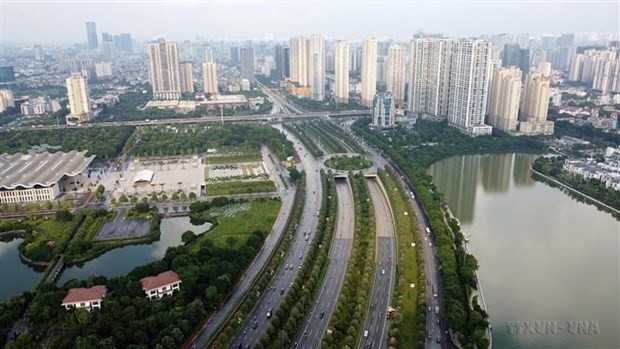
| The axis of Thang Long Boulevard connects the city centre with the western districts of Hanoi.(Photo: VNA) |
The city’s economy has revived rapidly after the COVID-19 pandemic. It recorded year-on-year growth of 8.89% in gross regional domestic product in 2022, higher than the target of 7- 7.5%, according to the Municipal Statistics Office.
This is a high rate compared to those in many recent years, showing local authorities' determination and businesses' efforts, it said.
State budget collection in the city reached 333 trillion VND last year, equal to 106.8% of the estimate. Of which, domestic revenue totaled 303 trillion VND, the highest in the country.
Hanoi’s GRDP grew by 5.97% in the first half of 2023, 1.6 times higher than the national average. The city’s budget revenue rose by 22.9% over the same period last year.
The city has carried out plans on improving the investment and business environment, thus raising confidence of domestic and foreign investors.
Compared with the northern key economic zone and the whole country, although Hanoi accounts for only 21.2% and 1%, respectively in area, 41.7% and 8.1% in terms of population, the capital city contributes 47.46% and 12.59% in terms of GRDP. It also contributes 52.48% and 17.07% in terms of state budget revenue and 14.19% and 4.61% of export turnover.
The capital city attracted 1.69 billion USD in foreign direct investment (FDI) last year, among the country's top localities in this field. The figure represents a year-on-year rise of 10.3%. It lured 2.26 billion USD of FDI capital in the first six months of this year.
Despite challenging economic conditions such as low demand for goods and reduced purchasing power, Hanoi's commercial activities are still thriving. The average total retail sales of goods and social consumption services increased by 12.84% in 2011-2015, 9.14% in 2016-2020, and 9.3% in 2021-2022. The scale of total retail sales of goods and services for social consumption in 2022 hit about 698 trillion VND, nearly 3.4 times higher than in 2010.
Payment methods based on modern technology and e-commerce account for about 7% of total retail sales of goods and services.
|
| Cat Linh - Ha Dong urban elevated railway, which stretches over 13km, was put into operation from November 6, 2021. (Photo: VNA) |
Despite the COVID-19 pandemic, Hanoi's export turnover increased by an average of 7.67% from 2016-2020. In 2021-2022, export turnover expanded at an average rate of 6.16% per year.
Agricultural and rural development is always a focus of Hanoi authorities. So far, 15 out of 18 districts have met the new-style rural standards. Per capita income in rural areas reached 56.3 million VND in 2022. The rural facelift has changed positively to become more civilised and modern, while the values of traditional cultural identity are preserved and promoted.
The city is striving to complete the task of new-style rural building by 2025, effectively manage and use land and water resources, protect the environment, conserve biodiversity, sustainably develop ecosystems, proactively respond to natural disasters, adapt to climate change, and ensure agricultural production and people's safety.
In the 2023-2025 period, Hanoi will focus on accelerating the restructuring progress of the agricultural sector, renewing its growth model following the promotion of clean, organic, and ecological farming. It will also prioritise creating favourable conditions for businesses to invest in agriculture and rural areas to create more jobs and improve people's incomes.