It is expected that by 2025, construction of line No. 2 of Nam Thăng Long - Trần Hưng Đạo will begin.
By 2030, the construction of 96.9km will be completed at a cost of $16.208 billion including line No.2 of Nam Thăng Long- Trần Hưng Đạo - Thượng Đình-Nội Bài-Nam Thăng Long, line No.3 of Nhổn-Hà Nội Train Station and Hà Nội Train Station-Yên Sở, and Line No.5 of Văn Cao-Hoà Lạc.
During this period, urban railways’ transport capacity will carry 2.2-2.6 million trips per day and night.
By 2035, the construction of 301km of the urban railway with a double track gauge of 1,435mm will be completed at a cost of $20.966 billion. This will cover line No. 1 of Ngọc Hồi-Yên Viên, line 2 extending to Sóc Sơn, line 2A extending to Xuân Mai, line 3 extending to Sơn Tây from Nhổn-Trôi, line 4 of Mê Linh-Sài Đồng-Liên Hà, line 6 of Nội Bài-Ngọc Hồi, Line 7 of Mê Linh-Hà Đông, line 8 of Sơn Đồng-Mai Dịch- Belt Road 3 -Lĩnh Nam-Dương Xá, and a satellite line of Sơn Tây-Hòa Lạc-Xuân Mai.
 |
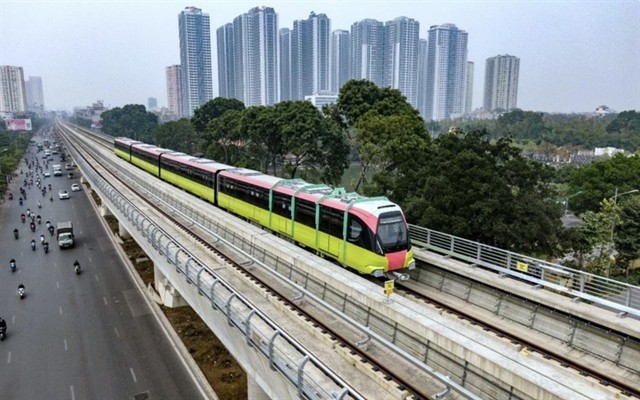
| A train is tested on the Nhổn-Hà Nội Train Station urban railway. VNA/VNS Photo |
After 2030, urban railways will account for 35-40 per cent of public passengers and can transport 9.7-11.8 million trips per day and night.
By 2045, an investment of $18.268 billion for 196.2km of 1,435mm double-track gauge urban railway will be completed for line 1 of Gia Lâm-Lạc Đạo extending from Dương Xá to Lạc Đạo), line 2 of Trần Hưng Đạo-Chợ Mơ-Ngã Tư Sở-Hoàng Quốc Việt, line 1A of Ngọc Hồi- second airport in the south, line 9 of Mê Linh-Cổ Loa-Dương Xá, line 10 of Cát Linh-Láng Hạ-Lê Văn Lương-Yên Nghĩa, line 11 of Belt Road 2 - southern axis- 2nd airport in the south), and line 12 of Xuân Mai-Phú Xuyên.
In the overall investment project to build the capital's urban railway system that has been recently submitted to the Hà Nội People's Committee by MRB, Nguyễn Cao Minh, MRB’s director, noted that the data will be researched and adjusted during the process of completing the project to ensure safety and exploitation efficiency fitting with the socio-economic situation of the city.
Urban railways are an important mode of transport providing a high-quality public transport system with large transport capacity, stability, reliability, safety and environmental friendliness as well as helping solve traffic congestion and accidents, and open up space for urban and socio-economic development.
The city’s urban railway system started construction in 2007 but progress has been at a snail's pace and has not met transport needs, Minh said.
On Hà Nội's roads, there are more than 7.8 million motor vehicles, including more than six million motorbikes and around one million cars of all types.
"The imbalance in transport market share has caused many issues such as congestion at peak hours, high transport costs and environmental pollution," Minh said.
According to the capital's transportation development plan, by 2030, the market share of public passenger transportation in the central urban area will be 50-55 per cent, and after 2030 it will be 65-70 per cent.
But to date, the city's public passenger transport market share is about 19.5 per cent, far below the planning targets, according to data from the Hà Nội Transport Department.
Developing urban railways to increase public passenger transport and reduce personal vehicles will contribute to easing congestion and creating motivation for socio-economic development, Minh said.
This is also a modern, environmentally-friendly form of transport and takes up less land than other modes of transport, he added.
He said it is necessary to complete the construction of the urban railway system contributing to strengthening the city's transport infrastructure capacity, which will be expectedly capable of transporting about 3.2 million passengers per day and account for 35-40 per cent of the public passenger transport market share in central urban areas and about 20 per cent in suburban areas.