|
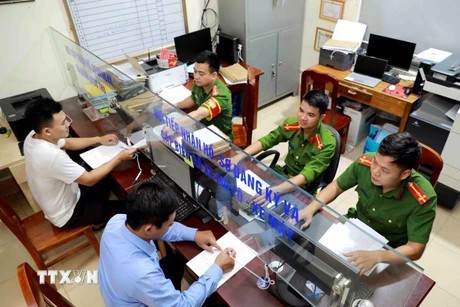
| Residents conduct administrative procedures at the Public Administration Service Centre of Thai Binh province. (Photo: VNA) |
Administrative units at the district level will be dissolved, and district-level local governments will cease operations from July 1 this year, according to a draft Law on Organisation of Local Governments (amended).
The draft law will be presented to the Government for consideration and subsequent submission to the National Assembly at its 9th session, which is expected to open in early May, the Ministry of Home Affairs said.
Compared to the current law, which consists of 50 articles, the draft amended Law on Organisation of Local Governments is expected to have 51 articles, including four new, four unchanged, three removed (related to the functions and powers of district-level local government), and 43 revised and supplemented.
Additionally, the local government model will be restructured from a three-tier system to a two-tier one, with the district level eliminated.
The provincial level will remain as currently defined, including provinces and centrally-run cities. Meanwhile, existing commune-level administrative units will be reorganised to form new ones, including communes, wards, and special zones (on islands), in accordance with the new organisational model. Special administrative-economic units will remain as currently regulated and will be established per the legislature's decisions.
|
| People carry out administrative procedures in Yen Duong commune, Tam Dao district, Vinh Phuc province. (Photo: VNA) |
The draft law clearly defines the responsibilities and powers of each level of local government. Accordingly, the provincial level will focus on issuing mechanisms, policies, strategies, and master plans; and addressing inter-regional and inter-communal issues that exceed the capacity of the commune level, require high expertise, and ensure uniformity across the province.
The commune level is responsible for implementing policies (from the central and provincial levels), focusing on tasks that serve the people, directly addressing community issues, and providing essential public services to local residents. It also handles tasks that require community participation and promotes the autonomy and creativity of the commune level. The commune-level local government will assume the responsibilities and powers currently assigned to both the district and commune levels.
A notable feature of this draft law is that the commune level will be authorised to issue legal normative documents to decide on matters within its jurisdiction and management scope./.