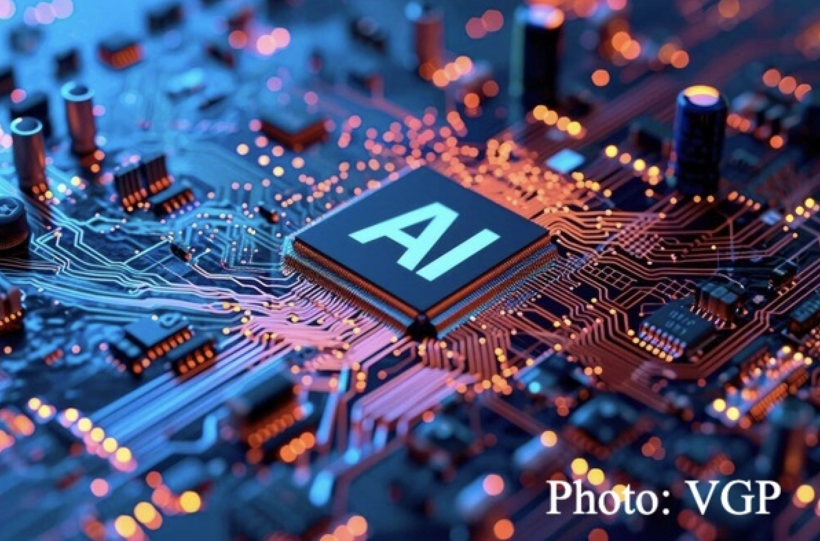
In the AI era, competitive advantage will not belong to businesses that deploy the most AI, but to those that can redesign how people, AI and enterprise systems work together to create value.
As Viet Nam promotes AI as a new driver of economic growth, the technology is rapidly becoming an integral part of corporate strategies. According to AWS’s “Unlocking Vietnam’s AI Potential” study, 18% of Vietnamese businesses had adopted AI in 2024, up 5 percentage points from the previous year. From customer service and software development to data analysis, AI is expected to help improve productivity and optimize costs.
However, the growing presence of AI in businesses does not necessarily translate into corresponding improvements in operational efficiency. According to the Microsoft Work Trend Index 2025, 91% of business leaders in Viet Nam believe this is the time to reassess their strategies and operating models to prepare for the AI era. This indicates that AI is no longer solely an information technology issue but has become a matter for corporate leadership.
Businesses are integrating AI into operations to improve productivity and drive enterprise-wide transformation.
From standalone AI applications to agentic automation
Many businesses have successfully deployed AI in individual departments, but most initiatives remain fragmented. AI can help individuals perform tasks more efficiently, but this alone is not enough to fundamentally change how an organization as a whole collaborates and creates value.
Against this backdrop, Agentic Automation is emerging as the next stage in AI development. Rather than simply assisting people with individual tasks, AI agents can proactively perform and coordinate multiple tasks across an entire workflow.
In manufacturing and supply chains, instead of having employees continuously monitor production, inventory and order data to identify potential problems, AI agents can proactively monitor operations, detect risks of disruption and trigger appropriate steps in accordance with established processes. Employees can then shift from manual monitoring to assessing exceptions and making decisions.
In human resources management, AI agents can proactively receive and categorize employee requests, suggest responses and escalate issues requiring human judgment to the relevant personnel. This allows HR professionals and managers to focus more on sensitive matters that require empathy or managerial decisions.
A common feature of these applications is that AI is no longer merely automating individual tasks previously performed by humans. It is beginning to take on part of an entire process, while people focus on work requiring judgment, exception handling and ultimate accountability.
This shift requires businesses to redesign how people, processes, technology platforms and governance mechanisms operate together.
The bottleneck lies in the operating model
As AI becomes directly involved in business operations, value creation no longer depends on technology alone. Instead, it depends on how effectively AI is integrated with people, data and existing operating models.
If processes and data have not been standardized, it is difficult for AI to move beyond individual experiments and become an operational capability at enterprise scale. The biggest bottleneck, therefore, may not lie in AI itself, but in how businesses organize their processes, data and resources.
According to Ryohei Oda, General Director of ABeam Consulting Vietnam, businesses need to rethink their approach to AI at this stage.
“Businesses often ask where they should start applying AI. But the more important issue is which part of the operating model they want AI to participate in, and whether the organization is ready to change so that AI can work alongside people.”
He said Agentic Automation is not simply about enabling AI to perform more tasks on its own. Rather, it is about designing a model in which people, AI, automation and enterprise systems can work together within an integrated operating model to create business value.
From this perspective, the focus of the next stage will no longer be on deploying standalone AI tools, but on transformation at the enterprise level. To generate value from AI at scale, organizations need to simultaneously build and redesign four foundations: people, processes, technology platforms and governance mechanisms.
From a digital infrastructure perspective, Pham Viet Hai, APJ Business Solution Manager at DigiSea, said AI can only generate value at enterprise scale when it can access the right data, interact with business systems and become part of operational processes, rather than existing as a standalone tool.
Ultimately, sustainable competitive differentiation in the AI era will not come solely from which technologies businesses possess or deploy, but from their ability to design an operating model in which people, AI, data and enterprise systems can work together effectively. This will also provide the foundation for AI to evolve from a supporting tool into an operational capability that creates value across the enterprise.
Technology innovation, resource and energy efficiency, and emissions reduction are becoming key priorities in many local industrial extension programs. From machinery support to the development of cleaner production models, industrial extension policies are helping bring sustainable production and consumption goals closer to rural industrial establishments.
The Grand Ho Tram has been named “Best Integrated Resort” at the 35th TTG Travel Awards 2026, marking its second consecutive win at the Asia-Pacific travel and hospitality awards.
New cooperation initiatives on grid digitalization, battery energy storage systems (BESS), technical capacity building and applications at power utilities are helping lay the groundwork for modernizing Viet Nam’s power system while strengthening knowledge sharing across Southeast Asia.
Northern localities are strengthening links in supporting industries, energy and logistics to build competitive value chains and create new growth drivers.
Technology innovation, resource and energy efficiency, and emissions reduction are becoming key priorities in many local industrial extension programs. From machinery support to the development of cleaner production models, industrial extension policies are helping bring sustainable production and consumption goals closer to rural industrial establishments.
New cooperation initiatives on grid digitalization, battery energy storage systems (BESS), technical capacity building and applications at power utilities are helping lay the groundwork for modernizing Viet Nam’s power system while strengthening knowledge sharing across Southeast Asia.
The Ministry of Industry and Trade is digitising science and technology management to reduce paperwork, shorten processing times and improve transparency.